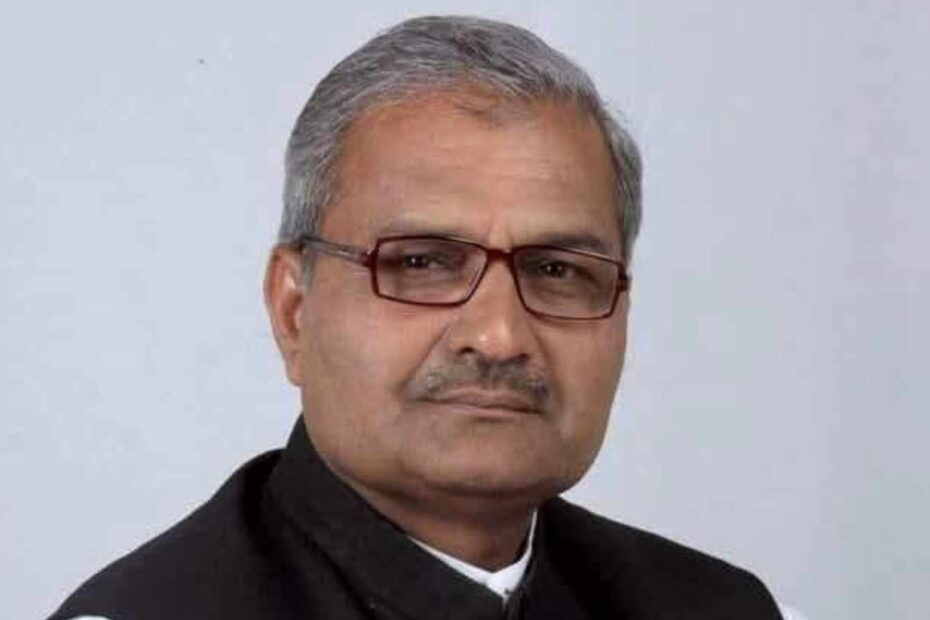
BJP MP Janardan Mishra also stated that vehicles in India can run on ethanol-blended petrol, but some are misleading people against it. (Photo: Facebook@Janardan Mishra)
Amid the controversy over the blending of ethanol with petrol, BJP MP Janardan Mishra Sunday defended the Centre’s policy as he questioned those opposing it: “Will pure petrol come from your father’s house?”
Speaking at the inauguration of new flight services from Rewa to Bhopal and Kolkata, Mishra said India produces only 20 per cent of its crude oil demands, while 80 per cent has to be imported from abroad, news agency PTI reported.
Express Opinion | India’s ethanol policy must count water, sustainability costs
Citing the global geopolitical turmoil, the MP from Rewa claimed that the vessels carrying oil from the Gulf nations have to travel an additional distance of approximately 18,000 km to bring the imports to India.
“In such a situation, when Prime Minister Narendra Modi talks about blending 20 per cent ethanol in petrol, some people start protesting. A movement is underway claiming that ethanol won’t work; pure petrol will. Will pure petrol come from your father’s house? If there’s no pure petrol in the country, where will it come from?” PTI quoted Mishra as saying.
Mishra also stated that vehicles in India can run on ethanol-blended petrol, but some are misleading people against it. “If ethanol is not produced, where will petrol come from, where will diesel come from?”
He further claimed that the vehicles in Brazil run on 100 per cent ethanol, and that too without any issues.
Brazil produces the maximum amount of ethanol in the world, and hence vehicles there run on 100 per cent ethanol, he said.
Story continues below this ad
Known for his controversial comments, Mishra said experts in India also believe that ethanol does not cause any damage to vehicle engines, yet there is “unnecessary” opposition to it.
Mishra also claimed that if there is any place in the world today where employment is highest, and inflation is the lowest, it is in India.
About the ethanol-blending row
The Centre is facing a backlash over a rapid increase in the use of ethanol in petrol from 10% to 20% in just three years. The government has, however, said that no decision has been taken on raising blending levels beyond the current 20%. Any decision in that direction will be taken only after detailed studies and stakeholder consultations, it has said, adding that there is also no plan to make lower ethanol-petrol blends and pure petrol available at fuel stations.
What are issues with higher ethanol blends
For people with E10 certified vehicles or older ones, the transition to E20 came in just three years, with little warning of the pitfalls. The experience left motorists, especially those owning older cars and two-wheelers, feeling shortchanged. There are multiple problems with using a higher ethanol blend in petrol for engines not designed for these blends.
Story continues below this ad
Engine damage: Ethanol has a higher content of water, which is corrosive. So, E20 or higher ethanol blends could damage the parts of the internal combustion engine.
Mileage: Many customers had flagged a drop in mileage after the E10 to E20 shift. The drop could be between 5-12%, depending on when the car was manufactured.
Ignition issue: Regular ICE cars running on higher ethanol blends are hard to start on winter mornings because ethanol burns at a higher temperature than petrol.
Exponentially worse performance: While a fuel with 10% ethanol (E10) makes little difference to a car’s performance, anything above that level is said to cause problems in engines that aren’t specifically built for it. And this performance worsens exponentially as the blending levels increase.
Story continues below this ad
What Nitin Gadkari has said
In an interview to Express journalist Anil Sasi, Union Road Transport and Highways Minister Nitin Gadkari said that because the calorific value of ethanol is lower than petrol, the average mileage can dip “marginally” as ethanol content increases in the fuel. However, the instances of vehicular damage being circulated on social media are “overblown” and part of a concerted “false narrative”, he added.
Gadkari said the E20 blend (20% ethanol and 80% petrol) was introduced nationwide last year only after clearances in multiple tests carried out by Pune-based testing lab ARAI (Automotive Research Association of India) and vehicle manufacturers.