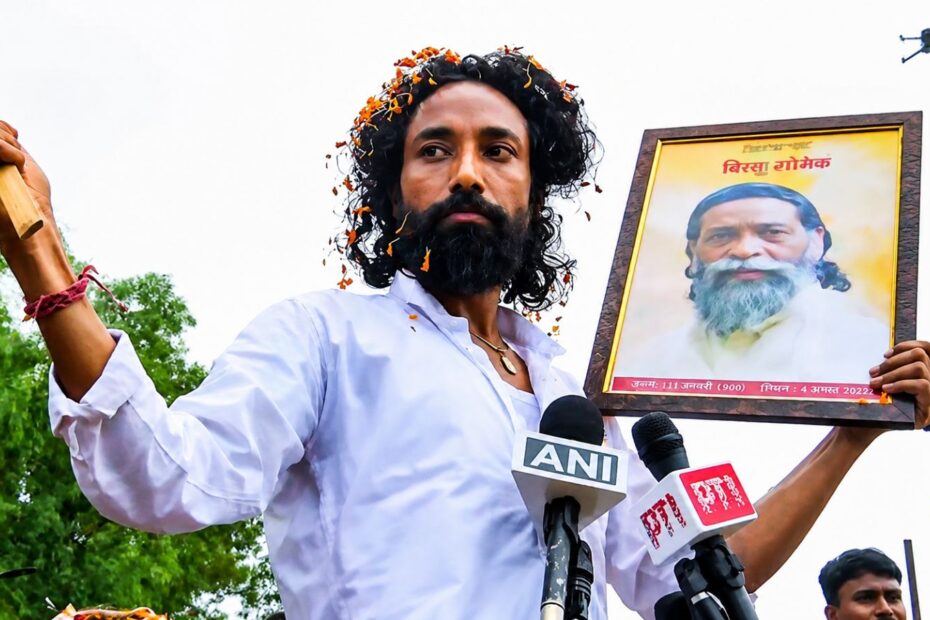
The Jharkhand protests against irregularities in state competitive exams present what seems to be an irony. While the protests are against the Hemant Soren-led Jharkhand Mukti Morcha (JMM) government in the state, protesters have been spotted with placards of the Chief Minister’s late father Shibu Soren, apart from those of Bhagat Singh and B R Ambedkar.
There have been several precedents of protests not posing questions against the core ideology of a party in power, but accusing its leadership of having fallen from the purported ideals of the party. This template does not just address the opponents of the ruling party but also seeks to address its old-timers by making the point that its past was better than the present.
Advertisement
Shibu Soren who was the leader of the JMM and one of its co-founders was a pivotal figure of the movement for the tribal state of Jharkhand from the 1980s. The demand was finally fulfilled in 2000, when the Atal Bihari Vajpayee government carved out Jharkhand from Bihar. Since then, Shibu Soren, who himself faced corruption allegations in his time, has held an iconic status in the state, particularly among the tribals who still did not constitute a majority in the state.
While not distancing themselves from the creation of the state in general, and tribal issues in particular, the protesters have separated the legacy of Soren senior from the politics of his son Hemant, thus celebrating the father even as they attack the son’s government.
This template isn’t new. In Maharashtra too, the Shiv Sena of Eknath Shinde celebrates Balasaheb Thackeray while attacking his son Uddhav of the Shiv Sena (UBT and accusing him of undermining his father’s legacy. The BJP also celebrates Bal Thackeray, an ally in the days of Vajpayee and L K Advani, while coming down hard on Uddhav.
Advertisement
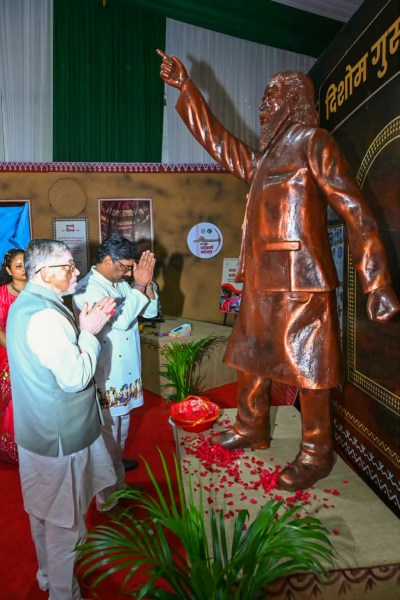 Jharkhand Chief Minister Hemant Soren with Jharkhand Governor Santosh Kumar Gangwar pay tribute to Padma Bhushan awardee and former state CM and his father, late Shibu Soren, during the inaugural ceremony of Jharkhand Adivasi Mahotsav on the occasion of World Indigenous Day at Morhabadi Ground. (ANI Photo)
In the above two cases, the focus is on the bloodline of the leaders: they are almost accused of undermining their fathers’ legacies. However, the template often holds even in the context of political parties and their worldviews in general, even when there is no direct family legacy involved.
The BJP ecosystem celebrates Sardar Patel, a lifelong Congress leader, and many other freedom fighters associated with the Congress, while singling out Jawaharlal Nehru and his descendants in the Nehru-Gandhi family. Here, the tacit charge is that one family captured a grand old party that had many iconic leaders to its credit, and “destroyed” it. The criticism is not directed at the entire history of the Congress.
Jharkhand Protest News Tap to Read Live Updates
The BJP’s critics, too, sometimes celebrate the Vajpayee days to project the Narendra Modi government as embodying a decline in political ethics. Mani Shankar Aiyar of the Congress, one of the most vociferous critics of Prime Minister Narendra Modi, penned an emotional open letter to an ailing Vajpayee in 2016 for The Indian Express, titled “Please Come Back, Atal Ji”. While Aiyar has been a lifelong critic of the RSS and the BJP, he too sought to establish that Modi somehow undermined the legacy of Vajpayee, his predecessor as PM from the BJP.
Also Read | Barbed wire fences, angry students: What Express saw at Jharkhand protest
This kind of criticism of a government or leader was dramatically visible during the Emergency of 1975-77 and just after it. Historian Ramchandra Guha notes such criticism of Indira Gandhi during the Emergency from the press in the West. “Visiting New Delhi during the Emergency, The New York Times’s A M Rosenthal — who had once served as his paper’s correspondent in India — concluded that, had Jawaharlal Nehru lived while Indira Gandhi reigned, the two would have been political opponents rather than allies,” Guha writes in India After Gandhi. “An Indian friend of Rosenthal’s captured that imagined scenario in this way: ‘Indira is in the Prime Minister’s house, and Jawaharlal Nehru is back to writing letters to her from jail again’.”
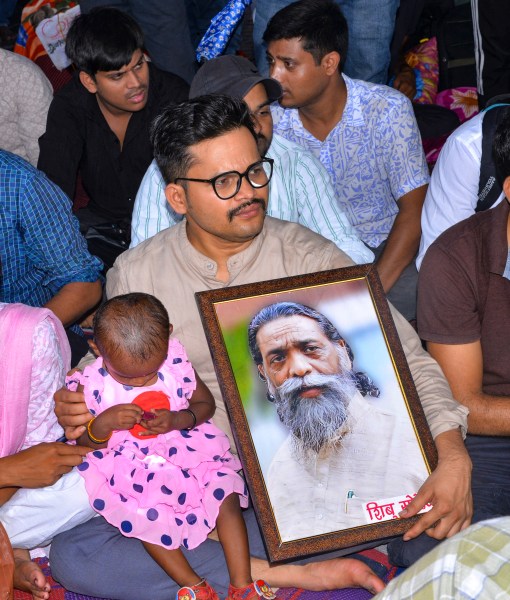 A man holds a portrait of Jharkhand Mukti Morcha (JMM) founder late Shibu Soren during an indefinite protest against the Jharkhand Government. (PTI Photo)
Just after the end of the Emergency, Kishore Kumar sang a song, Bapu Tere Desh Mein Kaisa Atyachar, for the movie Nasbandi, named after the forced vasectomy carried out during the Emergency. The song evoked Mahatma Gandhi and other Congress freedom fighters, including Nehru, to attack the Emergency, following the same template of criticising a leader for undermining her own family and party legacy. During the Emergency, Kumar was temporarily banned from All India Radio and Doordarshan for refusing to sing in praise of the government’s schemes.