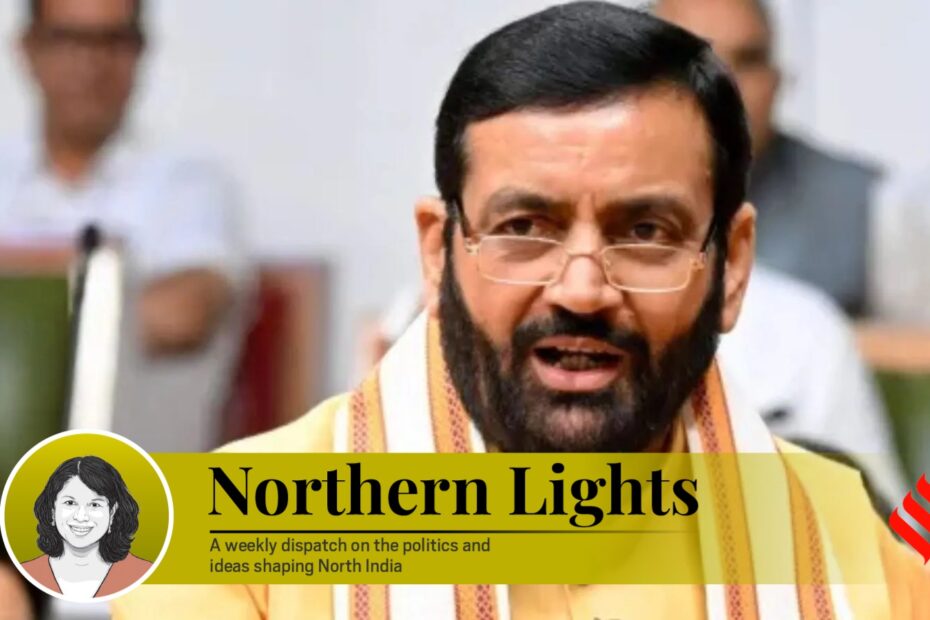
As Punjab begins its long march to the Assembly elections, Haryana Chief Minister Nayab Singh Saini is becoming an increasingly familiar face across the state.
Sporting a saffron turban during his visits, he has emerged as one of the BJP’s most visible campaigners in Punjab. Whether making unscheduled stopovers, as he did at a college to mark Shaheed Udham Singh’s anniversary, or addressing gatherings big and small, Saini’s message is remarkably consistent: Punjab and Haryana share a common history, and Punjab, too, can benefit from a BJP government.
Advertisement
Political observers point to Saini’s caste. The Saini community, a farming and landowning Other Backward Class (OBC) group, has a significant presence in parts of Punjab, particularly in the Doaba and Puadh regions. And while Saini makes it a point to thank Prime Minister Narendra Modi for his historic decision to set up the National Commission for Backward Classes, caste arithmetic alone does not explain why the BJP has invested so heavily in projecting him.
Compelling narrative
The more compelling reason is that Saini embodies the BJP’s larger political message. He is the CM of a neighbouring state where the party has transformed itself from a marginal player into the dominant political force. From winning just four seats in the 90-member Haryana Assembly in 2009, the BJP returned to power for a record third consecutive term in 2024 with a vote share of around 40%. Haryana is the party’s most compelling “double-engine government” success story in North India. Saini showcases not merely a leader but a model.
That message carries greater weight because of who Saini is. An earthy politician from a farming family, he speaks Puadhi, the Punjabi dialect spoken around Chandigarh, Ambala and adjoining parts of Punjab, allowing him to connect effortlessly with the Punjab electorate. His easy manner and rustic humour only add to his appeal, especially among the youth.
A reversal in fortunes
Advertisement
In many ways, Saini also represents a striking reversal in the fortunes of Punjab and Haryana.
For decades after the reorganisation of Punjab in 1966, Haryana was dubbed the poorer cousin of Punjab. The Green Revolution first took root in Punjab. It was Punjab Agricultural University, Ludhiana, that hosted Norman Borlaug, who developed the high-yielding wheat varieties. Meanwhile, Dr M S Swaminathan converted Rakhra village in Patiala into a vast seed farm that propelled the Green Revolution in the state. Punjab emerged as the food basket of India, leaving Haryana far behind for almost three decades.
Then history took an unexpected turn. Punjab was wracked by militancy between the late 1970s and early 1990s, which stalled its shift towards industry. Meanwhile, Haryana capitalised on its proximity to the national capital. Gurgaon became one of the fastest-growing urban centres in the country, attracting multinational companies, financial services, and manufacturing. Industrial hubs such as Manesar and Faridabad reinforced that growth, transforming Haryana’s economy from predominantly agrarian to one driven increasingly by industry and services.
As per the latest reports of the NITI Aayog and the Economic Advisory Council to the Prime Minister (EAC-PM), Haryana’s per capita income is roughly ₹3,95,618, over 52 per cent higher than Punjab’s per capita income of approximately ₹2,79,398.
Haryana aggressively pursued administrative reforms, digitised governance, invested in rural infrastructure and promoted diversification by giving MSP on 24 crops. Two-time CM Manohar Lal Khattar frequently claimed that Haryana had the country’s most robust direct benefit transfer system. Even today, the BJP continues to experiment organisationally. This week, it introduced weekly “tiffin meetings”, where party workers and leaders gather over home-cooked meals to strengthen grassroots engagement.
Saini is not simply campaigning in Punjab; he is presenting Haryana as evidence that sustained BJP rule can transform a state.
The symbolism extends beyond politics. Saini enjoys cordial relations with influential religious organisations in Punjab, including the Radha Soami Satsang Beas, a dera that enjoys one of the largest followings in the region, and Divya Jyoti Jagrati Sansthan. At his official residence, Kabir Kutir, visitors are greeted by a photograph of the Golden Temple in the dining room. Asked about it, Saini explains: “My mother Kulwant Kaur is from Punjab. We have always revered the Gurus.”
When the BJP sends Saini to Punjab, it is attempting to sell the idea that the state which once looked up to Punjab has, over the past three decades, forged a different developmental trajectory, and that Punjab can follow a similar path under BJP rule.
Whether Punjab’s voters accept that proposition remains to be seen. But for the BJP, Haryana seems to have become the strongest argument it can make in Punjab.