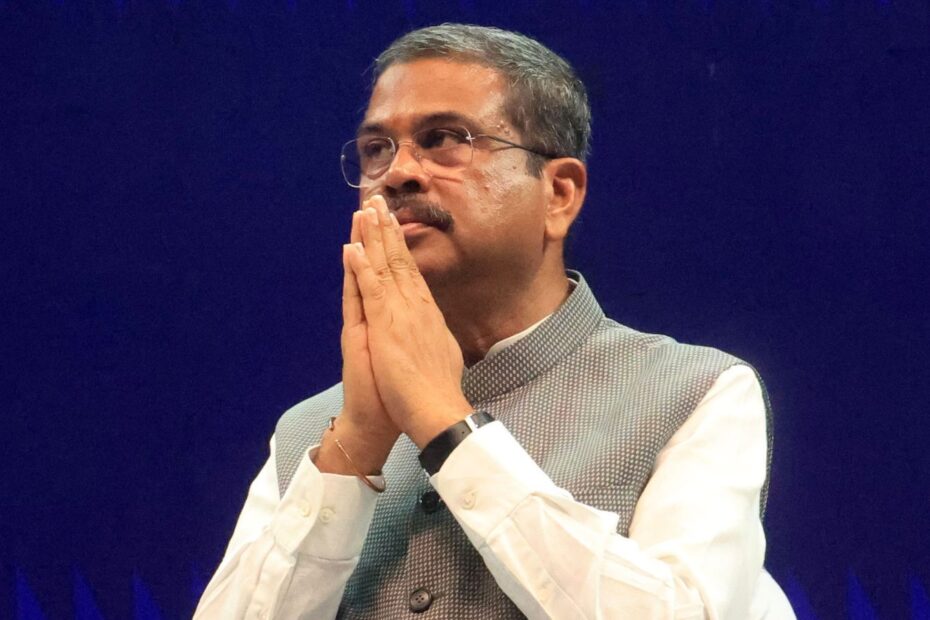
Dharmendra Pradhan (57), who resigned amid pressure over NEET paper leak on Saturday, had, over the past few years, emerged as one of the BJP’s most durable central leaders: an organiser first, a minister second, and a political manager who has remained close to the party’s top decision-makers. He is also among the few Odias who have made a mark in national politics and wield influence across India.
Born on June 26, 1969 into a political family, Pradhan was deeply involved in the RSS’s socio-cultural activities since childhood. His father Debendra Pradhan, a doctor, was a prominent BJP leader in Odisha, who became the Union minister in the Atal Bihari Vajpayee government.
Advertisement
Starting as an ABVP activist when he was a higher secondary student in Talcher College in his home town, he became president of the college’s student union in 1985, state secretary of the ABVP in 1993 and its national secretary in 1995.
Pradhan, who pursued his master’s degree in anthropology from Utkal University in Bhubaneswar, Odisha’s premier institution for higher education, contested the student union election in 1990 but lost to Arun Sahoo, currently a senior Biju Janata Dal (BJD) leader.
Also read | How Delhi’s Jantar Mantar found out about Pradhan’s resignation, and reacted
Following his father’s footsteps, he joined the BJP in 1998 and became an MLA for the first time in 2000 from the Pallahara seat in the BJD-BJP coalition government. As an MLA, he was conferred with the Utkalmani Gopabandhu Pratibha Sanman, the best legislator award of the Odisha Assembly.
Advertisement
Active in party organisation, Pradhan became the president of the party’s youth wing in 2001, and was elevated as national secretary in 2002. In 2004, he became the national president of Bharatiya Janata Yuva Morcha, the BJP’s youth wing.
Parliament stint begins
The same year, in 2004, he was elected to the Lok Sabha from Deogarh.
Active in the BJP’s national politics, Pradhan got a Rajya Sabha berth in 2012 from Bihar and became the petroleum minister in 2014 after Narendra Modi became the Prime Minister. During his tenure, he was closely associated with schemes such as Ujjwala and the wider push for expanded LPG access.
Following the BJP’s rise across India after 2014, Pradhan was considered the party’s most prominent face in Odisha and was known to have a close proximity to the BJP top brass. He secured a renomination to the Rajya Sabha in 2018 from Madhya Pradesh and retained his Union Cabinet berth in the Modi government’s second term.
Pradhan was given the education portfolio in 2021, which he continued to hold in the NDA government’s third term. After a 15-year gap, Pradhan returned to direct electoral politics in the 2024 Lok Sabha polls, winning from the Sambalpur constituency with a massive mandate.
Key to Odisha victory
Pradhan is also the architect of the BJP’s organisational base in Odisha. He toured the state when the party hardly had any presence there, and managed to induct potential grassroots leaders into the party’s folds.
It was because of Pradhan’s strategies that the BJP tested an impressive victory in the 2017 panchayat polls and won eight seats in the 2019 Lok Sabha elections. In 2024, he was key to the BJP assuming power on its own and defeating the Biju Janata Dal (BJD).
Known as an able manager and meticulous planner among party colleagues, Pradhan had proved his organisational skills by securing the BJP’s victory in other state elections as well.
Within the BJP, Pradhan had been part of its central power structure, close to Amit Shah, alongside figures such as Bhupender Yadav and Vinod Tawde. His strength lies less in public charisma than in organisational reliability: he has worked as a campaign strategist, state in-charge and problem-solver for the party in multiple states. That combination of loyalty, utility and political fluency has kept him relevant even in moments of controversy and public backlash.
Also read | ‘Modi’s stubbornness defeated’: Opposition reacts as Dharmendra Pradhan resigns
The stint that became his undoing
During his stint in education, his role expanded from administrator to political combatant. He had defended the National Education Policy, backed mother-tongue and multilingual education, and pushed the PM-SHRI and related reform agenda, but the ministry has also been dogged by controversies over exam integrity, Centre-state tensions with non-BJP states, and questions about implementation.
The biggest setback his tenure saw was the repeated blow to public confidence in national examinations, with the ministry facing scrutiny over paper leak allegations, cancellation and reworking of tests, and opposition criticism over the handling of the National Testing Agency and recruitment exams.
He was also at the centre of the long-running row with Tamil Nadu over the three-language formula, where opponents accused him of political overreach and “Hindi imposition,” turning education policy into a Centre versus state flashpoint.
His tenure also saw allegations of increasing interference of the RSS in the education sector, with the Opposition often alleging that premier institutions are being saffronised at the cost of quality education.
All of these have made him a frequent target of student groups, opposition parties and regional governments.