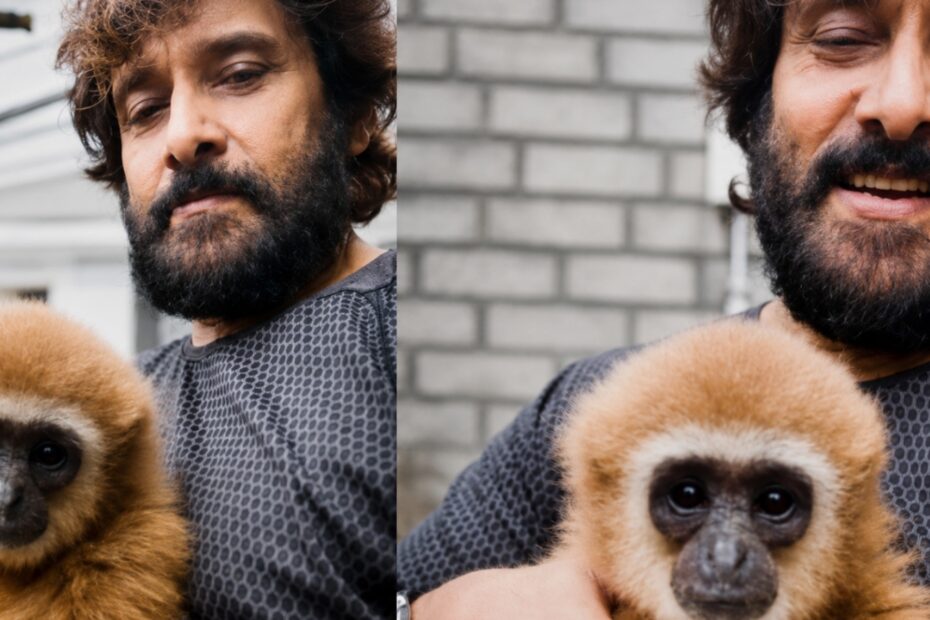
The video appeared on Instagram, travelled rapidly across social media, sparked ‘likes’ and outrage, and was subsequently deleted. (Photo: Screengrab of the viral video enhanced by AI)
It began as an affectionate, albeit ill-judged, social-media moment: Actor Vikram playing with a Lar Gibbon, the small ape comfortably clinging to him, fiddling with his hair as the camera rolled. The video appeared on Instagram, travelled rapidly across social media, sparked ‘likes’ and outrage, and was subsequently deleted.
But the story of the animal did not disappear with the post. The video has now prompted the Tamil Nadu Forest Department to begin tracing the gibbon’s journey into a private home in Chennai, where the video seems to have been filmed. The issue has opened up questions about the possession and transfer of exotic wildlife, and a document trail that, officials say, stretches from Chennai to Erode to Manipur and, according to records, to Malaysia.
Forest officials have sought ownership and other statutory documents relating to the animal after the video drew criticism from wildlife activists.
After the controversy, the forest department found that the gibbon had since been moved from businessman C K Ranganathan’s residence in Injambakkam to Erode. Ranganathan, founder-chairman of CavinKare, is the father of Manu Ranjith, who is married to Vikram’s daughter Akshita. Reports said the video was filmed at Ranganathan’s property along Chennai’s East Coast Road.
No monkey business
At the centre of the inquiry is not merely who possessed the animal, but how it even arrived there. Native to Southeast Asia, the Lar Gibbon (Hylobates lar) is classified as Endangered on the IUCN Red List and is listed in Appendix I of the Convention on International Trade in Endangered Species (CITES) of Wild Fauna and Flora. The category covers species for which international commercial trade is subject to the strictest restrictions. In India, the species also figures under Schedule IV of the Wildlife (Protection) Act.
Its import and possession, consequently, involve a regulatory chain that can include CITES export and import permissions, Directorate General of Foreign Trade documentation, and permissions and registration requirements involving wildlife authorities. A senior forest department official said they have started examining how the animal reached Tamil Nadu and whether statutory requirements governing its possession and transfer had been complied with.
The paper trail under examination begins in Manipur. Records cited by officials show that Laikhuram Singh, a Manipur-based stockholder, declared eight Lar Gibbons — four males and as many females —in 2020 under the then mechanism for declaration of stock of exotic live species through PARIVESH (Pro-Active and Responsive facilitation by Interactive, Virtuous, and Environmental Single Window Hub). Malaysia was recorded as their country of origin.
A later Form I filed under the Living Animal Species (Reporting and Registration) Rules, 2024, records the transfer of three gibbons — one male and two females — from Singh to S K Keshavanathan of Perundurai in Erode district. The transaction, dated June 5, 2026, describes the transfer as being for “adoption”. The application is yet to receive the approval of Tamil Nadu’s Chief Wildlife Warden.
Story continues below this ad
The case of the missing gibbon
When Forest Department officials inspected the premises in Erode, however, they found only a male and a female gibbon.
K V Appala Naidu, District Forest Officer, Erode, said Keshavanathan had informed officials that he had applied for possession of three animals but that one had subsequently died. “We need to verify if the animal actually died or if there was an undocumented transfer,” Naidu said. The trail then moves to Chennai.
Another Form I records the transfer of one male and one female Lar Gibbon from Keshavanathan to Chinni Krishna Ranganathan of Injambakkam on August 5. The document lists the mode of transfer as “purchase” and the purpose as “pet”. That application, too, is pending approval by the Chief Wildlife Warden, according to the records.
Officials say the existence of declarations and applications does not, by itself, settle whether the original acquisition, possession or subsequent transfers were lawful. Authorities are examining the underlying CITES and import documentation as well as the circumstances of each transfer.
Story continues below this ad
There is another question that could prove significant. Sources familiar with the inquiry said the gibbon seen in Vikram’s video appeared to be only two or three years old. If that assessment is established, they said, it would raise questions over whether it could even be one of the animals Singh declared as part of his stock in 2020 or not.
The Manipur origin has also drawn scrutiny with the northeastern border with Myanmar having long been identified as a route used in the trafficking of exotic wildlife into India, making the issue of a celebrity seen publicly interacting with an endangered exotic animal as a pet all the more pressing.