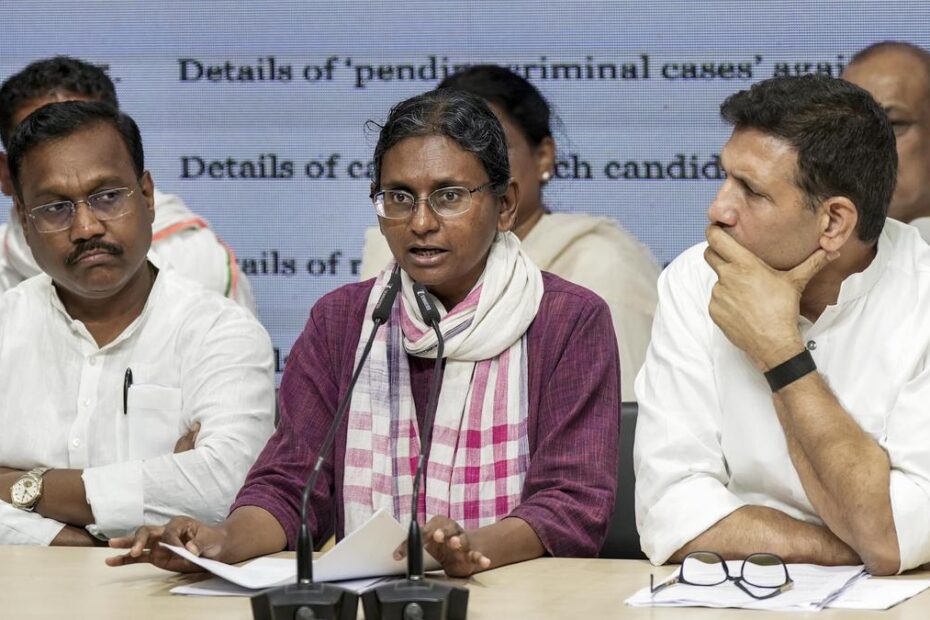
Observing that courts should ordinarily refrain from intervening in ongoing electoral processes, the Supreme Court on Friday (June 12, 2026) dismissed Congress leader Meenakshi Natarajan’s plea challenging the rejection of her Rajya Sabha nomination papers from Madhya Pradesh.
A Bench of Justices Prashant Kumar Mishra and A.S. Chandurkar observed that it had no jurisdiction to interfere with the order of the Returning Officer (RO) in view of Article 329(b) of the Constitution. The provision stipulates that no election to either House of Parliament or a State Legislature can be called in question except by way of an election petition filed in accordance with the procedure prescribed by law.
“…Whenever an attempt is made to invoke this Court’s or the High Court’s writ jurisdiction to interject during the conduct of elections, on every occasion the Court has rejected such an attempt, keeping in view the principles contained in Article 329 of the Constitution,” the Bench said.

The top court was hearing a plea filed by Ms. Natarajan, the Congress’ sole candidate for one of the three Rajya Sabha seats from Madhya Pradesh, challenging a June 9 order of the RO and Madhya Pradesh Assembly Principal Secretary Arvind Sharma rejecting her nomination on the ground that she had failed to disclose a pending criminal case in Hyderabad in her election affidavit.
Meanwhile, BJP candidates Tarun Chugh, Rajneesh Agrawal and Mahesh Kewat were declared elected unopposed to the three Rajya Sabha seats from the State on Thursday.
The Bench held that recognising an exception for “glaring” or “patent” errors in the rejection of nomination papers would amount to reading into Article 329 a “principle” that does not exist. It noted that such an approach would run contrary to the law laid down in its 1952 judgment in N.P. Ponnuswami v. RO, which bars the invocation of writ jurisdiction to challenge disputes arising during the course of an election.
…if this Court accepts such an argument to find out glaring cases which are required to be interfered with under Article 32 or Article 226 of the Constitution of India and the other set of cases in which the rejection is not so improper prima facie, relegating them to avail the remedy of filing an election petition, this Court will be reading some principle which is not provided for under Article 329 of the Constitution. We are afraid any such interpretation, that in some matters this Court can entertain a petition where a candidate’s nomination paper has been rejected while leaving some others to avail the remedy of an election petition, could not be encouraged,” the Bench underlined.
Appearing for Ms. Natarajan, senior advocate A.M. Singhvi argued that the RO’s decision suffered from a “patent error” and warranted interference by the court. He submitted that Section 33A of the Representation of the People Act requires disclosure only of cases in which charges have been framed. According to him, setting aside the RO’s order would “facilitate”, rather than obstruct, the electoral process and would not fall foul of the constitutional bar on judicial intervention in election matters.

‘No constitutional duty discharged’
The senior counsel also questioned the poll body’s decision to proceed with the declaration of results on Thursday (June 11, 2026) despite the top court being cognisant of the matter.
“Look at the conduct. My Lords are listing it today, and they declared the results last night… She [Ms. Natarajan] is only seeking an opportunity to contest. Let her fight and lose. She is only standing for election,” he said.
Mr. Singhvi further pointed out that the poll body was yet to decide the Congress’ written representation challenging the RO’s decision to reject Ms. Natarajan’s nomination.
“The Election Commission decides to keep silent…the conduct is reprehensible. It does not discharge its constitutional duty..If the level playing field is made non-level, then there cannot be any elections in this country,” he submitted.
‘No precedent’
However, Justice Mishra underscored that there was no precedent for judicial interference at this stage. “Show us any judgment of this Court where, after the nomination of a candidate in a parliamentary election, we have set aside the order of the RO and accepted the nomination,” he asked Mr. Singhvi.
Mr. Singhvi, however, pointed out that the absence of a precedent could not preclude the court from intervening in an exceptional case. He argued that, as a sentinel on the qui vive, the court was duty-bound to step in when confronted with “glaring facts”.
“…the facts have not come to Your Lordships, that does not mean that the law will change. If a fact comes to Your Lordships with such speed as I have brought it, then Your Lordships will apply the law,” he said.
‘Statutory right’
Senior advocate Mukul Rohatgi, appearing for the three BJP leaders who were elected unopposed to the Rajya Sabha from Madhya Pradesh, however, questioned the maintainability of the writ petition. He argued that the right to contest an election is a statutory right and not a fundamental right and, therefore, cannot be enforced through a petition under Article 32 of the Constitution.
“Supreme Court judgments have held that the right to contest an election is a statutory right. If you have no fundamental right, an Article 32 petition is not maintainable,” he submitted.
Senior advocate D.S. Naidu, appearing for the Election Commission, argued that the Congress leader was required to disclose all pending criminal proceedings before the RO, irrespective of the stage at which they stood. He contended that the statutory disclosure requirement is not limited to cases in which cognisance has been taken, or charges have been framed, and submitted that the appropriate remedy lay in an election petition.
The Bench ultimately dismissed the petition, holding that entertaining it would run contrary to settled judicial precedent. It, however, clarified that its observations on the rejection of Ms. Natarajan’s nomination would not prejudice any election petition that may be instituted before the concerned High Court.
Ms. Natarajan’s candidature was opposed by BJP Rajya Sabha candidate Mahesh Kewat and BJP state general secretary Rahul Kothari, alleging that she had failed to disclose details of a criminal case pending before a Hyderabad court in her election affidavit.
Accepting the objection, the RO held that Ms. Natarajan’s affidavit was incomplete as it did not disclose a notice issued to her by the Hyderabad court in October 2025. In his June 9 order, the RO noted that Ms. Natarajan had responded to the notice but had omitted to disclose the proceedings in Form 26 filed along with her nomination papers.
The Congress, however, has maintained that Ms. Natarajan was only a respondent in the proceedings and not an accused, and that no FIR was registered pursuant to her response to the complaint. According to the party, a notice issued before a court takes cognisance of a matter does not amount to a pending criminal case requiring disclosure under election law.
Published – June 12, 2026 01:42 pm IST
Email
SEE ALL
Remove