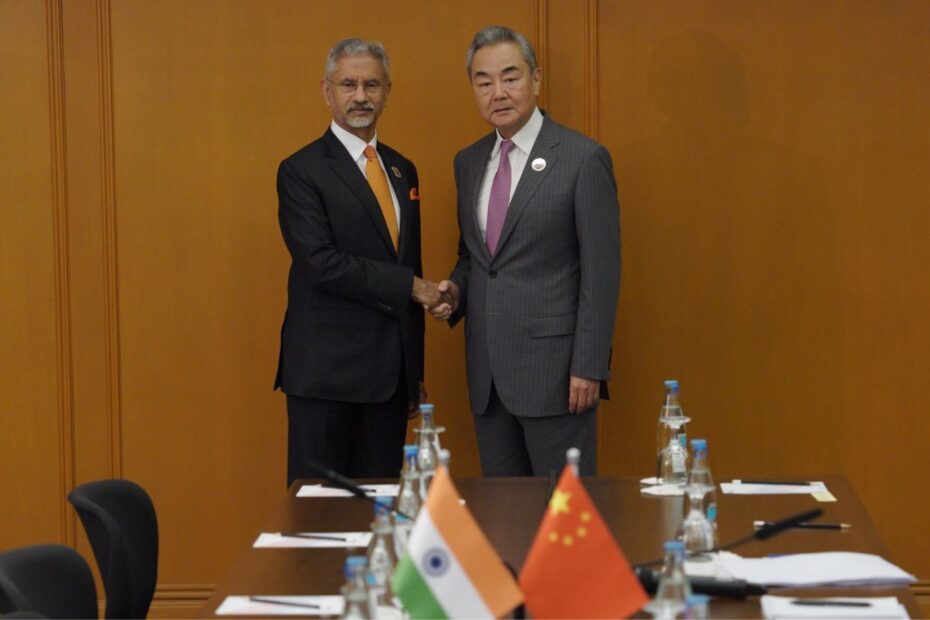
External Affairs Miniter S Jaishankar told his Chinese counterpart Wang Yi that lasting peace along the border remains the foundation for normalising bilateral ties (Photo: X/S Jaishankar).
External Affairs Minister S Jaishankar met Chinese Foreign Minister Wang Yi Wednesday and raised India’s concerns regarding supply chain predictability, fair market access, trade imbalances, and the need to facilitate official and people-to-people exchanges.
During the wide-ranging conversation in Manila on the sidelines of the East Asia Summit and ASEAN Regional Forum meetings, Jaishankar reiterated that peace along the border remains a prerequisite for normalising bilateral relations.
Placing the meeting in context, Jaishankar noted that the two leaders had met a year ago and recalled Wang’s recent visit to India. He said the interaction provided an opportunity to take stock of bilateral ties and exchange views on regional and global developments.
“Since the meeting of our leaders in Kazan in October 2024, relations between India and China have been gradually normalising,” Jaishankar said, referring to the October 2024 disengagement agreement along the Line of Actual Control (LAC) that concluded in November 2024. “This direction was further affirmed when they met in Tianjin last August.”
Mutual engagement
Outlining India’s approach toward Beijing since the military standoff began in May 2020, Jaishankar underscored the core principles of mutual engagement.
“We believe that a stable and cooperative relationship can best be developed on the basis of mutual respect, mutual interest, and mutual sensitivity,” he stated. “Such a relationship can make a valuable contribution to a multipolar Asia and a multipolar world.”
Reaffirming the centrality of border stability, Jaishankar added, “Peace and tranquillity in the border areas is obviously the prerequisite for normal ties. Since October 2024, both sides have engaged to ensure that important objective. This will continue to need our constant attention. Relevant mechanisms in this domain must be given full support and strong encouragement.”
Story continues below this ad
Invoking a diplomatic principle first highlighted at the 2017 BRICS summit in Xiamen, Jaishankar noted that differences between two large neighbouring nations must be carefully managed.
“It is natural that as two large and important nations, and that too proximate neighbours, India and China would have their own particular interests. That is why our leaders had agreed that differences should not become disputes. It is the responsibility of diplomacy to properly manage them,” he said.
Acknowledging recent progress in stabilising ties, Jaishankar welcomed key steps taken over the past several months, including the resumption of direct flights, updates to the visa regime, the restarting of the Kailash Manasarovar Yatra, and the recommencement of border trade.
Predictability of supply chains
He cautioned, however, that critical trade and economic friction points persist.
Story continues below this ad
“Fair market access and a trade balance rank high in that regard,” Jaishankar noted. “There are also concerns about the predictability of supply chains. Facilitating both official and people-to-people exchanges merits our attention. We also need to agree on meetings of various mechanisms and platforms as per our mutual priorities.”
The meeting comes against the backdrop of expanding economic ties alongside persistent trade gaps. China overtook the United States as India’s largest trading partner in 2025–26, with bilateral trade touching $151.1 billion. While Indian exports to China surged nearly 36 per cent to $19.47 billion, the trade deficit widened significantly to $112.16 billion.