Punjab’s urban local body elections scheduled for May 26 are shaping up as far more than a routine exercise. Spread across eight municipal corporations, 76 municipal councils and 21 nagar panchayats, these polls are increasingly being viewed as a semi-final to the 2027 Assembly elections for every major political party in the state.
Despite being technically urban polls, their footprint stretches deep into the state’s semi-rural belt. There are municipal councils and nagar panchayats in nearly every district of Punjab, which influence close to 90 of the state’s 117 Assembly constituencies. With around 36.73 lakh voters eligible to cast ballots – roughly 17.1% of Punjab’s total electorate of nearly 2.14 crore voters – these elections are being seen as the first major test of public mood after the 2024 Lok Sabha polls.
Advertisement
Challenge for AAP
For Chief Minister Bhagwant Mann and the AAP leadership, the stakes are especially high. While the party swept the 2022 Assembly elections, local body contests in Punjab have historically revolved around local equations, factionalism, and candidate-specific influence rather than state-level popularity alone. Moreover, historically, local bodies polls have favoured the ruling party – in the previous February 2021 polls, the then ruling Congress won a clear majority in all the eight municipal corporations and 77 out of 109 municipal councils.
After the AAP’s victory in the 2022 Assembly polls, many councils flipped to an AAP majority as councillors switched to the newly elected ruling party, while in many other corporations and councils, the AAP and Opposition Congress-led councils or corporations saw tussles over various developmental efforts.
Now, the challenge before the AAP is not merely electoral performance, but perception management amid growing criticism from Opposition parties, unions and even sections within its own organisation.
Advertisement
Political flashpoints
The Punjab State Election Commission has finalised the civic body polls with 7,623 candidates remaining in the fray after scrutiny and withdrawals. Originally, 10,809 nomination papers were filed. During scrutiny, 713 nominations were rejected, while 2,393 candidates withdrew from the contest. A total of 79 candidates have already been elected unopposed.
However, it is the rejection of nomination papers that has emerged as one of the biggest political flashpoints of the campaign.
In Barnala, anger over the rejection of several Opposition candidates’ nomination papers spilled onto the streets on Tuesday leading to a half-day bandh. Protesters raised slogans against the AAP government after 11 nomination papers of Opposition candidates were rejected. The issue handed the Opposition a ready-made campaign plank against the ruling party.
Similar scenes played out in Mansa, where protests erupted outside the office of the Sub-Divisional Magistrate on Monday amid fears that several nomination papers could be rejected during scrutiny. The situation became tense enough for AAP MLA Vijay Singla to be escorted by police personnel amid sloganeering by protesters. However, no nomination papers were eventually rejected in Mansa. “Ultimately, no nomination paper was rejected on scrutiny in Mansa, while in other districts it has happened,” said Babbi Danewalia, president of the Mansa Arhtiya Association, which represented commission agents for agriculture goods.
In Malout, too, protesters took out marches against the AAP government. In Amloh and Nabha, labour unrest added to the discomfort of the ruling dispensation. Members of the Safai Sewak Union staged protests by dumping garbage on roads during their strike. In Nabha, sanitation workers even protested outside the residence of the local MLA Gurdev Singh Dev Mann by throwing garbage after a heated argument between union members and the legislator.
The sanitation workers’ strike – which lasted from May 6 to May 21 – turned into a major embarrassment for the AAP as garbage piled up across towns and sewer lines remained choked. The agitation was finally postponed for 30 days after negotiations with the government, bringing relief to the AAP barely days before polling.
On Friday, civil secretariat employees at Mohali pledged not to vote for the AAP in a massive protest rally.
AAP discontent
Apart from “anti-incumbency” over civic issues, AAP is also grappling with internal dissent over ticket distribution.
In the Bathinda Municipal Corporation, local MLA Jagroop Singh Gill publicly expressed displeasure over candidate selection while AAP trade wing chairman Tarsem Garg resigned from the party. The main allegation from disgruntled workers is that “founder workers” were ignored while tickets were distributed to leaders who had recently switched from the Congress.
Similar resentment surfaced in Ferozepur district, where party insiders alleged that “loyal” workers were sidelined in favour of candidates considered close to a political strongman Gurpreet Singh Sekhon in the Mamdot and Zira municipal councils.
The discontent within a section of the AAP reached the party leadership during a meeting held in Ludhiana Wednesday, where state Agriculture Minister Gurmeet Singh Khudian allegedly had a verbal spat with senior AAP leader Manish Sisodia over ticket distribution in the Bathinda Municipal Corporation.
Oppn play
The Opposition has found in the nomination controversy an opportunity to corner the Mann government.
Punjab BJP president Sunil Jakhar has accused the AAP government of “undermining democracy” by allegedly rejecting nomination papers of Opposition candidates in areas where the BJP was electorally competitive. Jakhar announced that the BJP would move court against such rejections.
According to the BJP, the nomination papers of 21 party candidates were rejected in Batala, 10 in Moga, 11 in Barnala and three in Dhuri, among other rejections. “These nomination papers have been rejected without any concrete grounds,” Jakhar alleged.
The BJP has put its entire state leadership into campaign mode, including Union Minister of State for Railways and Food Processing Ravneet Singh Bittu, signalling the seriousness with which the party is viewing the elections despite its relatively limited organisational base in the state.
For the Sukhbir Singh Badal-led Shiromani Akali Dal (SAD), the elections are equally critical as the party attempts to regain lost political ground after consecutive electoral setbacks. Badal has emerged as the SAD’s principal campaign face, focusing heavily on the theme of “Punjab versus Delhi” politics and targeting both the AAP and the BJP as “Delhi-controlled parties”. Badal has also alleged that SAD leaders are being implicated in false cases, including the arrest of the party’s Faridkot district president.
The principal Opposition Congress, too, is attempting to use local anti-incumbency, labour unrest and civic dissatisfaction to rebuild its urban support base, though the party continues to battle factionalism at multiple levels.
Adding to the political pressure on the AAP is criticism over delays in holding the local body elections. The terms of the municipal corporations, councils and nagar panchayats had ended in February, and Opposition parties repeatedly accused the government of postponing polls due to its alleged fears of anti-incumbency after the Lok Sabha elections.
The AAP has also been targeted by the Opposition after a video went viral in which Shutrana MLA Kulwant Singh Bazigar was purportedly heard saying, “We will win for sure and if there will be any vote margin issue in a few wards, we will sort that by closing the gates… We learnt this from our opponents only.” The Congress, SAD and BJP have filed separate complaints to the State Election Commission over alleged booth capturing threats. Bazigar later said he had been “misunderstood”, claiming he had said he would “not let any Opposition parties’ leaders create nuisance” at polling booths.
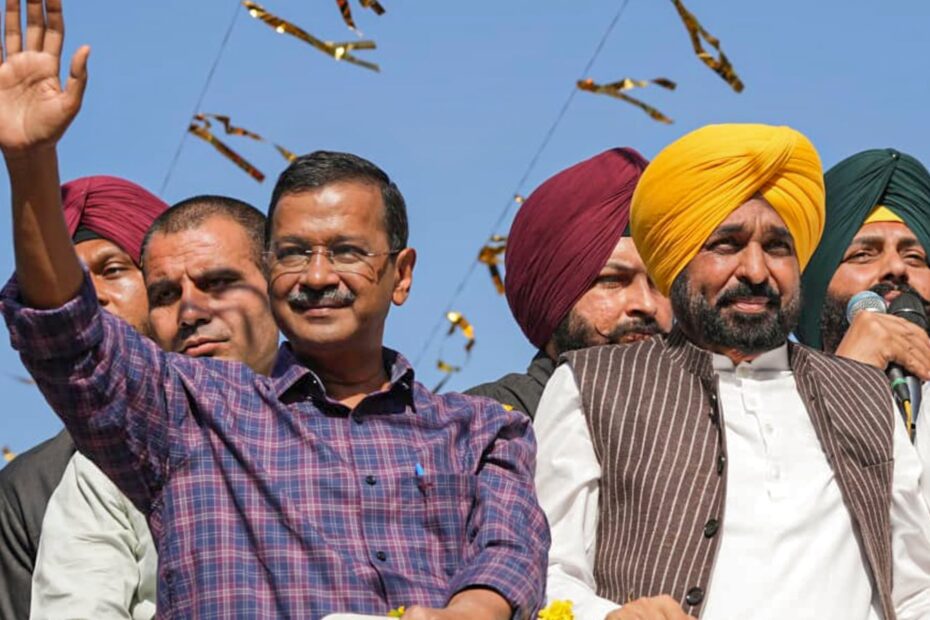
Despite the challenges, however, the AAP continues to project confidence. CM Mann and party national convener Arvind Kejriwal have campaigned aggressively, highlighting the government’s welfare schemes, free electricity, anti-corruption measures, infrastructure projects and development initiatives undertaken over the last four years. Kejriwal even claimed there were “pro-incumbency” sentiments for the party.
Yet, beneath the campaign rhetoric, the May 26 polls have effectively turned into a “referendum” on governance, organisation and political momentum of the AAP dispensation ahead of 2027.
The eight municipal corporations going to polls are Bathinda, Moga, Abohar, Barnala, Batala, Pathankot, Kapurthala and Hoshiarpur. Polling will take place through ballot papers, while counting of votes is scheduled for May 29.