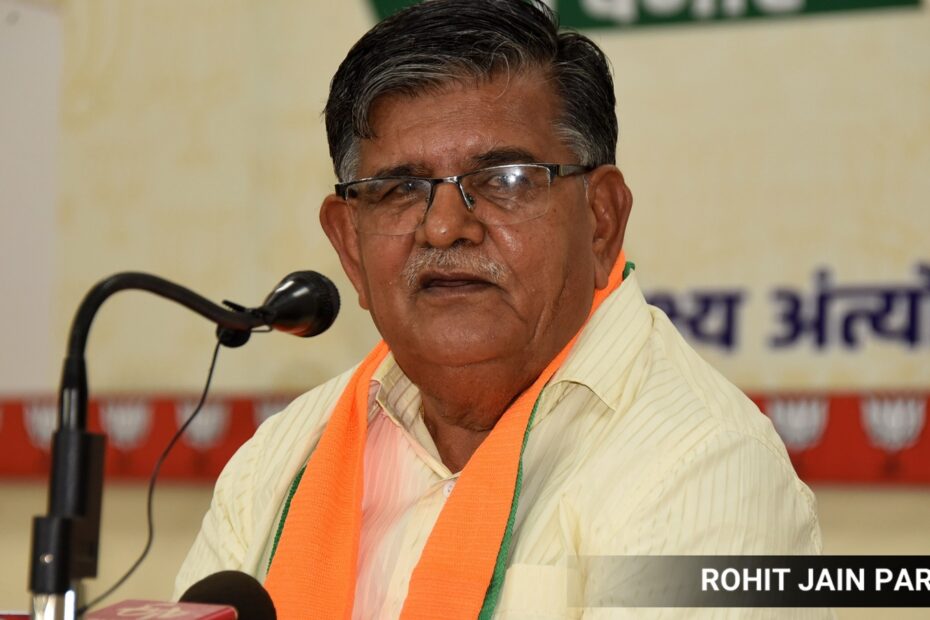
Punjab Governor and Chandigarh Administrator Gulab Chand Kataria is set to mark two years in office on July 31. He had been a BJP veteran in Rajasthan, where he had handled multiple roles in the party organisation as well as government including as the home minister.
In an interview with The Indian Express, Governor Kataria, 81, speaks on multiple issues, ranging from Punjab’s drug crisis to law and order situation, corruption to farmer protests, and Chandigarh’s future to the Centre-state relations. Excerpts:
Advertisement
* How do you assess your two-year tenure as Punjab Governor and Chandigarh Administrator so far?
One of the strongest memories from my tenure is the heartwarming spirit shown by people during the floods (in 2025). Even before the administration could mobilise, local residents had begun the rescue and relief works. Gurdwaras ran langars round the clock and people came together to help those in distress.
Later, helicopters were deployed extensively for rescue operations, while districts such as Amritsar, Gurdaspur and Tarn Taran saw excellent coordination between the civil administration and the Army. Amphibious vehicles deployed in Amritsar saved many lives, and rehabilitation after the floods was carried out efficiently. Those experiences strengthened my faith in both the people and the administration.
* You have consistently highlighted Punjab’s drug menace. How serious is the problem and what needs to be done?
Drugs are among Punjab’s biggest challenges. They are devastating poor families and destroying entire households. In border villages, I have seen young people lose their lives within months of becoming addicted to synthetic drugs. Earlier, liquor abuse would kill in years, but this only takes months.
Advertisement
I undertook a 17-day foot march to mobilise people against drugs. I also repeatedly urged the government to launch a statewide drive, which it did last year.
I also feel drug trafficking cannot flourish without the involvement of the police and the administration. The police have acted against some black sheep, but that has not been enough. The government, administration and people must work together if Punjab is to overcome this menace.
* Are you satisfied with Punjab’s law and order situation?
Extortion has become a very serious concern. Almost every day one hears of threatening calls, firing incidents or attacks on businesses. Such an atmosphere discourages investment and economic growth.
People also express concerns about corruption in politics and the administration. Corruption has seeped into top rungs of the administration.
* Punjab has witnessed prolonged farmer agitations in recent years. How should such disputes be resolved? What changes do agriculture need?
Every movement must eventually end through dialogue. Prolonged protests and road blockades hurt the state and its economy. There is a trust deficit between farmer organisations and the government, and that can only be bridged through sustained discussions. Also, I often hear that once two demands are met, two more crop up.
Agriculture itself also needs change. Farmers are not receiving returns commensurate with the effort and investment they make. Diversification into horticulture, fisheries, organic farming and high-value crops offers better opportunities and should be encouraged gradually.
* Your tenure has largely remained free of confrontation with the AAP-led Punjab government. How have you maintained your ties?
I believe in dialogue rather than confrontation. Whenever differences arise, I ask the government to explain its position and I present mine. We try to arrive at a consensus. For instance, during discussions over the appointment of vice-chancellors, I insisted that the prescribed process be followed. If I preferred one candidate from the panel of three, I explained my reasons. Differences need not become conflicts if both sides are willing to engage.
* You have reserved your decision on the ordinance to regularise temporary employees. Ealier you cleared the anti-sacrilege legislation without any delay. How do you approach such sensitive issues?
Each matter has to be examined carefully on its own merits. On the ordinance concerning temporary employees, I am studying how other states have handled similar issues, including the financial and legal implications of such a decision. Frankly, such an important matter is best debated in the Assembly than decided through an ordinance.
Regarding the anti-sacrilege legislation, I gave it my assent because I felt it tackled hurt sentiments. But now the Akal Takht says certain provisions affect its religious authority. Whenever legislation touches religious sentiments, it must be examined carefully. Ultimately, the constitutional process will determine the outcome.
* Punjab has frequently complained about delays in central assistance, including the Rural Development Fund and flood relief. How do you view these issues?
The Centre has tightened the requirement for utilisation certificates for all states. Under the centrally sponsored schemes, states are also required to contribute their share. Delays sometimes arise when utilisation certificates are pending or the state’s contribution has not been released. Proper accounting and compliance are essential for the smooth flow of funds.
* Do you see any resolution to the Chandigarh issue or the Sutlej-Yamuna Link (SYL) canal dispute?
Chandigarh became a Union Territory (UT) as part of the reorganisation process to address competing claims, and it is not an easy issue to resolve.
The SYL dispute should be settled through dialogue. Water is a national resource and should not be viewed as belonging exclusively to one state. At the same time, we must improve water-use efficiency through measures such as drip irrigation.
* Punjab continues to witness large-scale migration abroad. Can this trend be reversed?
Punjabis have achieved remarkable success overseas and naturally this inspires younger generations. That attraction will remain.
The only sustainable way to reduce migration is by creating quality employment opportunities and better facilities within Punjab. The growth of the start-up ecosystem is encouraging because some young people are now returning to build businesses here.
* Chandigarh has emerged as one of the country’s best-performing education systems. What is your take?
We have greatly strengthened government schools, and the effort shows. A government school student topped the Class XII examinations recently, while the number of students scoring above 98% has doubled from 27 to 57.
In Class X, the pass percentage has risen from 88% to 95%, and the number of schools recording a 100% pass result has increased from 17 to 35.
For four consecutive years, Chandigarh has ranked first nationally in school education. This year we scored 766 out of 1,000, nearly 30 points ahead of the next state. These achievements show that government schools can deliver excellence with the right support.
* But there is a persistent fear that Chandigarh will lose its character?
Heritage conservation is essential, but it should not become an obstacle to development. Strict heritage norms are justified in sectors 1 to 30, but applying similar restrictions elsewhere has limited the city’s growth.
Through the Master Plan 2031 review, we have invited public suggestions and are considering allowing greater vertical development where appropriate. The floor area ratio in industrial areas also needs to be increased. If Chandigarh does not expand sensibly, industries and investors will continue moving to Mohali and Panchkula.
Housing Board residents also face genuine difficulties. Nearly 58,000 houses come under the Board and even minor alterations often attract heavy penalties. We have already disposed of more than 3,500 of over 6,000 pending cases.
At the same time, encroachments on government land cannot be allowed. We have cleared the city of all slums while ensuring that eligible residents were properly rehabilitated.
* What have been your major healthcare and civic initiatives in Chandigarh?
We have strengthened healthcare infrastructure considerably. Government Medical College and Hospital, Sector 32, has upgraded its trauma and emergency services, while MBBS seats have been increased by 50.
Primary health centres and dispensaries have been upgraded so that patients can receive treatment closer to home, reducing pressure on hospitals. We have digitised patient records and introduced evening OPDs for the first time.
I also want Chandigarh to become a model in waste management. Waste should be viewed as a resource rather than a burden. Scientific processing can generate revenue, while methane produced from waste can be utilised. We are working with Indian Oil in this direction.
My vision is to develop Chandigarh into a leading medical, educational and tourism hub.
* You have won eight Assembly polls and one Lok Sabha election. How do you look at your electoral record?
People first want an accessible representative. They want someone whose behaviour does not change after winning elections, whose doors remain open to everyone, whether rich or poor, and who listens patiently to their problems.
Honesty also matters. A leader who works without corruption earns people’s trust. Public life is ultimately built on credibility and accessibility.
* What changes would you like to see in governance?
Governance requires both firmness and accountability. Rules must be enforced fairly and consistently.
Officers need to change their working culture. Annual Confidential Reports should not become mere exercises in mutual praise. Honest assessments, timely warnings where necessary and fair evaluations are essential. Only when accountability becomes part of the administrative culture can governance truly improve.