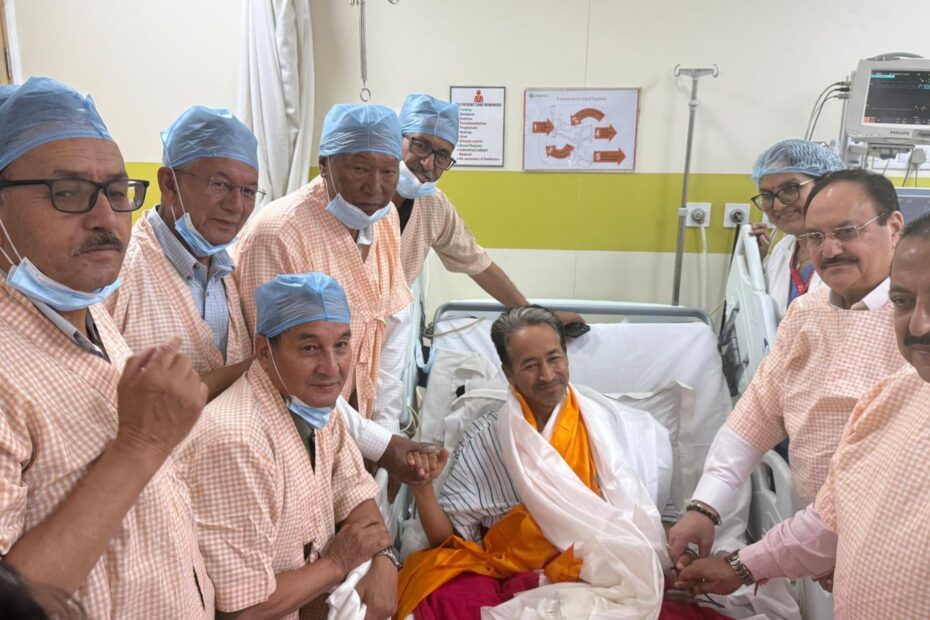
Three days of negotiations, the government softening its stand, and intervention by Sonam Wangchuk’s lawyer and leaders from Ladakh driven by concerns about his health. That’s what it took to nudge the activist, the face of the ongoing Jantar Mantar protests, to reconsider his position and break his fast late on Thursday night.
Sources said the government began making attempts to reach out to Wangchuk by the evening of July 20 when the protests ran into lathicharges and tear gas fired by the police during the march to Parliament. It is learnt that Vivek Tankha who was among the lawyers who fought Wangchuk’s National Security Act (NSA) case in the Supreme Court — and is known to be close to the activist — played a significant role in persuading him to end the fast. A source said Tankha’s intervention was driven purely by his concern for Wangchuk’s failing health due to the prolonged hunger strike. “He had lost more than 11 kg and those around him were concerned,” the source said.
Advertisement
Sources said that after speaking to Tankha, who is a Congress MP, Wangchuk issued an open letter to Nadda in which he put forward his conditions for ending the fast. He requested an “unequivocal assurance from the government that none of the young protesters will face any punitive or retaliatory legal action for participating in this movement”. This was a climbdown from the collective demand of the protests that Pradhan must resign.
“The government did not approach me for this. They were talking to Gitanjali (Angmo, Wangchuk’s wife). Yes, I helped Gitanjali and Sonam in the whole process as they were consulting me throughout. I was also trying to convince him to break his fast. Sonam ending his fast is separate from the ongoing movement. The movement of the youth continues. But his health was deteriorating. It was important to save his life. He is an inspiration to the youth in the country. He was to end his fast on July 20 itself. But the government treated him badly. So, he continued his fast,” Tankha told The Indian Express.
How the negotiations unfolded
On July 21, Union Ministers J P Nadda and Jitendra Singh met Wangchuk at Medanta Hospital in Gurgaon. The two are learnt to have assured him that issues raised by him would be taken up for discussion in Parliament and urged him to end his fast. Singh had spoken to Geetanjali Angmo earlier too, it is learnt.
Advertisement
On July 22, a delegation of MPs led by Tankha met Wangchuk and Angmo. They appealed to the activist to withdraw his indefinite fast, saying the struggle for a fair and transparent examination system had become a national cause. They urged the activist to end his fast as his message had resonated across the country.
Must Read | Differences between Sonam Wangchuk and CJP? Saurav Das answers big question
Several other MPs also tried to meet Wangchuk at the time but were not allowed. The delegation also handed over a letter signed by MPs cutting across party lines, among them Shashi Tharoor, Tiruchi Siva, Ram Gopal Yadav, Kapil Sibal, John Brittas, and Sagarika Ghose. “The nation, especially its youth, needs your wisdom and guidance far more than your sacrifice… Just as the Union Territory of Ladakh needs Sonam Wangchuk, India needs you too… not in suffering, but in service, serving those causes that will benefit generations to come. The country needs you,” read the letter.
Sources said that while Wangchuk was hesitant to break his fast, his wife took a stand that he had to keep his word to the government. Wangchuk had told the ministers that he would break the fast if the government agreed with his demands. But when Wangchuk seemed hesitant even after the government’s assurances, saying he had to follow the line set by the protesting students, Angmo “put her foot down, saying he cannot backtrack from his words”. “His wife finally persuaded him to end the fast.“ said a minister.
By late night on July 23, Nadda and Singh arrived at Medanta with a written assurance from the government. It said, “Government is positive on not registering cases against those protesting peacefully at Jantar Mantar in Delhi and those participating in the march to Parliament on July 20, 2026.”
The assurances included a discussion in Parliament and “suitable compensation” for suicide victims following the NEET paper leak. PM Narendra Modi had already announced by then that a new Bill would be introduced in Parliament to deal with paper leaks.
Also Read | CJP’s nationwide protest today after Sonam Wangchuk ends hunger strike
Sources close to Wangchuk said his decision was entirely informed by his concern for the well-being of protesters who he felt could face serious legal trouble in future. Sources said Wangchuk was likely to stay in the hospital for the next few days to complete his recovery. He is likely to meet youth leaders at Jantar Mantar before going back to Ladakh.
Role of Ladakh leaders
In parallel, civil society leaders from Ladakh arrived in Delhi from Leh on July 21. Their attempts to meet Wangchuk at Safdarjung Hospital and then at Medanta, however, were unsuccessful on July 21 and 22. On July 23, however, the leaders were allowed to meet Wangchuk in the morning, accompanied by an Intelligence Bureau official.
The Ladakh leaders too urged Wangchuk to end his fast. “The movement had moved beyond him. He had done his part. By the time we met him, an understanding had already been reached between the government and him about ending his fast. He just wanted a written assurance, which came late at night. We need him in Ladakh to spearhead our own negotiations with the government on issues concerning our region,” a leader in the Ladakh delegation told The Indian Express.
Amid all this, the government also assured Ladakh leaders that talks to resolve issues concerning the region would be held soon, sources said.
— With inputs from Liz Mathew