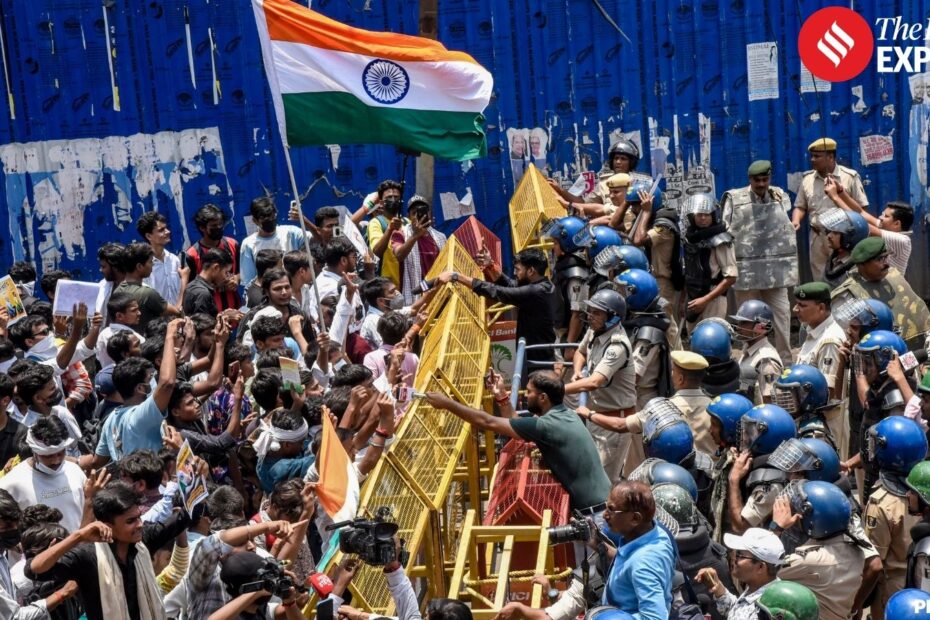
Dharmendra Pradhan’s resignation under pressure from students and the youth marks more than a ministerial fall. It is the third time in 12 years that the Modi government has been forced to retreat following mass mobilisation. This is also the second time a minister in the government has stepped down under public pressure, if one includes M J Akbar’s resignation in the wake of the #MeToo movement.
Each episode says something important about how this regime understands power, legitimacy and dissent. The pattern is striking: the government resists as long as it can, dismisses the moral force of protest for as long as possible, and moves only when the political cost of standing firm begins to outweigh the cost of surrender.
Advertisement
CAA-NRC
The first major instance came during the agitation against the Citizenship Amendment Act (CAA), when the government publicly began to soften on the proposed National Register of Citizens (NRC) project. Technically, it was never a formal rollback of a Cabinet decision because no nationwide NRC notification had been issued. But politically, the message was unmistakable.
When the Prime Minister himself said the government had not decided on NRC, even though Union Home Minister Amit Shah had repeatedly spoken of a nationwide exercise and had used the infamous “chronology” phrase to signal the government’s intent, it amounted to a retreat. The project was effectively put in cold storage. The government sensed that the issue, once pitched as a legal-administrative measure, had become a wider political liability.
Farmer protests
The second moment came with the farmers’ protests, where the government held out for nearly a year before finally conceding defeat and repealing the three farm laws. Here too, the pattern was similar, but the scale was larger. Initially, the government treated the agitation as manageable, believed it could outlast the protesters and tried to frame the movement as geographically limited and politically engineered.
Advertisement
But the farmers refused to disperse and the protest became a sustained, disciplined challenge to the government’s authority. When Modi eventually announced the withdrawal of the laws and apologised to farmers after a year, it was a rare admission that the state had been compelled to step back not by persuasion but by pressure.
Paper leak protests
The current protest against Dharmendra Pradhan and his education ministry’s failure to stop paper leaks has now become the third such moment. What is different this time is not just the issue, but the social composition of the movement and its mode of mobilisation. The protests were not led by a fixed ideological organisation or by one recognisable command structure. They were organic, decentralised, and deliberately leader-light.
The crowd itself became both the voice and the vehicle of the movement. That made it difficult for the government to solve the problem through standard political negotiation, which usually depends on engaging a few identifiable leaders who can bargain, compromise, or be co-opted.
The movement’s organisational form also made it unusually resilient. It was peaceful, yet tightly coordinated. It spread through networks that the government was poorly equipped to understand, let alone counter. Memes and Instagram reels full of irony and humour gave the protests a cultural energy that official messaging could not match.
What was different this time
In earlier protest cycles, the BJP could often rely on a familiar playbook: question the protest’s credibility, attack its leadership, split the coalition, or wait for fatigue to set in. This time, the protest narrative expanded faster than the government’s rebuttal, and the Opposition was not even the main engine. That was part of the shock.
The July 20 crackdown, rather than scaring the protesters into retreat, appears to have hardened their resolve. That too matters. A movement of young people that does not visibly flinch after a police response changes the equation for the state. Governments are used to negotiating with organisations that fear disruption, loss of face or exhaustion.
But a youth mobilisation driven by outrage rather than institutional discipline can be harder to manage because it does not always respond to the usual signals of threat or concession. Even when Sonam Wangchuk softened his position, the protesters kept the resignation demand alive. That showed that leadership here was dispersed, and that compromise with one figure could not necessarily settle the street.
Why BJP appeared unsettled
There is another reason, BJP sources said, that this episode has unsettled the BJP. Unlike the anti-CAA protests or the farmers’ movement, this one has drawn heavily from the party’s own social base.
“That is politically more dangerous than protest by declared opponents. The government can more easily dismiss an agitation as partisan when it comes from groups it already treats as ideological adversaries. But when students and young people – and these are middle and lower middle class students – who are otherwise inside or near the BJP’s core ecosystem begin to mobilise, the government cannot simply externalise the dissent,” a BJP leader said.
Thus, the government has had to confront a more unsettling possibility: that the impatience with the state now extends beyond the usual opposition belt.
M J Akbar’s resignation as junior external affairs minister came in different circumstances. Unlike the protests against CAA-NRC, farm laws, or Pradhan, the #MeToo movement was not directed at the government’s policy or legitimacy. Yet it remains the only clear instance in the Modi years of a minister resigning under public pressure in the face of a civil-society movement. Akbar stepped down after sexual harassment allegations and the pressure generated by the #MeToo wave made his position untenable.
Where BJP struggles
The three agitations — farm laws, CAA, and NEET paper leak — in a way, have also brought into view the larger character of the government. The Modi government has often shown that it understands power very well. It knows how to dominate the agenda, how to hold the initiative, and how to convert politics into a contest of strength.
What it has often struggled with is sustained democratic engagement with disagreement. It appears not to be naturally inclined to treat dissent as something that should be continuously negotiated in a plural society. Instead, it tends to wait until the pressure becomes politically damaging, and only then recalibrates. In other words, it is responsive to threat, but not always to argument.
Yet, sources in the government say, the Pradhan episode is a tactical retreat to contain the damage. The government believes it has contained the immediate issue while preserving its larger authority.
“The idea is to assuage the feeling of anger that is there in the youth today, even though we believe resignations actually don’t solve the issue. The government has already made it clear that it is committed to addressing all issues of students and the same will be done,” a BJP leader said.