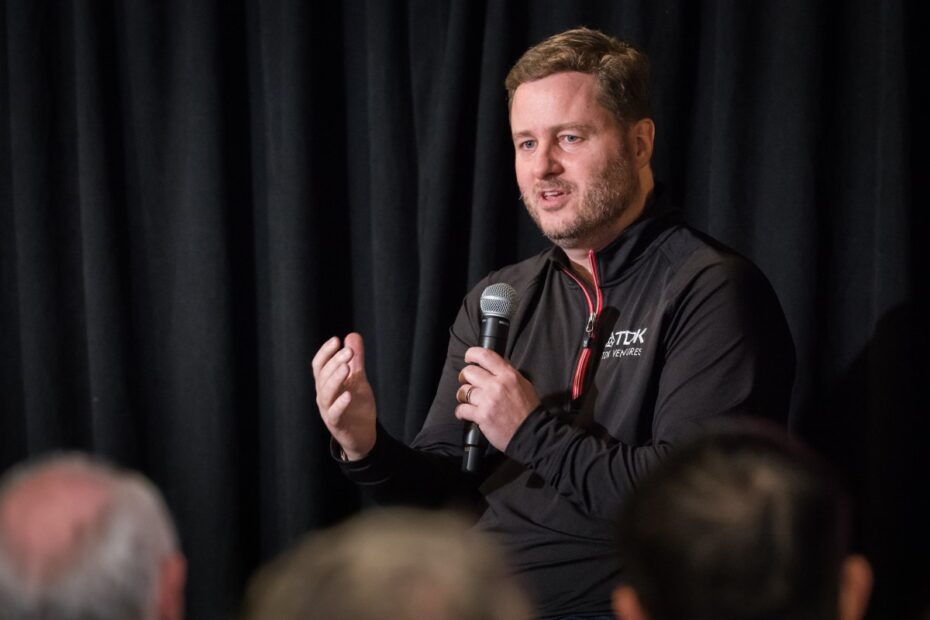
Nicolas Sauvage holds that the best bets only appear obvious after four years—a view he expressed onstage last week at StrictlyVC’s San Francisco event, co-hosted by TDK Ventures. He’s been testing this theory since 2019, when he launched the corporate venture arm of the Japanese electronics giant, which now oversees $500 million across four funds. Groq, an AI chip startup valued at $6.9 billion in its latest funding round last fall, exemplifies this mindset most prominently. In 2020—long before the generative AI surge made infrastructure investments seem like a no-brainer—Sauvage invested in the company, which was founded by Jonathan Ross, a key engineer behind Google’s Tensor Processing Units. Groq has been focused on inference from the outset: the computationally intensive process that occurs each time a model generates a response to a query. Ross built his chip by first creating the compiler, then simplifying the architecture to the point where, as Sauvage puts it, “you can’t remove one part and have it still work.” Though it may have appeared niche to others, Sauvage—aware of his parent company’s constraints—recognized the asymmetry. In contrast to consumer hardware, which faces inherent limitations, demand for inference continues to grow exponentially with each new application and model. Sauvage couldn’t have foreseen that demand for inference would skyrocket this year, driven by all the AI agents making and acting on dozens of calls (instead of just a single query). But in some ways, Ross got lucky too. After all, a Japanese electronics conglomerate primarily known for magnetic tape doesn’t appear, at first glance, to be the most obvious investment partner.