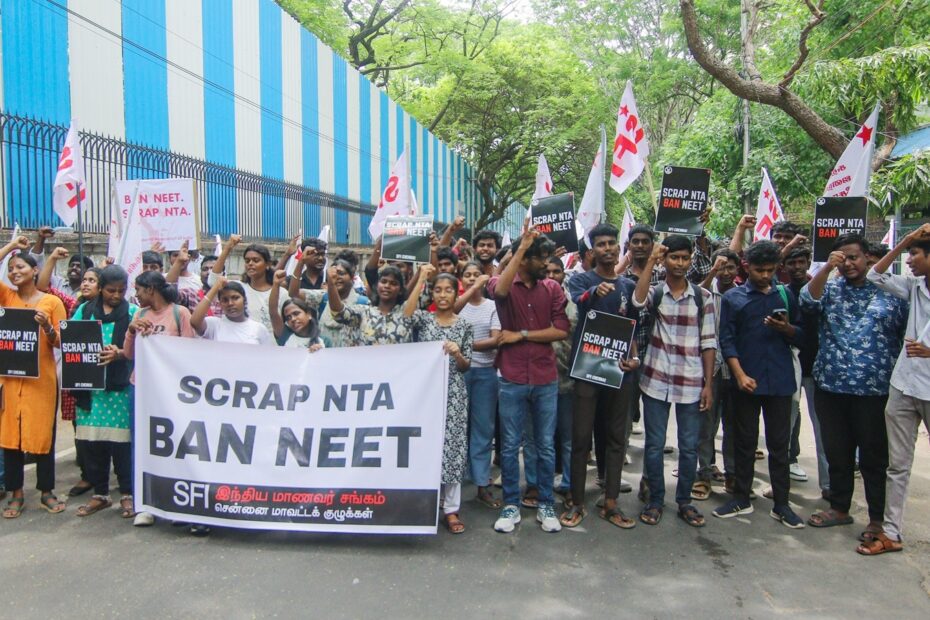
Days after the NEET-UG examination for admission to undergraduate medical courses was scrapped following an alleged paper leak, Union Education Minister Dharmendra Pradhan announced last Friday that it will be a computer-based test (CBT) from next year onward. So far, it has been a pen-and-paper exam.
However, the Parliamentary Standing Committee on Education, Women, Children, Youth and Sports, in its report submitted to Parliament last year (371st Report, 2025), preferred the pen-and-paper model, saying, “Between the two, the Committee supported a greater focus on pen-and-paper examinations given that there are several models of such examinations which have been leak-proof for several years – including the CBSE exams and the UPSC exams. The Committee recommends that the NTA closely study these models and implement the same.”
Advertisement
The NTA (National Testing Agency), constituted by the Centre in 2018, conducts the NEET-UG exam among several other centralised admission tests for various professional and academic courses.
The House Committee had not rejected the online model entirely, though. “The Committee was informed that with regards to securing the examination process, the tradeoffs are as follows. Pen and paper exams offer more opportunities for paper leaks, while computer-based tests (CBT) can be hacked in a manner that is difficult to detect,” it stated, adding that “In the case of CBT, the Committee recommends that these exams be hosted only in government or government-controlled centres and never in private centres.”
The Committee, headed by senior Rajya Sabha MP from the Congress, Digvijaya Singh, had flagged several problems with the NTA’s operation, urging it to improve its functioning.
Advertisement
“The Committee reiterates that the NTA’s performance in the last year has not inspired much confidence. It has been brought to the notice of the Committee that in the year 2024 alone, of the 14 competitive examinations conducted by the NTA, at least five faced major issues and as a result, three examinations viz. UGC-NET, CSIR-NET and NEET-PG had to be postponed, one examination viz. NEET-UG saw instances of paper leaks, and one examination i.e CUET (UG/PG) saw its results postponed,” it noted.
“In JEE Main 2025 held in January 2025, at least 12 questions had to be withdrawn due to errors noted in the final answer key of the engineering entrance exam. The Committee observed that such instances do not inspire confidence of the examinees in the system. The Committee therefore recommends that NTA needs to quickly get their act together so that such instances… do not occur in future,” the panel said.
Blacklisted firms
In its report. the Committee noted that “several firms involved in paper setting, administration, and correction have been blacklisted by one organisation/state government but that this however, is not impeding their securing of contracts from other states or organisations”.
It stated that “such blacklisted firms must not be engaged for any entrance test by the NTA or the state governments”, adding that “The Committee therefore recommends that the Department (Department of Higher Education) should compile a nationwide list of blacklisted firms along with the persons or entities that constitute such firms so as to prevent such firms/persons/ entities from securing future contracts and bring further clarity in this regard.”
The panel underlined that “the NTA collected an estimated ₹3,512.98 crore while it has spent ₹3,064.77 crore on the conduct of examinations thereby creating a surplus of Rs 448 crore in the last six years”, recommending that this corpus be used to “build the agency’s capabilities to conduct tests itself, or to strengthen regulatory and monitoring capabilities for its vendors”.
The NTA, the Committee stated, should produce not just an audited statement but also “an Annual Report clearly outlining its activities in detail and submit the same to the Parliament annually”.
Calling upon the NTA to declare CUET results in time given repeated delays, it said, “Such a delay is a cause of major concern as it not only delays the admission process but also delays the start of the academic session by the on boarded Universities which ultimately puts unnecessary pressure on the students,”
Coaching centres
Expressing concern over the mushrooming of private coaching centres for competitive exams, the parliamentary panel recommended that the Department of Higher Education work with the NTA “to ensure that the papers are set to more closely reinforce the curriculum of school examinations, so as to avoid the introduction of a parallel curriculum and the accompanying coaching centre industry”. It called for “a high-level committee to address the proliferation of coaching centres and suggest methods to regulate the same”.
Tamil Nadu panel
A high-level Tamil Nadu committee on the Centre-state relations, set up by the then M K Stalin-led DMK government in April 2025, recommended that the NTA be disbanded and exams be conducted once again through diverse agencies. It made various suggestions for the education sector, among other things, while flagging federal concerns.
The committee, headed by Justice Kurian Joseph, retired Supreme Court judge, comprises former IAS officer K Ashok Vardhan Shetty and ex-Vice Chairman of Tamil Nadu State Planning Commission M Naganathan as members.
It submitted Part I of its report in February this year, which the then Stalin government tabled in the Assembly. The report pitched for removing education from the Concurrent List and placing it in the State List. It also demanded that top 100 institutions be freed from the UGC and other regulations, subject to a 10-year review; exams be conducted by diverse agencies yet again; and that the practice of the Governor as the Chancellor of state universities should end.
The panel also called upon the Centre to “amend Article 343 to constitutionally entrench English as the permanent official language of the Union”.
“Decisions with nationwide consequences affecting millions of students are taken by a small coterie, with no independent oversight and no statutory accountability to Parliament. The NTA relies almost entirely on deputationists (22), contract staff (38), and outsourced workers (138) – a structure ill-suited for conducting high-stakes, all-India competitive examinations requiring secrecy and accountability,” the report said, adding that “Registered merely as a society, the NTA lacks statutory backing. It is governed by a ten-member body dominated by ex-officio representatives from Central institutions, with no State representation.”
The panel stated: “Sensitive functions – question paper printing, logistics, computer-based testing, data handling, and surveillance – are fragmented across contractors, plying vulnerabilities and diffusing accountability…. This concentration of authority in a single central body, combined with a fragile institutional design and weak accountability mechanisms, has created a classic single-point-failure risk.”
The panel also targeted the overcentralisation of the NEET exam leading to states having no say in admissions to colleges established, funded and administered by them, seeing this “as the most aggressive intervention in the federal educational space”.
“The consequences of NTA’s fragility were laid bare in 2024. NEET-UG was compromised by confirmed paper leaks in multiple States. Shortly thereafter, the UGC-NET was cancelled following a breach, while CUET results were not declared in time repeatedly,” the report read.
“Even with flawless execution, high-stakes national entrance tests, particularly for undergraduate admissions to State institutions, remain constitutionally undesirable, pedagogically unsound, socially inequitable, and harmful to student well-being, With a malfunctioning NTA, these risks are only magnified,” the panel added.