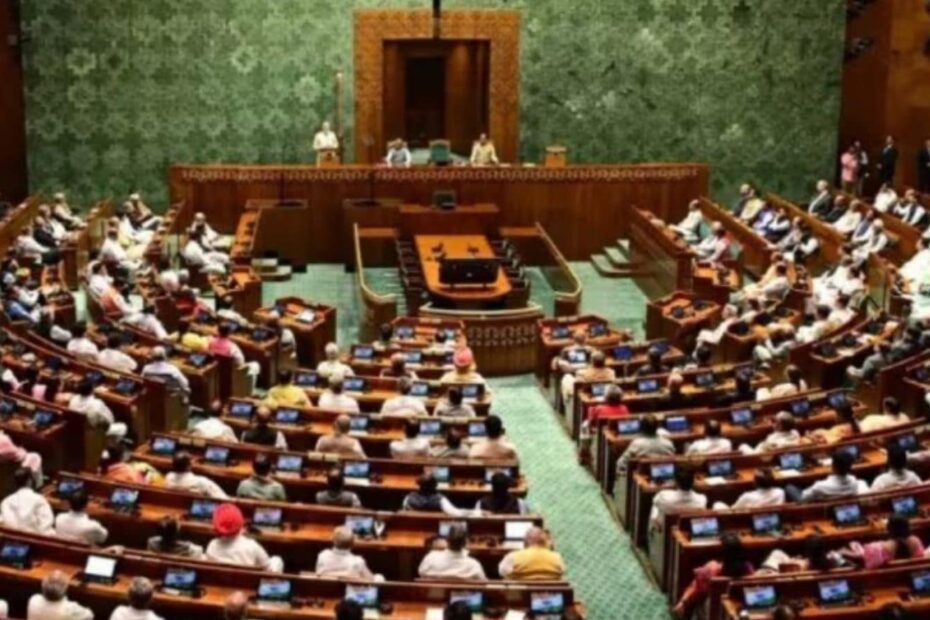
The defeat of the Constitution (One Hundred And Thirty-First Amendment) Bill, 2026, in the Lok Sabha on Friday — and the consequent lapse of the accompanying Delimitation and Union Territory Bills — is not the end of the delimitation controversy. It has just been delayed by one year. The three Bills were brought in to advance the implementation of the women’s reservation law and operationalise it in an expanded House.
When delimitation was last frozen for 25 years by the Atal Bihari Vajpayee government in 2001, Article 81 was amended to extend the freeze on delimitation for 25 years to keep the inter-state distribution of seats at the 1971 Census levels.
Advertisement
Article 81 (3) says, “In this article, the expression ‘population’ means the population as ascertained at the last preceding census of which the relevant figures have been published: Provided that the reference in this clause to the last preceding census of which the relevant figures have been published shall, until the relevant figures for the first census taken after the year 2026 have been published, be construed — (i) for the purposes of sub-clause (a) of clause (2) and the proviso to that clause, as a reference to the 1971 census; and (ii) for the purposes of sub-clause (b) of clause (2) as a reference to the 2001 census.”
Clause 2 sub-clause (a) of Article 81 pertains to the distribution of Lok Sabha seats among states, and says, “There shall be allotted to each State a number of seats in the House of the People in such manner that the ratio between that number and the population of the State is, so far as practicable, the same for all States.” This was frozen at 1971 Census levels.
Sub-clause (b) of Clause 2 of Article 81 pertains to delimitation of seats within states, and says, “Each State shall be divided into territorial constituencies in such manner that the ratio between the population of each constituency and the number of seats allotted to it is, so far as practicable, the same throughout the State.” This was frozen at 2001 levels.
Advertisement
So, as per the present Article 81, unless the freeze on delimitation as per 1971 levels where distribution of seats between states is concerned is extended again by amending Article 81 before the data of the ongoing Census are released, the freeze will automatically lapse and the next delimitation will have to reflect the population figures of the ongoing Census, meaning that the share of the states will change drastically to the detriment of states such as Kerala and Tamil Nadu and the advantage of states such as UP, Bihar, Rajasthan, Gujarat and Maharashtra. The reason: the constitutional principle enshrined in Article 81 is one person, one vote, one value. And the ratio of the populations of the above-mentioned states has changed drastically since 1971.
Also Read | Explained: How government’s delimitation push will reshape states’ representation in Lok Sabha
Announcing the Census exercise, the press release of the Cabinet on December 12, 2025, said, “The Census of India would be conducted in two phases: (i) Houselisting and Housing Census – April to September, 2026 and (ii) Population Enumeration (PE) – February 2027 (For the UT of Ladakh and snow bound non-synchronous areas of UT of Jammu & Kashmir and states of Himachal Pradesh and Uttarakhand, PE shall be conducted in September, 2026).” The timeline shows that this will be the first Census after 2026 whose figures may be available in late 2027.
Senior Supreme Court advocate Vikas Singh and former Lok Sabha Secretary General P D T Achary told The Indian Express that unless the freeze is extended, it will automatically lapse when the figures of the ongoing Census become available.
It is likely that the next pressure from Tamil Nadu and other southern states on the Centre will be to introduce a Constitutional Amendment Bill to further extend the freeze, as was done in 1976 and 2001, and this time BJP ally TDP may also be forced to join ranks with the southern states in asking for this.