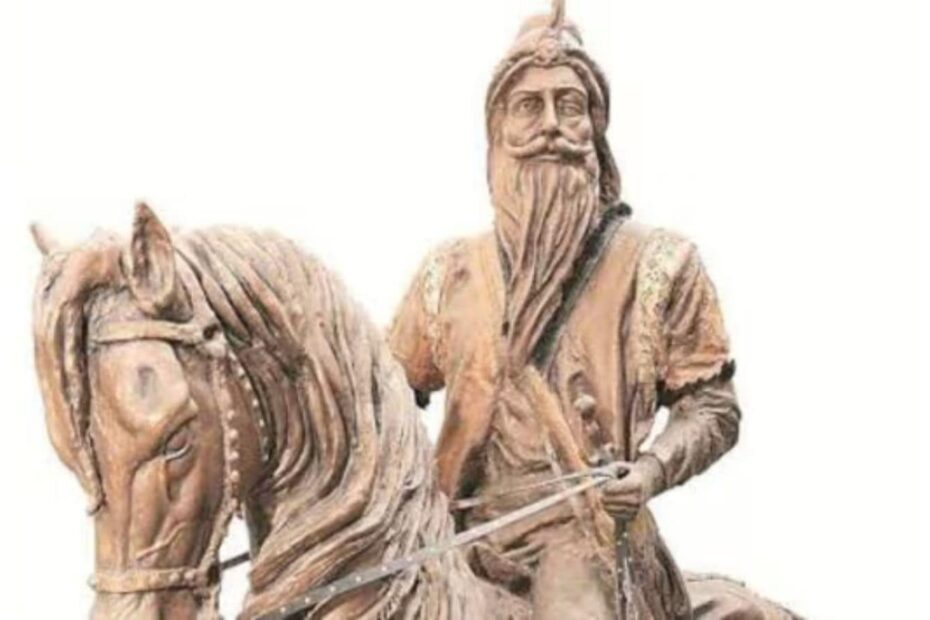
Nearly two centuries after Maharaja Ranjit Singh’s death, Sarkar-e-Khalsa – the sovereign Sikh empire established by him in 1799 – remains a potent political touchstone in Punjab. Across party lines, leaders invoke it to signal inclusive governance, communal harmony and Sikh pride, making it a recurring reference point in electoral politics and debates over Punjab’s identity.
The symbolism was on display last week too as the BJP named Kewal Singh Dhillon as its Punjab president, replacing Sunil Jakhar. The move was widely seen as an attempt to woo Sikhs and the influential Jat Sikh community in particular. Dhillon invoked Sarkar-e-Khalsa, while the party unveiled a large portrait of Ranjit Singh at its Chandigarh office.
Advertisement
Dhillon said the BJP would seek to replicate the Maharaja’s Sarkar-e-Khalsa and its model of “equal treatment of all communities”. There is a reason why the term continue to resonate in contemporary Punjab politics.
What is Sarkar-e-Khalsa and how is it associated with Maharaja Ranjit Singh?
Historian Indu Banga says the term Sarkar-e-Khalsa was used by Sikh rulers even before Maharaja Ranjit Singh. “Khalsa was the sovereign ruler, often referred to as Khalsaji, while Sarkar denoted the administration. Hence the term ‘Sarkar-e-Khalsa’,” she says.
Advertisement
According to Banga, Ranjit Singh followed the same tradition. “He never formally assumed the title of Maharaja despite being the only ruler in this part of India to preside over a trans-regional empire.”
In his book Ranjit Singh: Maharaja of the Punjab, Khushwant Singh wrote that Ranjit Singh’s empire stretched from “Tibet to the deserts of Sindh and from the Khyber Pass to the Sutlej”. His army was considered among the most powerful in Asia and included not only local recruits but also European officers and soldiers.
“It was the first Indian force in a thousand years to stem the tide of invasions from the north-west frontiers of Hindustan,” Khushwant Singh wrote.
Yet, Ranjit Singh remained wary of grand titles. Historian Hari Ram Gupta, in History of the Sikhs: The Sikh Lion of Lahore, notes that the ruler’s seal bore the inscription “Akal sahae Ranjit”, meaning “God is the protector of Ranjit”.
Is this the first time Punjab politicians have invoked the term?
No. The term was frequently invoked by Shiromani Akali Dal (SAD) patriarch and five-time Punjab Chief Minister Parkash Singh Badal.
Ranjit Singh belonged to the Dhillon clan, a Jat Sikh caste. Badal was also a Dhillon, as is the present BJP state chief.
Badal prominently displayed portraits of Ranjit Singh in his office and often invoked the ruler while launching welfare schemes. His famous Sangat Darshan programme, through which he directly interacted with people, was often described as being inspired by the Maharaja’s accessibility to his subjects. The SAD’s slogan, “raj nahi seva (not rule but service)”, was also inspired by the ideals associated with Ranjit Singh’s rule.
Why is Sarkar-e-Khalsa an ideal that contemporary politicians aspire to?
Ranjit Singh’s reign represents the golden age of Sikh rule. His kingdom was known not only for its military might but also for its relatively inclusive and benevolent governance.
Historian Bikrama Jit Hasrat, who taught at Santiniketan and authored Life and Times of Ranjit Singh, wrote that the ruler broke with many conventions of his era by relying less on lineage and hereditary privilege and more on merit. Key positions in the administration were given to capable officials drawn from different religious and social backgrounds.
His court included Hindus, Muslims, Sikhs and even Christians. Fakir Syed Waheed-ud-Din of Lahore, a descendant of the Fakir family that served the Maharaja, wrote that Ranjit Singh sought to treat his subjects equally, irrespective of caste or creed.
The Maharaja regularly visited Harmandir Sahib , but he also paid obeisance at Hindu temples and Muslim shrines. He donated generously to places of worship across communities and is believed to have contributed more than 1,000 kg of gold for plating the domes of the Kashi Vishwanath Temple in Varanasi in 1835.
Historians point out that Ranjit Singh’s inclusiveness was rooted in political pragmatism. Banga notes that Sikhs constituted only around 10% of the population at the end of his reign. Governing a volatile frontier region exposed to repeated threats from the northwest and increasing pressure from the British required broad-based participation in the administration and the army.
“Ranjit Singh’s rule was exceptional because Punjab was perhaps the only region where three major religions coexisted in significant numbers, with Christianity also making its presence felt by 1834 when the first missionaries arrived in Ludhiana,” she says.
Why is BJP invoking Sarkar-e-Khalsa?
By invoking Ranjit Singh and Sarkar-e-Khalsa, the BJP appears to be appealing to Punjab’s syncretic traditions and shared cultural heritage.
The party has faced challenges in the Sikh-majority state since the 2020-2021 farmers’ agitation and amid concerns among sections of the Sikh community regarding its Hindutva politics. The invocation of Sarkar-e-Khalsa also taps into the idea of Punjabiyat, a cultural ethos that seeks to transcend the fault lines of caste, religion and region.