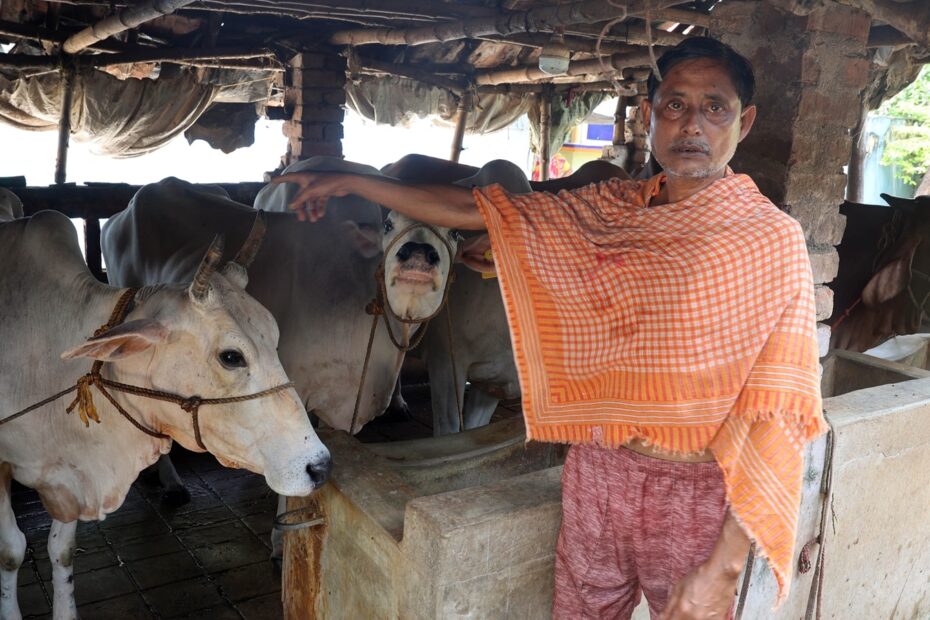
Standing near his cowshed in Ghoshpara in Bhangar, South 24 Parganas (about 28 km from Kolkata), Sadhan Ghosh says he is running out of options. He took a loan of Rs 5 lakh from a local moneylender at 4% interest rate, and hoped to repay it by selling nine of the 10 cows he owns. That looks difficult for now, Ghosh says. Meanwhile, “every day, I am spending Rs 500 per cow on fodder”.
About 15 minutes drive from Ghoshpara is Polerhat Goru Haat (Polerhat cow market). On any given day, nearly 2,000 cows would be bought and sold here, especially ahead of Bakr-i-Eid, which is falling this year on May 27-28. These days, the ground holds barely two dozen cows, tied to poles or cycle vans, with their owners and a handful of buyers standing around listlessly in the summer heat.
Advertisement
In one of its first steps after coming to power, the BJP government in Bengal announced strict imposition of the state’s Animal Slaughter Control Act, 1950 – meaning that only an animal aged 14 years and above can be slaughtered legally, and that the animal must have a joint certificate issued by the head of a municipality or panchayat samiti and a government veterinary surgeon declaring it “fit for slaughter”.
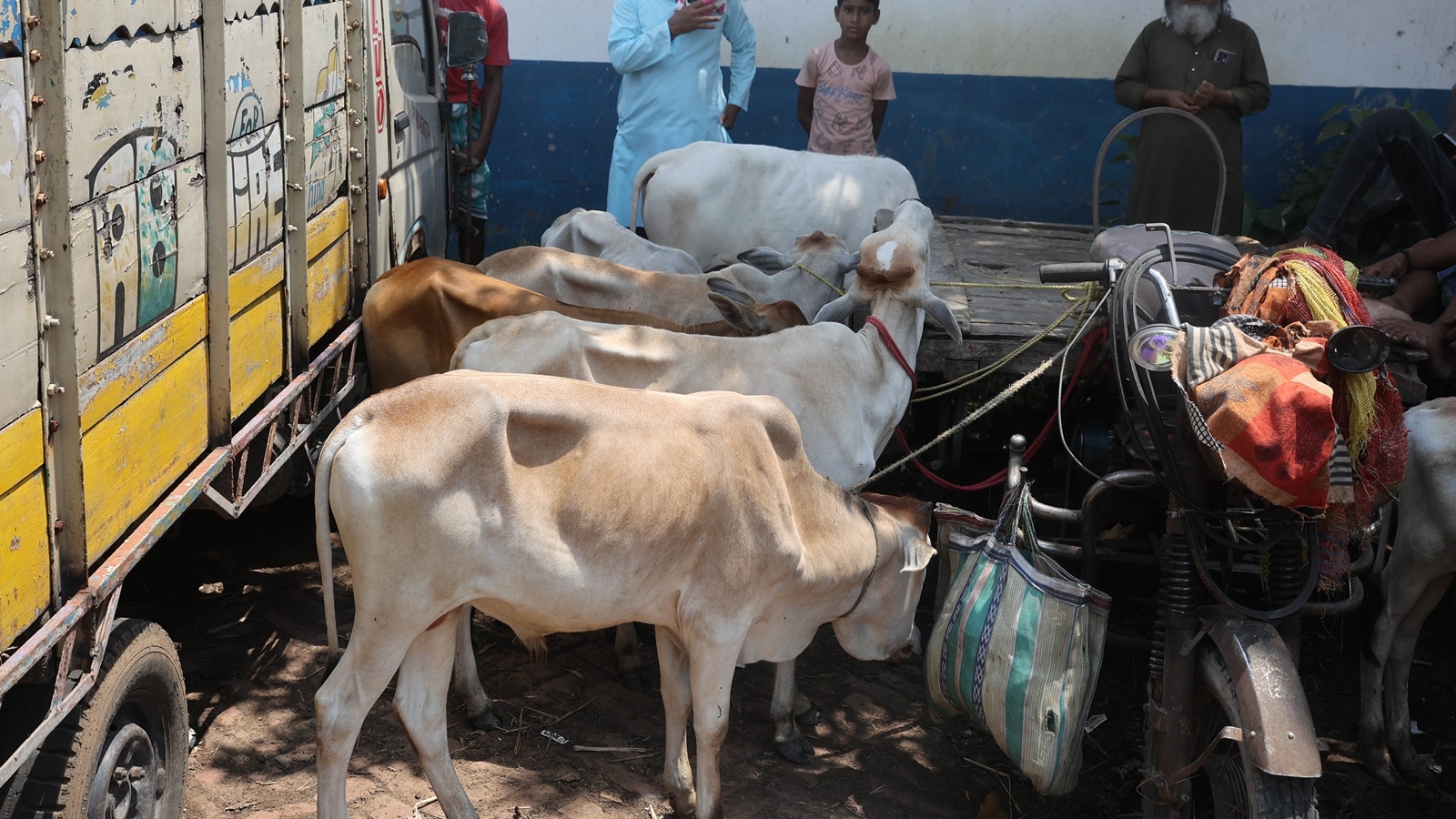 Scenes from the Polerhat cattle market in Bhangar. (Express photo by Partha Paul)
In the absence of any mechanism to determine the age of an animal, or to provide a fitness certificate, and amidst apprehensions over what a violation under a BJP government may mean, the Polerhat cow market has emptied out. Kolkata is feeling the pinch too, with beef prices shooting up from Rs 280 to Rs 600 per kg.
West Bengal is among the handful of states in the country where the consumption of beef and slaughter of cows is allowed, under strict regulation.
Advertisement
As the sale of cows drops, the goat and sheep market in Kolkata’s Rajabazar, one of the largest in the state, is bustling, as the “safer option”. While all animals officially require veterinary checks for slaughter, it is barely enforced in the case of goats and sheep.
Indian Secular Front (ISF) leader and Bhangar MLA Naushad Siddiqui wrote to Chief Minister Suvendu Adhikari on Monday urging that veterinary doctors be deployed at the panchayat level to provide the needed fitness certificates, adding that members of both the Hindu and Muslim communities were suffering due to the May 13 notice curbing the trade in cows.
Pointing to the coming Bakr-i-Eid, Siddiqui wrote: “… Section 12 of the West Bengal Animal Slaughter Control Act, 1950 empowers the State Government to grant exemption for slaughter of animals for religious purposes”.
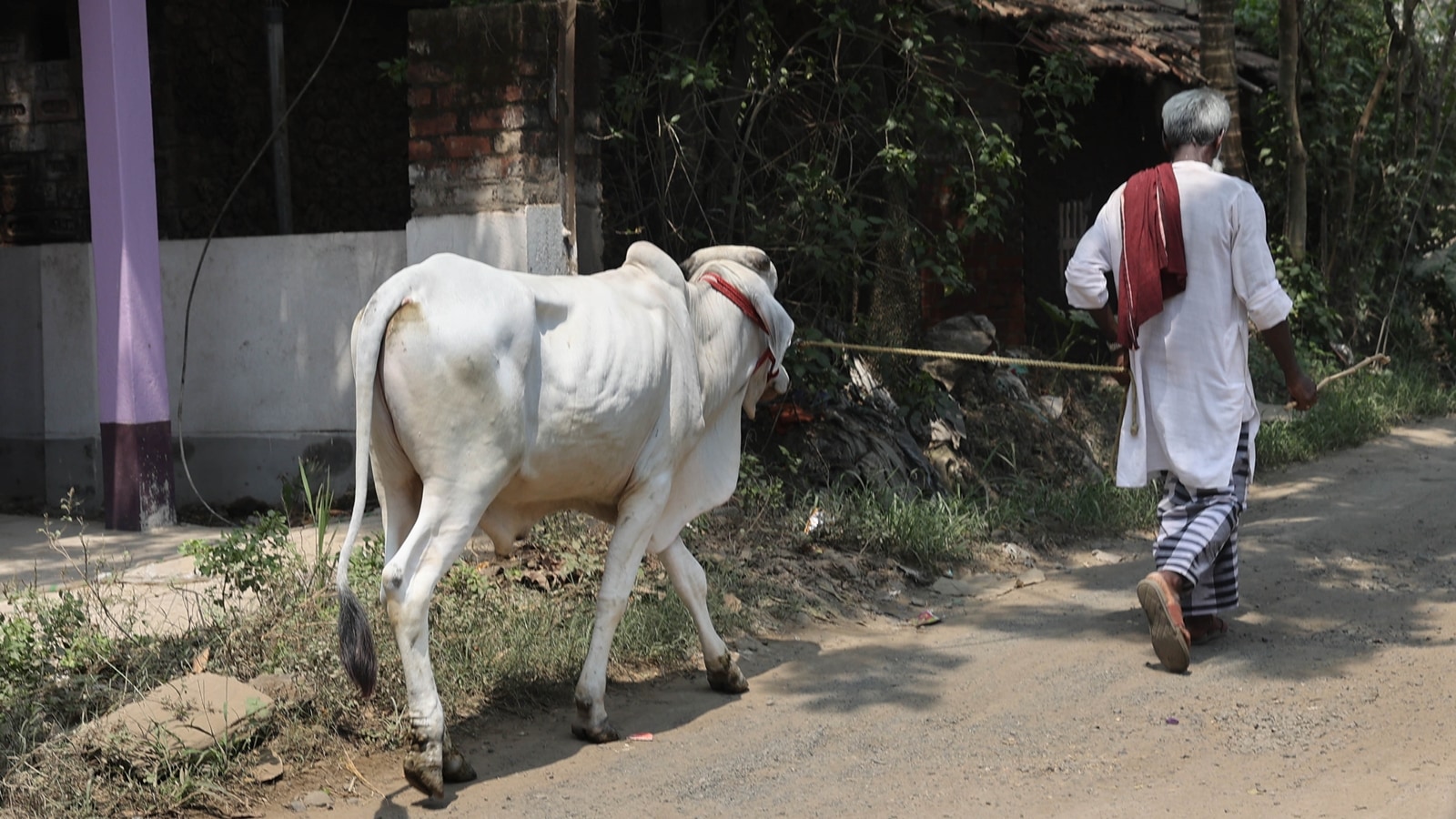 Sadek Molla, 56, resident of Shyamnagar, Bhangar. (Express photo by Partha Paul)
But BJP Rajya Sabha MP Rahul Sinha invoked “greater cause”. He told The Indian Express: “For a greater cause, some people have to tolerate some discomfort. If parents are old, one should not sell them. Therefore, after deep thought and deliberations, an existing law has been implemented as it should have been.”
A hapless Sadhan Ghosh tries to make sense of this. “A cow (of the breed Ghosh owns) gives adequate milk only for up to seven months to a year. Plus, these cows cannot breed. So, I planned to sell nine of the 10 I had bought after borrowing Rs 1 lakh from a bank and Rs 5 lakh from a moneylender… Now I have heard only animals over 14 years old can be sold for slaughter, and with a fitness certificate. How will I know the age of my animal? Where will I get such a fitness certificate?… I don’t know anything.”
His Ghoshpara neighbour, Bhaskar Ghosh, 33, owns 22 cows and hoped to sell 15. “We are goshala owners, we supply milk. And, every year around this time, we sell the cows which do not give enough milk or cannot breed. This has been happening since my grandfather’s time. But this time suddenly, the old 1950 law which I had never heard of has been imposed.”
Bakr-i-Eid is usually the time of high profits for them, with each cow bought for Rs 70,000-80,000, fetching at least Rs 1 lakh, Bhaskar says. His losses may be higher than Sadhan’s as he took a loan of “Rs 7 lakh at 5% interest”. “I have to pay for the fodder too. I am broke. What will we do with these cows? How long can we go on feeding them?”
Aparna Ghosh, 48, says the government should have given some time to cow rearers like them to comply with the norms.
At the Polerhat cow market, which springs up on a small field, Sadek Mollah, 54, a resident of Shyamnagar, is leaving with his cow and a grandchild who had accompanied him. “I have been here since 6 am. Now it is 2 pm,” Sadek says, adding that at this time last year, they would have struggled to even enter the field, with the market spilling out.
Mir Arifin, 30, who came from Bashirhat, 41.7 km away, with five cows, says they have reconciled to seeing no business this year. “No one here has a fitness certificate or can tell you the age of their cow… I expected Rs 40,000 for my cows. I just got one offer today, of Rs 15,000. I did not sell… Last year, every day, around 2,000 cows were sold. Since this morning, only around a dozen have been sold. People are scared.”
Mahibul Islam, a buyer at the market, says the demand is also low due to confusion over slaughter permissions this year. “The government has said qurbani (sacrifice) would be allowed only in designated places, which have not been identified yet, and that one cannot slaughter in public.”
Mahibul hopes to still get a good deal over a cow. If not, he will go for a goat. “Many of my neighbors are turning to goats for qurbani.”
The Calcutta Beef Dealers’ Association points out that the State-owned slaughterhouse in Tangra has been shut for the past two days too, further causing prices to soar. “There is no meat,” says a beef shop owner in Rajabazar on the condition of anonymity.
A member of the beef dealers’ association says they have no idea why the slaughterhouse is shut. “We were not served any notice. Only two animals (both buffaloes) are being slaughtered here every day now, that too to meet the needs of Kolkata Zoo.”
The association is planning to meet Kolkata Mayor Firhad Hakim, of the Trinamool Congress, to plead their case.
The Nakhoda Masjid Imam, Maulana Muhammed Shafiq Qasmi, says what they want above all is clarity. The government could have avoided the distress to both Muslim and Hindu cow traders by speaking to all the stakeholders and putting the infrastructure in place before announcing suddenly that it was imposing the 1950 law, he says.
“Another issue is that while cows are connected to Hindu sentiments, the curbs are also for buffaloes, ox, camel and all other big animals. The government should reconsider this. Everyone will follow the law but the government should make life easy for the people.”
Otherwise, Qasmi adds, they should go the whole distance. “We are law-abiding citizens. We will not do qurbani of cows. In fact, the government should make the cow the national animal and ban their slaughter and even meat export (altogether).”
Before Siddiqui, senior Congress leader Adhir Chowdhury wrote a letter to the CM raising “the unease and confusion” on the issue. In Muslim-dominated places like Murshidabad, Chowdhury said, the district authorities could “identify and demarcate specific locations where people could practise customs associated with the religious faith they profess”.