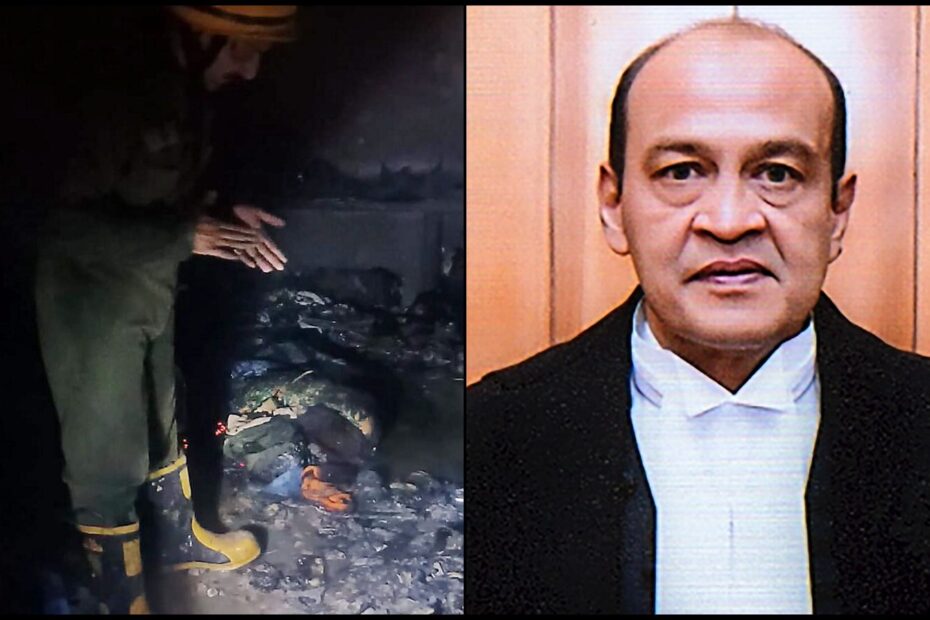
Firefighters responding to a blaze (left) at Justice Yashwant Varma’s (right) residence reportedly found large quantities of burnt currency in a storeroom. (File photo)
A three-member inquiry committee has found that unexplained Rs 500 currency notes were recovered from former High Court judge Justice Yashwant Varma’s official residence in New Delhi and that he failed to provide a satisfactory account of their origin. The Lok Sabha Speaker had constituted the inquiry panel to investigate the ground upon which Justice Varma’s removal was sought.
Tabled in Parliament on Wednesday, the panel’s report confirmed that bundles of cash were discovered in a storeroom at 30, Tughlaq Crescent, New Delhi, following a blaze on the intervening night of March 14 and 15, 2025, when Justice Varma was serving as a judge of the Delhi High Court.
Supreme Court judge Justice Aravind Kumar headed the inquiry committee. It also comprised former Bombay High Court Chief Justice Shree Chandrasekhar and Senior Advocate B V Acharya.
The report noted that Justice Varma “failed to furnish a satisfactory explanation regarding the presence, source or ownership” of the currency notes found inside the official residential premises.
It said that material evidence was neither secured nor preserved, the crime scene was compromised before official inspection, and the subsequent disappearance of the cash remains unexplained. The panel said this finding rests on a failure to preserve evidence and institutional acquiescence rather than proof of direct physical removal by the judge.
The committee noted that Justice Varma’s explanation on March 22, 2025, and the subsequent stand he took “did not exhibit the candour, transparency and institutional responsibility expected in the circumstances”.
“It remained evasive and unsatisfactory when tested against the evidence of independent official witnesses and corroborative material,” the report said.
Story continues below this ad
Also Read | How Justice Yashwant Varma’s resignation stops impeachment probe into ‘burnt cash’ row
The committee highlighted that in a letter to then Chief Justice of India Sanjiv Khanna, who had sought an explanation following the incident, Justice Varma stated that that “he was never aware of any money or cash lying in the outhouse storeroom; that neither he nor any member of his family had knowledge of cash; that no such cash or currency notes had been shown to his family members or staff; that the question of explaining the source did not arise; and that he rejected any insinuation of removal of currency notes from the storeroom”.
However, the panel noted, “He failed to enter the box and say so on oath and did not face cross-examination. Hence, adverse inference has to be drawn against him.”
The report further criticised his conduct during the probe. “Having participated in the proceedings up to completion of evidence in proof of charges and after seeking time to produce evidence on his behalf, (Justice Varma) suddenly decided to withdraw from the proceedings and made it clear that he will not participate in the proceedings any more. Thus, he has failed to co-operate with the committee in its proceedings.”
After the row erupted, on March 20, 2025, the Supreme Court Collegium recommended Justice Varma’s transfer from the Delhi High Court to the Allahabad High Court.
Story continues below this ad
Two days later, the Chief Justice of India constituted an internal in-house inquiry committee to investigate the allegations.
The internal probe substantiated the charges and forwarded its findings to the President and Prime Minister for further action.
Impeachment motions were subsequently introduced in both Houses of Parliament, prompting the Lok Sabha Speaker to set up the inquiry panel under the Judges (Inquiry) Act, 1968.
Justice Varma moved the Supreme Court, challenging the in-house inquiry committee and the constitutionality of the Parliamentary Inquiry Committee. However, the Supreme Court dismissed both petitions, holding that established procedures were strictly followed.