
Officially 46 years old, the BJP was born on April 6, 1980, as the Janata experiment faltered and fragmented. The party started as one largely criticised across the political spectrum — despite the mainstreaming of its predecessor, the Jana Sangh, by the JP movement — and over the past 12 years has established itself as the dominant political force in the country.
The prime charge against the party as it started its political journey was that it was not “secular”. It also had the image of “Bania-Brahmin party”, which indicated its narrow social base. Since then, the party has reshaped the political discourse on both counts.
Advertisement
Secularism
As the BJP’s first president, Atal Bihari Vajpayee tried to counter the charge that the BJP was not secular through a language of moderation, arguing that Gandhian socialism was the party’s creed. However, this was a time when, in the days of Khalistani militancy, Indira Gandhi had also endeared herself to Hindus who took pride in religion, and the BJP suffered heavy electoral losses. Following Indira’s assassination, it was reduced to just two seats in the 1984 elections, and Vajpayee himself lost to Madhavrao Scindia from Gwalior.
Then came the Advani era, when the BJP began to question secularism. The Rajiv Gandhi government’s reversal of the Shah Bano judgment of the Supreme Court through the Parliamentary route made the BJP start questioning the Congress’s secularism. Asserting that the Congress denied justice to a Muslim woman under pressure from maulanas, the BJP reframed Congress’s secularism as minority appeasement.
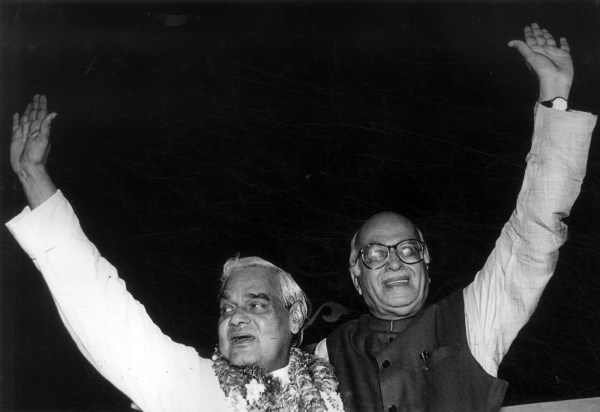 BJP leaders Atal Bihari Vajpayee and LK Advani, waving towards supporters after winning the general election. (Express Archive/Arun Jethe)
In the Palampur resolution of 1989, the BJP officially supported the Ram Temple movement, and its performance across northern, central, and western India improved significantly. This was a step further in the Hindutva direction: from claiming to be genuinely secular rather than pseudo-secular, the party took a distinctive Hindutva turn. The Babri Masjid was demolished on December 6, 1992, and the BJP was almost ostracised by all other parties that had Muslim votes to seek.
Advertisement
By then at the cusp of power but in need of allies, the BJP played the Vajpayee card, making him its face in Parliament. This move was to define the BJP’s politics over the next two decades: soft Hindutva, but with inclusive gestures, and projecting moderates in its leadership. The strategy worked and the party stayed in power for six years from 1998 to 2004.
Between 2004 and 2014, the BJP underwent a transformation as Vajpayee bowed out and Advani unsuccessfully tried to step into his shoes with a more moderate tone. Within years of failing to capture power in 2009 — it held on largely due to Gujarat, Madhya Pradesh, Chhattisgarh, and Bihar — the party veered towards Narendra Modi, its most visible Hindutva face, to reverse its fortunes.
The 2014 sweep showed that, contrary to what Vajpayee had believed, a Hindutva image actually worked for the party, apart from the severe anti-incumbency that the Congress suffered because of the 2G spectrum and the coal block allocation allegations.
Also Read | 47 years of BJP: ‘Our party is guided by principle of India first’, says PM Modi
Social justice
Modi’s rise was also the moment the BJP successfully shed its “Bania-Brahmin” image.
Much of the scholarship failed to read what the BJP had been doing for decades. The fallacy arose from the belief that Mandal politics was a counter to the rise of the BJP, largely because the party had been defeated in UP in 1993, a year after the Babri demolition, by the “Dalit-Bahujan” alliance of the Samajwadi Party and the Bahujan Samaj Party.
In reality, the rise of social justice politics was connected with the decline of the Congress and the gradual rise of the BJP. The coming together of the socialists and the Jana Sangh in the 1960s on the plank of anti-Congressism paved the way for the rise of the OBCs. When the Congress lost power in many states in 1967 — its first big electoral shock — the Jana Sangh and the socialists were part of the unstable Samyukta Vidhayak Dal governments in northern India and Karpoori Thakur became the Deputy CM of Bihar.
In the 1970s, the JP movement against Indira also saw the Jana Sangh and the socialists as co-travellers. The 1977 Janata government reflected this social coalition and the Mandal Commission was constituted by the Morarji Desai government, of which leaders of the Jana Sangh were part.
Thus, the Jana Sangh and BJP had begun social engineering way before the 1990s, which saw the party actively promote social justice politics and OBC leaders such as Uma Bharti, Kalyan Singh, Vinay Katiyar, Shivraj Singh Chouhan, Sushil Modi, and Narendra Modi.
By the time of Modi’s rise at the Centre, the BJP’s social engineering drive intensified, with the party placing OBCs, Dalits and tribals in key positions in government. By this time, in UP and Bihar, many OBC and EBC communities had begun to dislike the Yadav leadership among OBCs, and they veered towards the BJP in large numbers. The BJP, which could afford not to field a single Muslim and had a surplus of seats to spare, obliged.
The rise of the BJP has unsettled not just many beliefs among India’s intellectuals but has also unsettled intellectuals themselves as a class, as people in large numbers have begun to distrust people they call “Left-liberal”, a class that provided intellectual leadership till a decade ago.
While Hindutva still retains its sway as an idea, the now-stayed UGC regulation on caste discrimination has brought some confusion among sections of the “upper castes” regarding the party’s intent. However, with the Opposition trying to regain its foothold among Dalits, OBCs, and tribals in recent years and accusing the BJP of being against their interests, the ruling party has had to walk the extra mile to retain its edge among these sections.