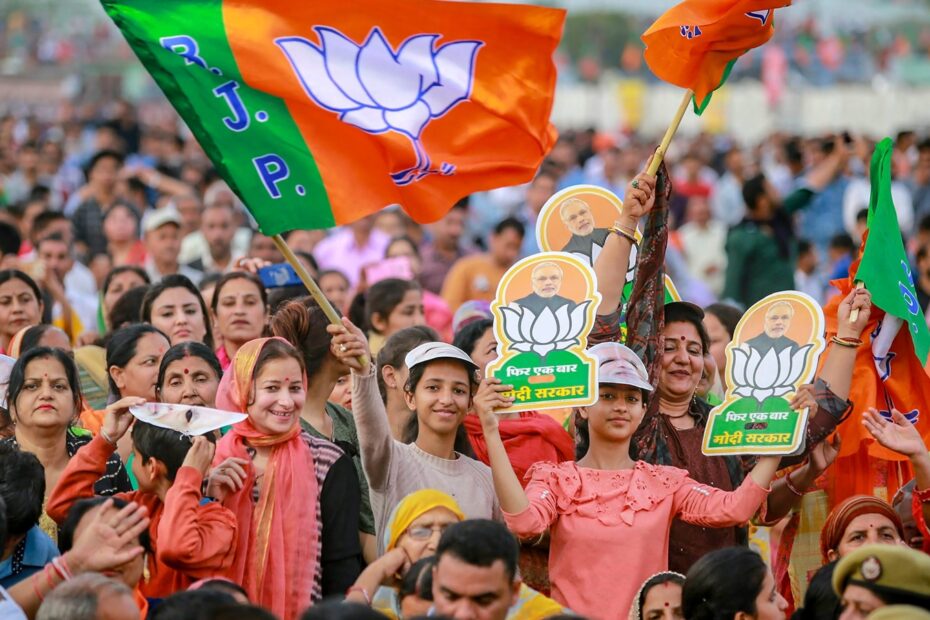
With the 2027 Uttar Pradesh Assembly elections still months away, the battle for women’s votes is heating up. Amid reports that the BJP government is considering a cash benefit scheme for women from families that fall below the poverty line, Samajwadi Party (SP) chief Akhilesh Yadav has sought to raise the stakes, announcing an annual benefit of Rs 40,000 for women if the SP returns to power.
The competing moves point to an emerging political calculation in Uttar Pradesh: women, who constitute nearly half of the state’s electorate, are increasingly being treated not merely as beneficiaries of welfare schemes but as a distinct electoral constituency.
Advertisement
According to the final electoral roll published on April 10, Uttar Pradesh has 13.39 crore registered voters, including 6.09 crore women. Women account for 45.46% of the electorate, compared with 54.54% men.
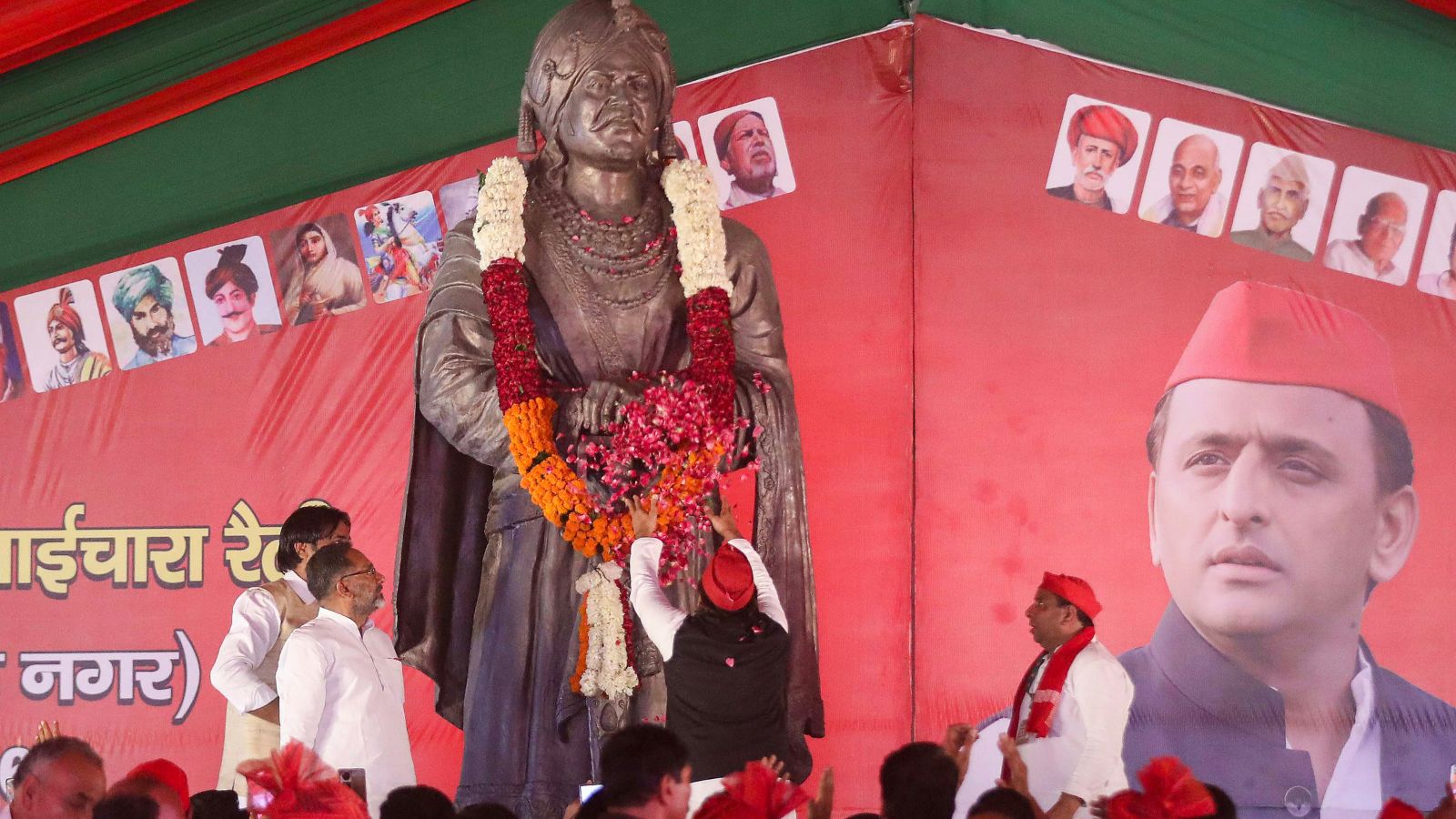 Samajwadi Party (SP) chief Akhilesh Yadav pays floral tribute to a statue of Emperor Mihir Bhoj during a rally, in Dadri, Uttar Pradesh. (PTI)
This makes women an even more consequential constituency for the 2027 contest as even a slight shift in voting preferences can have an impact across the state’s 403 Assembly constituencies.
Read | Why Congress wants early seat-sharing talks with Samajwadi Party in UP
While the BJP is trying to build a political narrative around welfare delivery, particularly schemes that reach households directly, a cash transfer targeted at women from poorer families would fit into that broader politics of direct benefits while giving the government a fresh pre-poll measure to take to voters.
Advertisement
But reports of the proposed scheme have also given Akhilesh an opportunity to challenge the BJP on the quantum of assistance.
Read | Brij Bhushan’s comeback in BJP has the key hurdle removed
In a post on X, Yadav described the reported Rs 20,000 proposal as another “jumla” and said the BJP had little left except money to seek votes. He argued that the government could have provided such assistance earlier instead of spending large sums on publicity.
Akhilesh then announced that an SP government would provide Rs 40,000 per woman every year, with the amount increasing annually.
The significance of the announcement lies as much in its timing as in the amount. Rather than waiting for the BJP to formally announce a scheme and then respond to it, the SP has attempted to establish its own benchmark for what women should expect from the next government.
This puts the BJP in a politically tricky position: if it announces a lower amount, the SP can portray it as inadequate; if it raises the amount, the election risks becoming a competition over welfare commitments.
Read | After Bihar setback, will upper-caste discontent hurt BJP in Uttar Pradesh?
The SP chief, with the announcement, is also seeking to argue that the issue should not simply be whether the government gives women something, but how much, on what terms and with what degree of continuity.
What other states are doing
The strategy of cash benefits is not unique to Uttar Pradesh. In recent Assembly elections, political parties across states have increasingly used direct cash transfers to women as an electoral proposition. In Karnataka, the Congress promised Rs 2,000 a month to women heads of households under the Gruha Lakshmi scheme ahead of the 2023 Assembly election.
In Maharashtra, the Mahayuti government’s Mukhyamantri Majhi Ladki Bahin Yojana, which provides Rs 1,500 a month to eligible women, became a central plank of the 2024 Assembly election campaign. In West Bengal, the Trinamool Congress (TMC) government increased the Lakshmir Bhandar payout by Rs 500 a month from February 2026, just ahead of the Assembly election.
However, implementing the schemes has proven to be difficult. In Karnataka, the Gruha Lakshmi faced registration and technical problems soon after its launch, with beneficiaries reporting difficulties involving ration cards, Aadhaar linkage and bank accounts. Later, payment delays were reported in several districts.
In Maharashtra, the Ladki Bahin scheme has faced a different set of implementation hurdles. Mandatory e-KYC and Aadhaar-bank account verification have resulted in delays for some eligible beneficiaries, with officials citing data mismatches, incorrect submissions and technical problems.
Lessons from 2022 polls
In the 2022 Assembly elections, 559 women contested. The Congress fielded 155 women candidates, BJP 45, BSP 38 and SP around 42. Only 47 of them won. The Congress had one winner and SP 12, while the remaining winners were from the BJP and its allies.
The Congress had made a strong pitch around women’s representation in 2022 with AICC general secretary Priyanka Gandhi Vadra’s “ladki hun, ladh sakti hu (I am a woman and I can fight)” but its electoral dividends were low. The BJP, meanwhile, fielded fewer women candidates but emerged as the principal beneficiary among the winning women candidates.
For the SP, the lesson is particularly relevant. The party now appears to be approaching women less the question of representation alone and more through a direct economic proposition, drawing on the broader politics of welfare and cash transfers that has gained ground in several states.
The political calculation is that a benefit credited directly to a woman’s account may create a more immediate connection between the beneficiary and the government than a broader household welfare programme.