Will Californians ever catch a break?
Although rents in the L.A. metro area dropped to a four-year low in December, the median rent is still over $2,000.
And for those hoping to become homeowners, good luck with that. Four California cities ranked among the world’s least affordable cities for home buyers when comparing property costs to local incomes.
Add rising auto insurance rates to the mix, and it makes for a trifecta sure to enrage residents of the Golden State.
A California driver who paid the state’s average premium of $1,087 in 2022 could be paying hundreds more today for auto insurance, my colleague Laurence Darmiento reports.
And that’s only for drivers who have avoided accidents and tickets — which can drive premiums even higher.
The top 10 insurers in the state won approval last year to raise premiums an average of 6% — on top of a 15.4% hike in 2024 and a 13% jump in 2023, according to Standard & Poor’s Capital IQ.
Add it all up and rates by insurers that write about 85% of all California auto insurance policies climbed more than one-third from 2023 to 2025.
Here’s more on why rates are surging in the state, plus some good news after the premium increases.
Several forces are driving the higher rates. They include sharply rising prices for new cars and auto parts, which is being driven by inflation and exacerbated by President Trump’s tariffs, as well as collisions that are more severe, which is influenced by factors including increasing speeds on highways and heavier vehicles.
All-wheel drive — a popular feature on already heavy SUVs that adds hundreds of pounds to a vehicle’s curb weight — now accounts for 60% of all vehicle sales, Laurence writes.
Also, fast-accelerating electric vehicles are heavier than their gas-powered counterparts due to their batteries.
It didn’t help that during the pandemic emergency drivers sped on open roads, ushering in an era of higher speeds.
“These are things which are fundamentally changing the equation of force in crashes. More crash force equals higher repair costs,” said Matt Moore, chief insurance operations officer at the Insurance Institute for Highway Safety.
The average cost of collision repair rose to $4,774 last year, well above the $3,225 cost in 2019, according to a recent analysis.
Despite California’s long and tortured history with auto insurance, rates in the state remain below the national average.
That’s because of Proposition 103, which voters passed in 1988 in response to skyrocketing premiums. It established an elected insurance commissioner with the authority to reduce or deny insurer requests for rate hikes. It also allows consumer groups to challenge higher rates.
A 2019 study by the Consumer Federation of America found that, from 1989 to 2015, California auto insurance rates rose by only 12.5% compared with a nationwide average of 61.1%, saving residents $154 billion.
More recent nationwide data calculated by industry trade publication Auto Insurance Report found that, in 2023, Californians spent an average of $1,223 on car insurance, about $60 below the the national average.
And although some California insurers are still seeking rate hikes, Geico has held them steady this year and State Farm Mutual Automobile Insurance Co., California’s largest vehicle insurer, filed for a 6.2% rate decrease.
State Farm also announced recently that it would be returning $5 billion to customers nationwide, or about $100 per policyholder.
It cited improved underwriting results, including less frequent accidents and lower repair costs, indicating the spike in those costs might be leveling off.
Here’s more on the state’s surging insurance rates.

A proposed ballot measure to require voters to show government identification may be on the state ballot in November. Above, voters at a Union Station site in L.A. in 2020.
(Irfan Khan / Los Angeles Times)
- California’s voter identification initiative would require voters to present a government-issued ID at polls and provide ID numbers on mail-in ballots.
- The measure also would require election officials to verify the citizenship of every voter.
- Supporters say it would protect election integrity, but opponents contend it’s unnecessary and would disenfranchise communities of color, elderly voters and those with disabilities.
- At least three U.S. service members are among the hundreds confirmed dead in a widening war across the Middle East, set off by a string of U.S. and Israeli attacks on Iran this weekend that killed Supreme Leader Ayatollah Ali Khamenei.
- President Trump says the U.S. attacked Iran because the Iranian regime posed “imminent threats” to the U.S. and its allies. But some in Congress are pushing back on what is being called “a war of choice with no strategic endgame.”
- Several flights were canceled Sunday out of LAX after Middle East countries closed their airspace amid the Iran conflict.
- In L.A. and in Cooperstown, Freddie Freeman will forever be a Dodger, not a Brave, writes columnist Bill Shaikin.
- Gov. Gavin Newsom is a lot more complicated than you think, argues columnist Robin Abcarian.
- Jane Fonda and Tucker Carlson agree on this: Trump’s Iran war is bad — and a betrayal — writes news and culture critic Lorraine Ali.
- With the midterm vote starting, here’s where things stand in the national redistricting fight, columnist Mark Z. Barabak writes.

A poppy glows in candlelight at the Flower Hour event.
(Jennifer McCord / For The Times)
- Wellness workshop: Smoke a joint and get deep with flowers at this guided floral design workshop in downtown L.A.
- Restaurants: The best places to eat and drink in L.A. this month include an Argentinian bistro with a connection to Bad Bunny’s Super Bowl performance.
- Theater: Here’s how a tiny L.A. theater company is taking community theater to the next level by developing and performing three one-act plays per month.
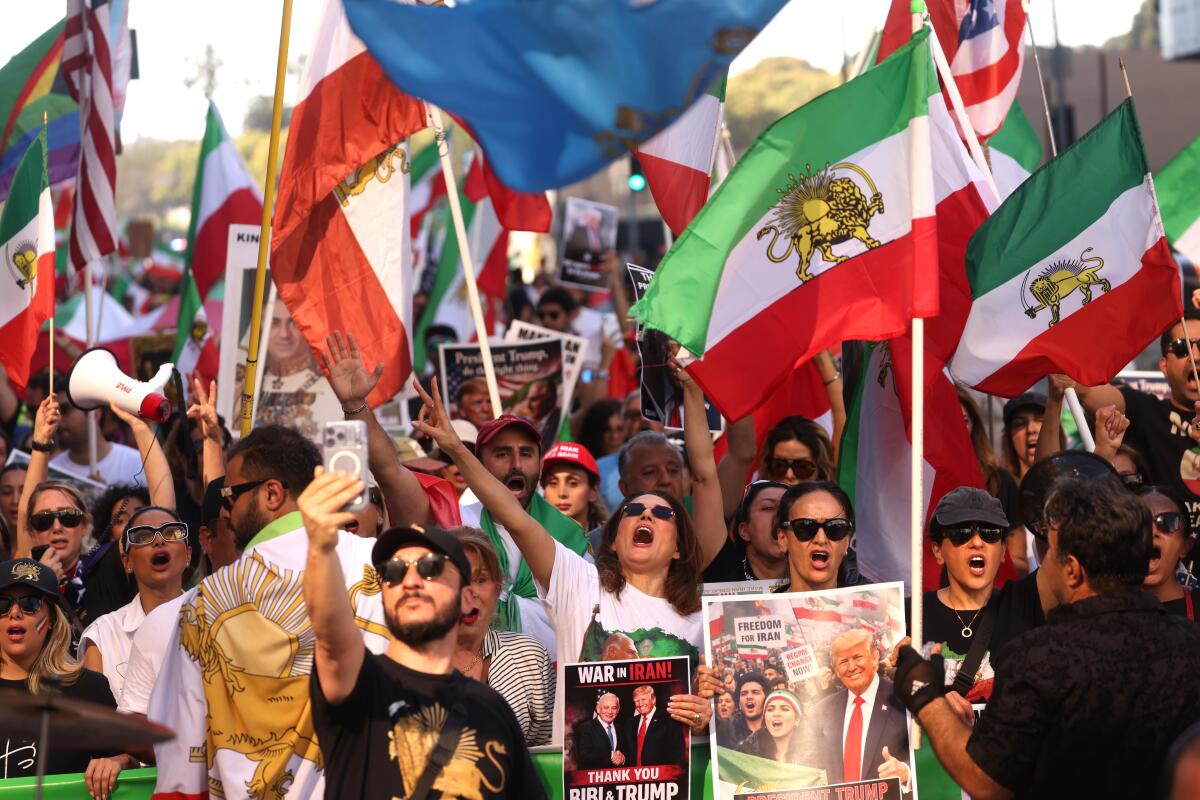
(Genaro Molina / Los Angeles Times)
Today’s photo is from Times photographer Genaro Molina during a rally Saturday in Westwood, where hundreds marched through the streets after the death of Iranian Supreme Leader Ayatollah Ali Khamanei. On Sunday, an even larger group of demonstrators rallied.
Jim Rainey, staff reporter
Hugo Martín, assistant editor, Fast Break desk
Kevinisha Walker, multiplatform editor
Andrew Campa, weekend writer
Karim Doumar, head of newsletters
How can we make this newsletter more useful? Send comments to essentialcalifornia@latimes.com. Check our top stories, topics and the latest articles on latimes.com.