Executive Summary Introduction 1. This report is the endline evaluation of the 4th Cycle of the United States Department of Agriculture (USDA) McGovern-Dole International Food for Education and Child Nutrition Program (the FY 20 McGovern Dole project), covering all activities of the project. This evaluation includes all six districts, including the three (Doti, Jajarkot and Achham) that were gradually transitioned to the government from FY 2022/23. The evaluation is commissioned by WFP Nepal Country Office and is conducted from August 2024 (start month) to April 2025. 2. The FY 20 McGovern Dole project aims to achieve three key results: improved literacy of school-age children, increased use of health, nutrition and dietary practices, and improved effectiveness of food assistance through local and regional procurement (LRP). The project’s duration is four years, from 1 November 2020 to 30 September 2024, with a no cost extension granted until September 2025. 3. USDA, which has a long history of supporting Nepal’s efforts to promote food security and enhance opportunities for education, is the largest global donor to school feeding efforts. It provides U.S. agricultural commodities, funding, and technical assistance to reduce hunger, support nutrition, and improve literacy and primary education, especially for girls, worldwide. Nepal has received USDA assistance since FY 2011. The World Food Programme (WFP) began to support the midday program in selected basic schools in Nepal in 1974 and has thereafter continuously worked in this sector, with the Government scaling-up its investment in 2020/21. Improving the quality of education standards and educational outcomes in community schools has remained high on Nepal’s development agenda. Having acknowledged the contribution of the midday meal in improving educational outcomes, the previous School Sector Development Plan, 2016/17-2022/23 (SSDP) included the school health and nutrition program with midday meals to support student learning and retention in schools. The School Education Sector Plan, 2022/23-2031/32 which follows the SSDP further envisaged to strengthen the midday meal program. In 2023/24, the government allocated USD 87 million to the national Mid-day Meal programme budget, about 6% of the nation’s education budget. After teacher’s salaries, the school meal budget is the second largest allocation in the education. 4. The midday meal program, a cash-based model, is one of Nepal’s most extensive educational sector programs implemented by the Ministry of Education, Science and Technology (hereafter Ministry of Education). In 2022/23, the midday meal program reached 3.313 million school children, from pre-primary to grade 5, in community schools nationwide. Of these the FY 20 project targeted 246,755, which were to be gradually reduced based on the transition plan.1 5. The purpose of the evaluation is to provide an evidence-based, independent assessment of the performance of the Mc Read More
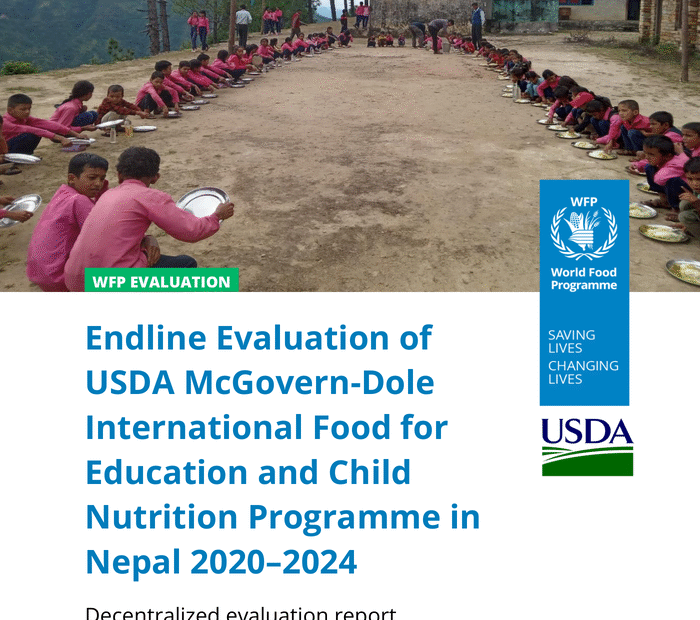
Nepal, Endline Evaluation of USDA McGovern-Dole International Food for Education and Child Nutrition Programme 2020-2024 | World Food Programme
- by stefan