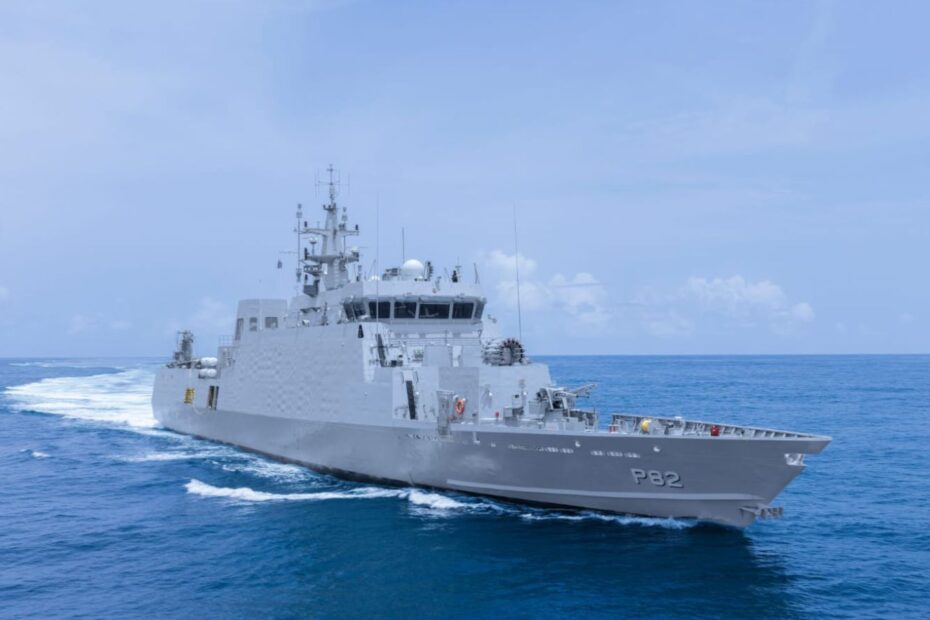
INS Mangrol, the third vessel in the Mahe-class Anti-Submarine Warfare Shallow Water Craft (ASW-SWC) series, was commissioned at the Naval Dockyard in Mumbai Monday, strengthening the Indian Navy’s ability to detect and counter enemy submarines in shallow coastal waters.
Designed to operate in shallow and confined waters where larger warships may face limitations, the indigenously built vessel will help protect ports, harbours, and coastal approaches against underwater threats.
Built by Cochin Shipyard Limited (CSL), Kochi, INS Mangrol is equipped with advanced sonar, lightweight torpedoes and other anti-submarine systems that enable it to detect, track, and counter hostile submarines. With more than 80 per cent indigenous content, the vessel also reflects the Navy’s push to strengthen domestic capabilities in warship construction and defence technology.
Also Read | ‘Tech delayed is tech denied’: IAF Chief says Air Force can learn from Navy’s approach to self-reliance
Vice Admiral Sanjay Vatsayan, Flag Officer Commanding-in-Chief of the Western Naval Command, commissioned the ship.
During the commissioning ceremony, Vice Admiral Vatsayan said the Navy had commissioned 10 ships in 2026, with another eight expected to enter service by the end of the year.
“Our fleet currently comprises 151 platforms, including 131 ships and 20 submarines,” he said.
“We currently have 42 ships under construction at Indian shipyards, while Acceptance of Necessity (AoN) has been accorded for another 69 ships, six submarines and 120 Fast Interceptor Craft. With these additions, our fleet is projected to grow to more than 170 platforms over the next few years, with a new ship being commissioned every 40 to 50 days. By 2034, approximately 60 per cent of our platforms are expected to be less than 10 years old on average,” Vatsayan said.
Advanced sonar, torpedoes for underwater threats
Story continues below this ad
The induction of the Mahe-class vessels is part of the Navy’s efforts to bolster its coastal anti-submarine warfare capabilities and replace the ageing Abhay-class corvettes, which entered service between 1989 and 1991.
Their shallow-water design is intended to address the specific challenges of detecting and responding to submarines operating close to the coast, including around strategically important ports and maritime infrastructure.
Also Read | Future wars can’t be fought by individual services: Air Chief at INS Malvan ceremony
INS Mangrol is equipped with the Abhay hull-mounted sonar, lightweight torpedoes, an indigenous anti-submarine rocket launcher and the Mareech Advanced Torpedo Decoy System. Together, these systems help the ship detect and track underwater threats, engage hostile submarines, and deploy countermeasures against incoming torpedoes.
Powered by three diesel engines and fitted with waterjet propulsion, the ship has high manoeuvrability, making it suitable for operations in shallow and confined waters. Beyond anti-submarine warfare, it can conduct underwater surveillance, low-intensity maritime operations, and mine warfare tasks.
Story continues below this ad
It can also work alongside maritime patrol aircraft, helicopters and other naval vessels to strengthen surveillance and anti-submarine operations.
From 2013 approval to commissioning
INS Mangrol has been built under the Centre’s Make in India and Aatmanirbhar Bharat initiatives. Its induction is part of a broader effort to increase the share of indigenously designed and manufactured platforms in the Navy’s fleet.
The programme for shallow-water anti-submarine vessels dates back to 2013, when the Defence Acquisition Council, the Ministry of Defence’s principal procurement body, approved the acquisition of 16 such vessels.
Also Read | ‘Wagh Nakh’ on its crest, how submarine-hunter INS Malvan will help the Navy shield India’s coast
Following the tender process, CSL and Garden Reach Shipbuilders and Engineers emerged as the lowest and second-lowest bidders, respectively, in October 2017. CSL quoted Rs 5,400 crore for the project, with GRSE required to match the bid to secure the contract.
Story continues below this ad
The first vessel in the series, INS Mahe, was commissioned at the Naval Dockyard in Mumbai on November 24, 2025. The second, INS Malvan, was commissioned at Karwar Naval Base on July 22, 2026. INS Mangrol was delivered to the Navy on March 31, 2026, ahead of its commissioning.
Named after the coastal town and fishing harbour of Mangrol in Gujarat’s Junagadh district, the warship also carries forward the legacy of the earlier INS Mangrol (M85), a minesweeper that served the Navy until April 7, 2004. The naming follows the Navy’s tradition of preserving the legacy of its former warships.