Uttar Pradesh goes to the polls within months, 12 years after a BJP surge that seemed to dwindle a bit in the 2024 Lok Sabha polls. The party’s challenge amid signs of discontent among the youth and also sections of the “upper castes” will be to pull it off yet another time.
However, the challenge before it lies in the stats: while the BJP did very well in the state from 2014 to 2022, its performance gradually declined in successive elections. It will hope to reverse the 2024 dip, when the Samajwadi Party (SP) got the better of it, winning 37 seats against the BJP’s 33.
Advertisement
Here’s how the BJP reversed its fortunes in the country’s most populous state in 2014, but has shown signs of a slight decline in recent years.
2014 Lok Sabha elections
These elections saw the Narendra Modi wave sweep the state and give the BJP its first simple majority in the Lok Sabha.
The BJP — powered by a Modi wave representing muscular nationalism, Hindutva and significant support from non-Yadav OBCs and Dalits — routed the Samajwadi (SP) and the BSP. The BJP won 71 out of 80 seats in the state, its ally Apna Dal won two, the SP five, and the Congress two. The BSP drew a blank, something that set off a decline in its fortunes that has still not been reversed.
Advertisement
The BJP secured 42.63% of the votes in 2014. This was a big jump from the 2009 Lok Sabha polls, in which the BJP won just 10 of the 71 seats it contested, securing a 17.5% vote share. In the 2012 Assembly elections too, the BJP had won 47 out of the 398 seats it contested, securing just 15% of the votes cast.
Must Read | UP polls to youth unrest: Why BJP is treading with caution over delimitation
In 2014, the BJP swept almost the entire state, barring the Yadav belt of Firozabad, Mainpuri and Kannauj, the Muslim-Yadav-heavy Azamgarh, and Badaun.
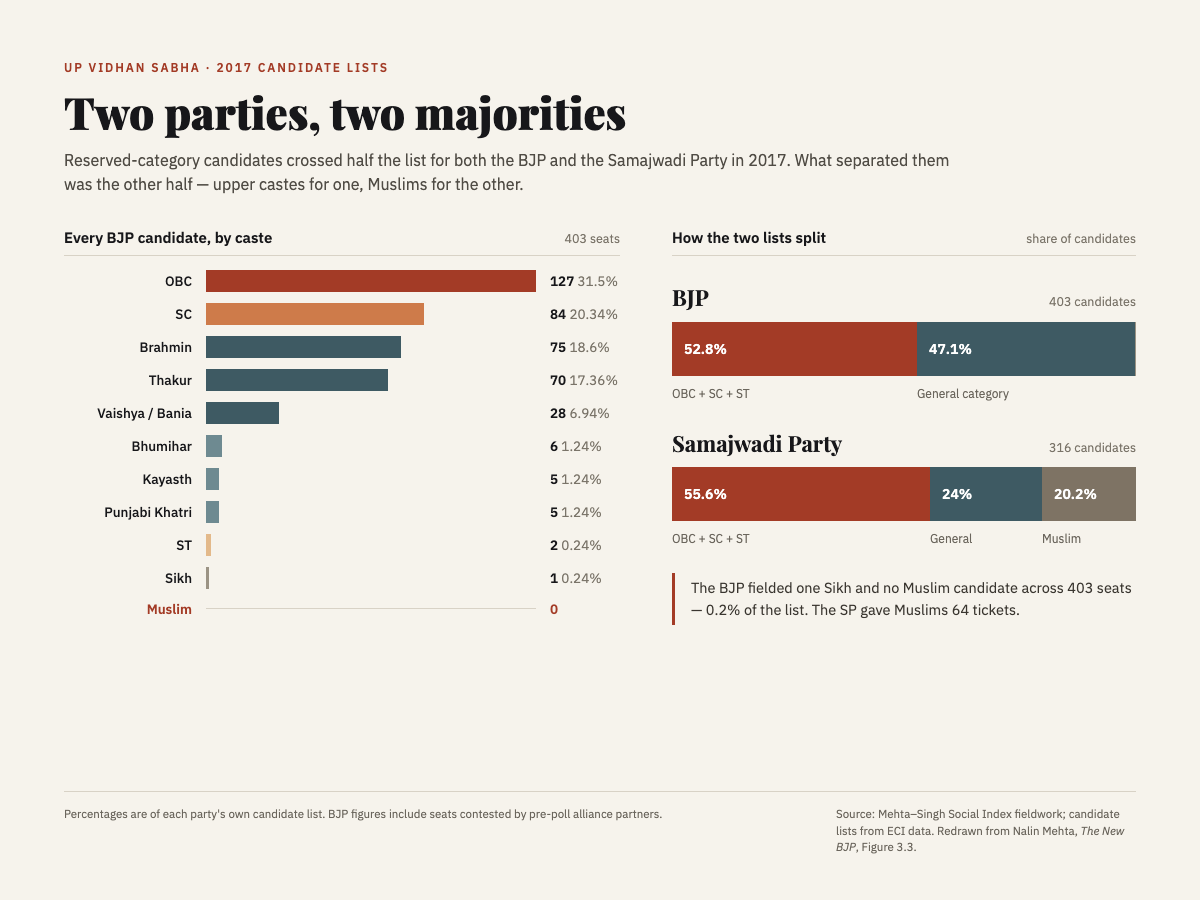
In his book The New BJP, journalist Nalin Mehta writes that the party fielded only 15 OBC candidates in the 2009 Lok Sabha election in UP but increased it to 26 OBC candidates in 2014. Just two of these were Yadavs, illustrating a conscious shift towards non-Yadavs in order to break the SP’s OBC base. This was done without affecting the “upper castes”, as the party also fielded 18 Brahmins and 13 Thakurs. The BJP’s sweep thus signified a clear OBC shift towards the party, also assisted by the alliance with Apna Dal.
2017 Assembly polls
The BJP’s dominance continued in the 2017 Assembly polls despite demonetisation. Critics also said the move harmed parties such as the BSP, as it deprived them of cash to spend on polls.
The BJP won 312 of the 384 seats it contested in the 403-seat Assembly, securing 40.54% of the votes cast. Routed in 2014, the SP showed a somewhat improved performance, winning 47 seats and securing 22.3% of the votes, the same as in 2014. It wasn’t, however, able to transcend its Muslim-Yadav base. The BSP secured only 19 seats, continuing on its downward curve.
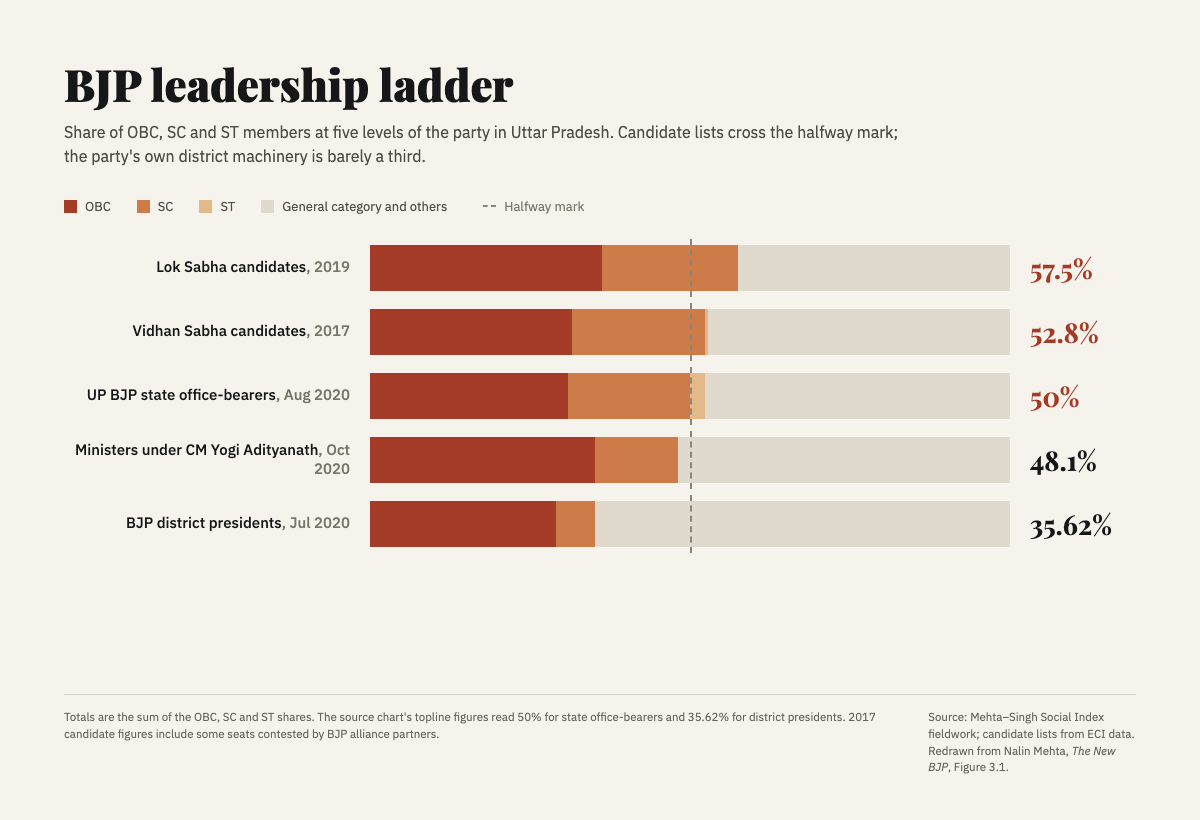
The BJP fielded 127 OBC candidates in the election, showing a continued outreach to the group. The SP fielded 100 OBCs, mainly Yadavs, writes Mehta. The percentage of OBCs and Scheduled Castes in the BJP’s candidate list was 52.8%. It made this shift without harming the “upper castes”, as it fielded 75 Brahmins and 70 Thakurs. The reason: it could afford not to field Muslims.
Its alliances with the Apna Dal (Sonelal), with a Kurmi base, and the Suheldev Bharatiya Samaj Party (SBSP), with a Rajbhar base, were also a clincher for the BJP.
Also Read | UP’s 25-crore population is an advantage, not a challenge: CM Yogi Adityanath
2019 Lok Sabha polls
These polls marked the high point of the BJP’s UP dominance, though its seats declined because the SP, the BSP, and the Rashtriya Lok Dal (RLD) came together in an attempt to stitch a grand OBC-SC-Muslim alliance.
In what marked a remarkable convergence of votes across the Hindu social spectrum, the BJP won 62 seats out of the 78 it contested despite the grand alliance against it, registering almost 50% vote share. That the Jats had deserted the RLD became clear as it could not open its account in western UP. The BSP won 10 seats and the SP five, making many say that while the SP’s votes got transferred to the BSP, the opposite did not happen convincingly. One reason could be the wariness of Dalits towards the SP, as the latter’s 2012 victory in the state was immediately followed by attacks on Dalits.
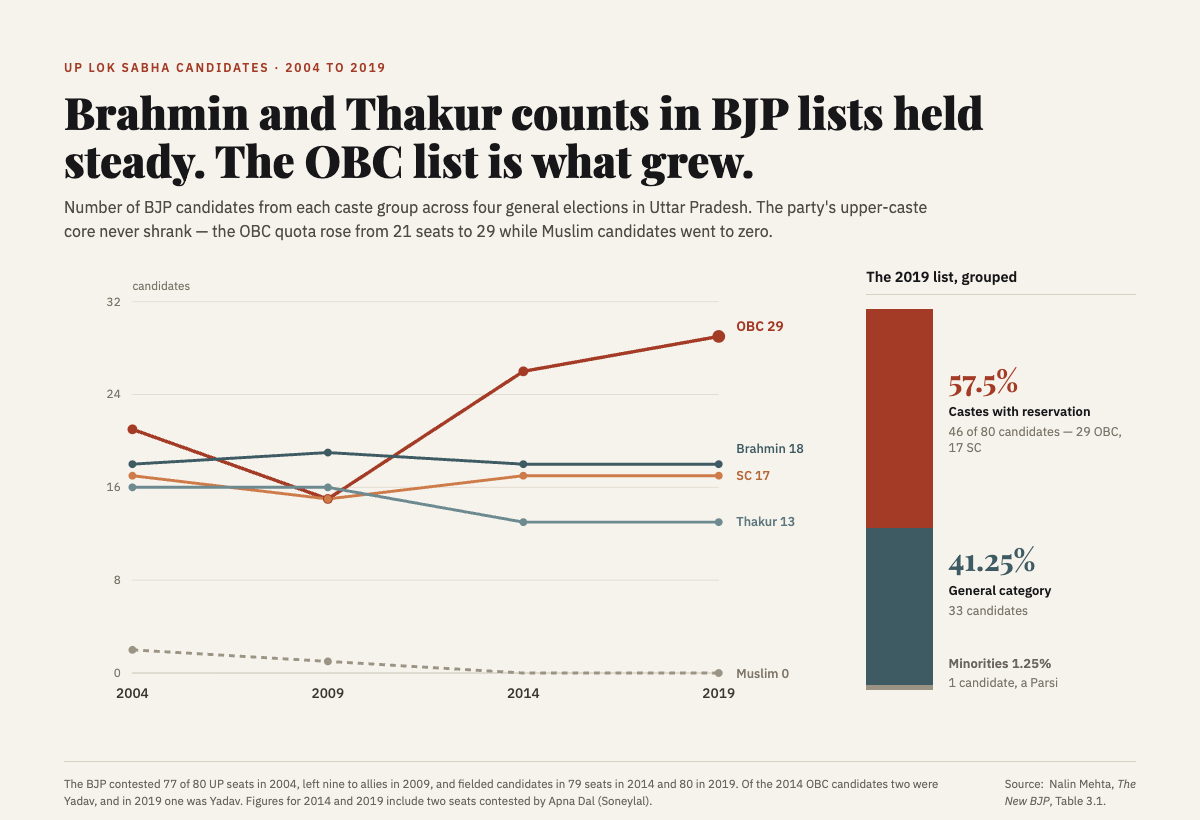
Mehta shows that OBCs and SCs accounted for 57.5% of the BJP’s candidates, something that effectively punctured the attempted OBC-SC-Muslim coalition of the grand alliance. The vote was a Hindutva-plus-social-justice vote, as there were indications of a counter-polarisation among Hindus across castes that helped the BJP. The aerial strikes against Pakistan also added muscular nationalism to the mix.
The BJP’s alliance with the Apna Dal (Sonelal) and the NISHAD Party helped further expand its social reach.
2022 Assembly polls
In 2022, the BJP’s tally took a hit though it retained enough firepower to win a reduced majority. But the SP’s red zones emerged in many parts of the state’s map in eastern, central, and north-west UP.
The BJP won 255 seats and the SP went up to 111, regaining lost ground. The BJP scored a 42.2% vote share and the SP 32.76%. But the BSP came down to a lone seat: Rasra in eastern UP.
Apart from a general anti-incumbency, the election was less one-sided because Akhilesh Yadav increased the representation of non-Yadav OBCs. Yadav also formed an umbrella alliance with Om Prakash Rajbhar’s SBSP, along with other OBC-based parties such as RLD, Apna Dal (Kamerwadi), Janwadi Party (Socialist), and Mahan Dal. The SP managed to bring on board prominent OBC leaders from the BJP, including Swami Prasad Maurya, Dara Singh Chauhan, and Dharam Singh Saini.
The combined vote share of the SP-led umbrella alliance rose to 36.4%, 7.5 percentage points lower than the NDA’s vote share.
2024 Lok Sabha polls
These elections gave the BJP a jolt in UP, despite the momentum generated by the construction of the Ram Temple in Ayodhya. The Opposition made a pointed attack on the BJP, saying it wanted 400-plus seats across the country to change the Constitution and do away with reservation. Many BJP leaders interpreted the party’s fall to 33 seats in the state as a result of sections of the OBCs and Dalits abandoning it. There were also signs of some unease among Thakurs over ticket distribution in west UP and Brahmins over the purported indifference to their concerns in east UP. The BJP’s vote share came down to 41.67%, an 8 percentage point dip from 2019.
Following his Pichhda-Dalit-Alpsankhyak (PDA) outreach, Akhilesh Yadav fielded just five Yadavs — all from his family — and 27 non-Yadav OBCs. The BJP fielded 24 non-Yadav OBCs and one Yadav. Akhilesh gave as many as nine tickets to Kurmis.
He made a Dalit outreach by fielding two more Dalits than the number of reserved SC constituencies. He also fielded 11 “upper caste” candidates, including four Brahmins, thus trying a wide social spectrum. The experiment clicked and the SP with 37 MPs edged past the BJP in the state.
It remains to be seen if the SP can build on its gains, or if the BJP has the firepower to win the state again.