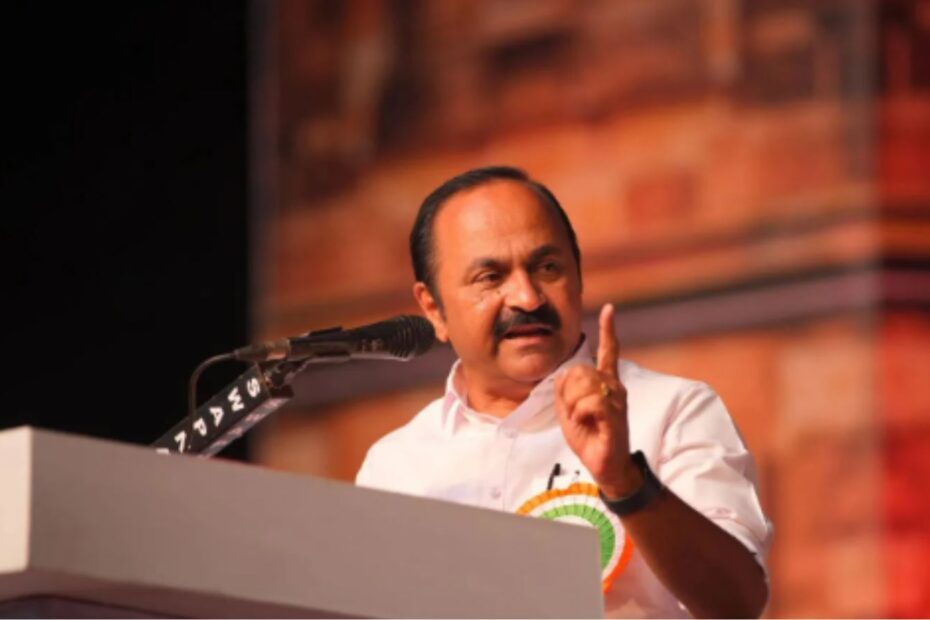
In what could put the BJP in Kerala on the backfoot and seemingly complicate its carefully cultivated Christian vote base, Kerala Chief Minister V D Satheesan recently promised to examine Dalit Christians’ demand for reservation.
Speaking at a function marking the 163rd birth anniversary of social reformer Ayyankali on Friday, Satheesan said Dalit Christians were denied the benefits and reservation available to both Christians and Scheduled Castes (SCs). His government, he said, would study the issue and find ways to address the community’s backwardness.
Advertisement
The statement drew a sharp response from the BJP’s SC Morcha with its state president, Shajumon Vattekkad, demanding Satheesan withdraw his remarks.
“The CM is playing the politics of appeasement. If his move is to take away the reservation meant for the SC community and extend the benefit to Dalit Christians, he should realise that he is playing with fire,” Vattekkad said, adding that the quota granted to the SC community by the Constitution was “not charity but their right”. He said the BJP SC Morcha would mobilise the SC community and launch an agitation against the government.
BJP state vice-president K S Radhakrishnan also questioned the rationale for extending SC reservation to Dalit Christians. In a Facebook post on Tuesday, he argued that if conversion removed caste identity and caste oppression, there was no basis for claiming SC status. If caste discrimination persisted among Christians, he said, the Christian community should first acknowledge and address it.
Advertisement
Hindu Aikya Vedi state president R V Babu also opposed any move to extend SC reservation to converted Christians, alleging that the government was “supporting religious conversion”. The Vedi is an umbrella organisation of several Sangh Parivar outfits in Kerala.
The issue comes against the backdrop of tensions within the BJP and Sangh Parivar over the party’s efforts to woo Kerala’s Christian voters.
A contentious issue for BJP’s Christian outreach
The demand for SC status for Dalit Christians is a long-standing one, particularly among sections of the Christian community and the Catholic Church in Kerala. Dalit Christians are largely descendants of historically marginalised Hindu communities that converted to Christianity.
Under the Constitution (Scheduled Castes) Order, 1950, SC status is restricted to members of Hindu, Sikh and Buddhist communities. Successive governments have considered demands to extend SC status to Dalits who converted to Christianity or Islam.
For the BJP, the issue poses a political dilemma. The party has in recent years stepped up its outreach to Kerala’s Christian community, seeking to expand its electoral base beyond its traditional Hindu support.
The issue of conversion had been a major hurdle in the BJP’s outreach to the community. It went to the back burner after a section of the BJP state leadership argued that Christian population in Kerala is on the decline and hence religious conversion should not remain a barrier between the party and the Christian community.
The party’s outreach has also sought to project Hindus and Christians as communities with shared interests, particularly in opposition to what BJP leaders describe as Muslim appeasement.
But the issue of religious conversion has remained a fault line within the BJP and the wider Sangh Parivar.
Last year, the arrest of two Kerala Catholic nuns in Chhattisgarh on allegations of religious conversion and human trafficking brought those tensions into the open. Kerala BJP leaders, including state president Rajeev Chandrasekhar, rejected the allegations of forced conversion and said the party would stand by the nuns.
The position, however, drew criticism from sections of the Sangh Parivar in Kerala, who cited the case as an example of what they alleged was the conversion of members of marginalised Hindu communities by Christian organisations.
FCRA reignites unease
The debate resurfaced this year over the Foreign Contribution (Regulation) Amendment Bill, 2026, introduced by the Union government and subsequently referred to a Joint Parliamentary Committee.
While BJP leaders sought to allay concerns among Christian organisations over the proposed changes, sections of Hindutva organisations in Kerala demanded stricter scrutiny of foreign funds received by churches, alleging that such funds could facilitate religious conversion.
Kerala’s Dalit Christians
The issue is particularly significant in Kerala, which has a sizable chunk of Dalit Christians whose ancestors converted generations ago. The community has argued that it continues to face caste-based social and economic disadvantages despite conversion and therefore should receive the same constitutional safeguards available to Dalits in other religious communities.
A substantial number of Dalit Christians live in southern and central Kerala, including districts where the BJP is seeking to expand its support base. Dalit Christians belonging to the Syro-Malabar Catholic Church are concentrated largely in Kottayam, while sizeable non-Catholic communities, including Pentecostal groups, are present in Pathanamthitta and Idukki.
Limited electoral gains
The BJP’s efforts to cultivate the Christian vote have included bringing Christian leaders into the party and fielding Christian candidates in constituencies with sizeable Christian populations. But the 2026 Assembly elections did not produce a significant electoral breakthrough among Christian voters.
The BJP won three Assembly seats — Nemom, Kazhakkoottam and Chathannoor — but the party’s gains in these constituencies were largely attributed to its traditional Hindu support base rather than a decisive shift among Christian voters.
The limited electoral returns have added to the debate within the BJP over the direction and political payoff of its Christian outreach. While some leaders have continued to advocate engagement with the community, sections of the Sangh Parivar have become increasingly vocal about religious conversion.
Centre’s panel on SC status
The question of extending SC status to Dalits who have converted to Christianity or Islam is also under consideration at the national level.
In 2022, the Union government appointed a commission headed by former Chief Justice of India K G Balakrishnan to examine the issue. The commission’s tenure was extended several times, with its latest extension running until June 2026.