At the end of its first 100 days in power, the Tamilaga Vettri Kazhagam-led government Thursday sought to define its economic ambitions not simply by the size of investments it could attract, but by something considerably harder to manufacture: the confidence that factories can be built, approvals secured and businesses expanded without the government becoming an obstacle.
At its first major investment conclave, the Vettri Tamil Nadu Investment Conclave 2026 in Chennai, the government signed 97 memoranda of understanding involving proposed investments of Rs. 67,542 crore and employment for more than one lakh people.
The agreements take the cumulative investment commitments secured during the government’s first 100 days past Rs 1 lakh crore, with more than 1.2 lakh potential jobs, Industries, Investment Promotion and Commerce Minister S Keerthana said.
“This is, on average, Rs 1,000 crore of committed capital for every single day we have been in office,” Keerthana said. “Some would call that a significant milestone. But for us, the number is only a small part of the story. Your confidence in our government is the important story.”
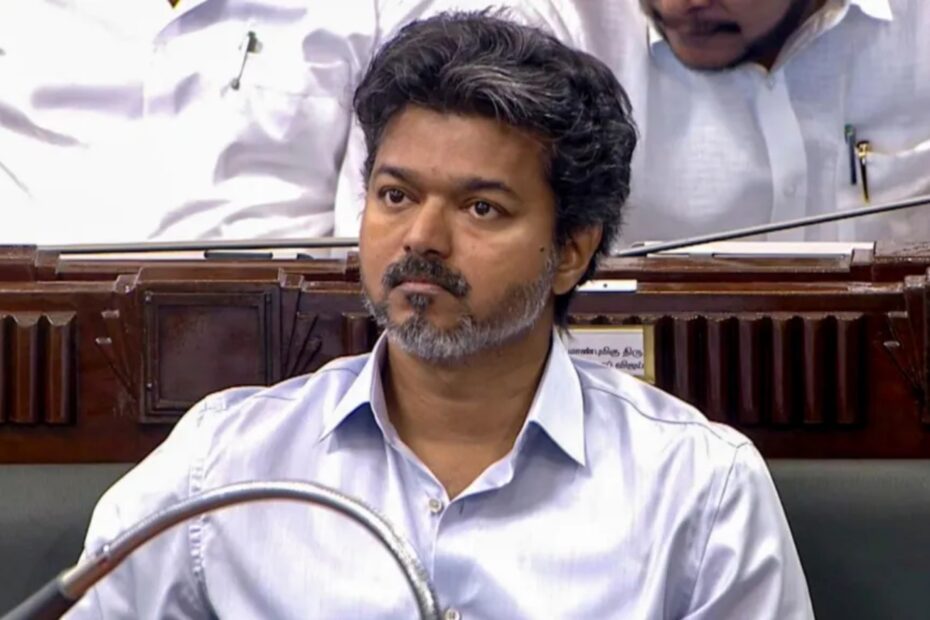
The MoUs were exchanged in the presence of Chief Minister C Joseph Vijay, Keerthana, Guidance Managing Director and Chief Executive Officer Deepak Jacob and Industries Secretary S Vijayakumar. Guidance, the State’s investment-promotion agency, was instrumental in bringing together the agreements.
For a government completing its politically important first 100 days, the conclave also offered Vijay’s administration an opportunity to set out the economic architecture behind its promise of building a 1.5-trillion USD Tamil Nadu economy by 2036.
“It is a big number, but its impact is even larger,” Keerthana said. “For a young graduate, growth means a better job. For a woman, it can mean economic independence. For an entrepreneur, it means the confidence to take a risk.
Story continues below this ad
For a family, it means upward mobility. And for a district like Ramanathapuram, which is receiving its first industrial investment today, it means that a young person will not have to leave home to find opportunity.”
That emphasis on geography in the industrial projects is significant in a state whose industrial strength has historically grown through several regional entrepreneurial centres rather than around Chennai alone.
Southern India’s industrialisation developed a more diverse social and regional base than the old stereotype of a Madras-centred business class suggests, with Coimbatore and its surrounding region emerging as a major centre of light engineering, cotton textiles and knitwear.
Coimbatore’s rise was particularly striking because it lacked many conventional advantages of an industrial centre — mineral resources, proximity to major ports or the status of a political or financial capital — yet developed into a manufacturing powerhouse through locally rooted entrepreneurship.
Story continues below this ad
Beyond Chennai
The larger historical trajectory is one of a Tamil industrial economy repeatedly widening its entrepreneurial base, including the movement of farming communities into manufacturing.
Thursday’s investment map suggests that the Vijay government wants to extend that geography while changing its technological composition.
The Hinduja Group has committed Rs 2,500 crore across renewable energy, electric mobility, automotive and digital mobility businesses, including more than 200 MW of solar, wind and battery projects.
Phoenix Kothari Group’s Rs 1,000-crore investment will mark what the government described as Ramanathapuram’s first major industrial investment.
Story continues below this ad
Germany’s Daimler India Commercial Vehicles will invest Rs 4,000 crore to expand its 400-acre Oragadam operation for commercial-vehicle design, research and manufacturing. Saint-Gobain has proposed Rs 2,000 crore for a greenfield facility in Krishnagiri and expansion in Kancheepuram, while Japanese zipper and fastening-products manufacturer YKK will invest Rs 1,651 crore in Tiruvallur, with a projected 4,316 jobs.
Also Read | AI cities, space corridors and a bigger Chennai: Vijay sketches Tamil Nadu’s next growth model
Ascendas Firstspace will develop a Rs 1,000-crore industrial park in Tiruvallur. Super Micro Computer plans server-assembly operations in Chennai. Titan will invest Rs 1,000 crore in Hosur to expand premium watch, jewellery and electronics automation facilities, creating 1,200 jobs, while Lucas TVS has committed Rs 2,500 crore across multiple facilities.
Big-ticket bets across manufacturing and mobility
The government’s intended shift towards newer industries was also visible in aerospace and life sciences. Agnikul Cosmos will invest Rs 400 crore and proposes 1,500 jobs around assembly and integration of reusable liquid-propelled launch vehicles, Skyroot Aerospace will invest Rs 250 crore and create 500 jobs in storage, assembly, integration and testing.
Eight life-sciences companies signed agreements, including Caplin Group, which will invest Rs 925 crore, partly in an integrated biologics and biosimilars research and manufacturing facility in Tiruvallur. S3V Vascular Technologies will invest Rs 525 crore in Kancheepuram, while Cellbios Healthcare & Lifesciences will invest Rs 150 crore across Dindigul and Krishnagiri.
Story continues below this ad
Keerthana said the mix of investments — both greenfield and brownfield — mattered as much as their aggregate value.
“Greenfield tells us new investors are choosing Tamil Nadu for the first time,” she said. “Brownfield tells us that companies already here are choosing to expand because they have experienced our workforce, our infrastructure and our way of doing business, and decided: more in Tamil Nadu.”
The government, she said, wants the next phase to concentrate on “advanced manufacturing, electronics, semiconductors, life sciences, renewable energy, aerospace, R&D and GCCs.”
Also Read | Babies get gold, sarees for brides: Spending-heavy debut for Vijay’s 1st budget
“Every government inherits an economy,” Keerthana said. “Our mandate, as given by our honorable Chief Minister, is not merely to grow the economy but to significantly upgrade it.”
Story continues below this ad
The real pitch — make government less visible
Perhaps the more consequential promise, however, concerned the machinery of government itself. Keerthana announced a 21-day clock for approvals, licences and invoices, presenting it as an attempt to impose deadlines on the state rather than merely on investors. “We are not simply asking you to trust us,” she said. “We are putting a clock on ourselves.”
It may be seen as an unusually revealing formulation of the government’s industrial pitch. That the ideal investment bureaucracy may ultimately be one that investors barely notice.
“One day I hope that the greatest compliment our government receives from industry is something much simpler,” Keerthana said — that an investor can “come to Tamil Nadu, invest, build, hire, innovate and expand and hardly have to think about government interference.”
Then she supplied her own definition of what success would look like. “The approvals worked, the infrastructure worked, the roads worked, the ports worked, the talent was available, the power stayed on.”
Story continues below this ad
Also Read | Why Vijay tested Cauvery waters with Karnataka: ‘Even hostile nations try to resolve issues’
For a government stepping into the celebrations of its first 100 days, the Rs. 1 lakh crore figure provides a headline. Whether those commitments translate into factories, jobs and investment across districts will supply the longer test.
“We now have 100 days of proof behind us — a proof of concept, as you call it,” Keerthana said. “But we have a decade of ambition ahead of us.”