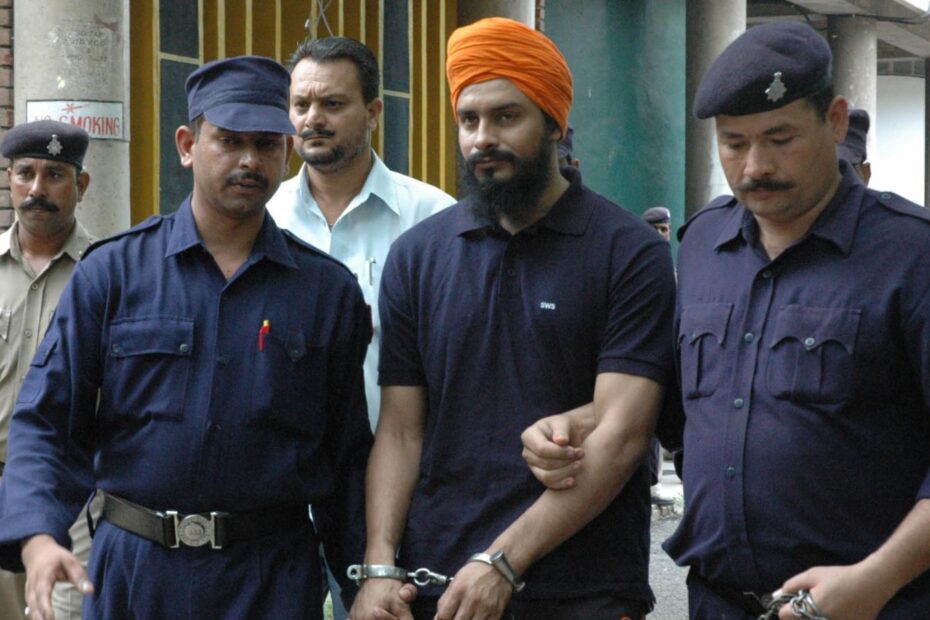
For years, Jagtar Singh Hawara was a name Punjab’s political establishment treated with extreme caution.
Born on May 17, 1970, in Hawara village of Fatehgarh Sahib, Hawara was convicted for his role in the 1995 assassination of then Punjab chief minister and Congress leader Beant Singh and regarded as a high-risk prisoner. After his dramatic escape from Burail Jail in Chandigarh in January 2004, successive Punjab governments were reluctant even to keep him in a Punjab prison. So, since he was re-arrested by a Delhi Police Special Cell team in June 2005, he has remained lodged in the Capital, first in high-security Tihar and now in Mandoli jail.
Advertisement
Today, however, as Assembly elections approach in Punjab and the Panthic vote is seen as up for the asking, the political mood around Hawara could hardly be more different.
Also Read | ‘For his mother’s sake, I am forgetting that wound’: Ravneet Singh Bittu on Hawara parole
From the ruling Aam Aadmi Party (AAP) to the Congress and sections of the Shiromani Akali Dal (SAD) and BJP, politicians and political groups in Punjab are backing Hawara’s demand for parole “on humanitarian grounds” to meet his mother, Narinder Kaur, 83, who is unwell. Even Beant’s grandson Ravneet Singh Bittu, who is now with the BJP, has joined the calls for Hawara’s release.
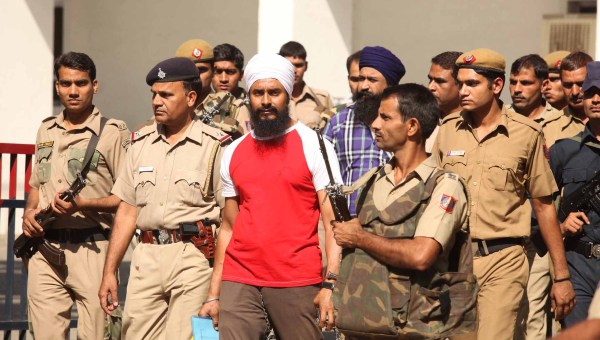 Jagtar Singh Hawara (first time in chains) and Pramjit Singh Bheora emerge from the district court where they were produced in Burail jail-break case. (Express Archive Photo by Jaipal Singh)
The momentum coincides with sustained mobilisation by Sikh organisations, particularly the Qaumi Insaaf Morcha, a campaigner for the release of what it calls political prisoners. In February, it held a gathering in Hawara Kalan in Fatehgarh Sahib seeking parole for Hawara.
Advertisement
Punjab CM Bhagwant Singh Mann has recommended that the parole be at least for 10 days. Both Mann and Bittu have met Governor Gulab Chand Kataria to press their case, with the CM hoping that Hawara can meet his mother after more than three decades.
The shift in Hawara’s circumstances is perhaps best captured by the unlikely popularity of a song celebrating the militant, which goes: “Pinjre de vich band nai rehna aisse sheran ne (Lions will not remain locked in cages forever).”
The song found a place during the recent Jantar Mantar protest in Delhi, and went viral on social media, celebrating Hawara as a figure of Sikh pride.
His supporters have also been building support on the ground, with longtime associate Jaswant Singh saying panchayats in dozens of Fatehgarh Sahib villages had passed resolutions supporting his parole. Jaswant says the numbers now stand at around 150, including resolutions from Hindu temples.
Also Read | Commutation of Rajoana’s death penalty: the story and the controversy
The AAP government’s pro-Hawara tilt is a contrast from as recently as March, when it had opposed parole for him. In a letter to the Punjab and Haryana High Court, the government said: “… 25 criminal cases are registered against the convict Jagtar Singh Hawara. Due to this, the Senior Superintendent of Police, Fatehgarh Sahib, and the Director, Bureau of Investigation, have not recommended granting parole to the prisoner.” In July, High Court proceedings showed he had 36 criminal cases against him; had been convicted in seven, completed sentences in six, and was serving his life sentence in the Beant assassination case.
At his parole hearing back in June last year, Hawara’s counsel told the court that he had spent about 29 years in custody and had never been granted parole or remission. In the July hearing, the High Court ordered a time-bound procedure for deciding his parole application.
Hawara’s initiation into militancy began with the Babbar Khalsa International, and he went underground during this period.
Beant Singh was killed in a suicide bombing outside the Punjab and Haryana Civil Secretariat on August 31, 1995, killing both him and the suicide bomber Dilawar Singh, as well as 15 others.
Also Read | Why Bhagwant Mann’s parole request for Beant Singh assassin has sparked a row
In January 2004, Hawara escaped Burail jail through a tunnel with co-accused Jagtar Singh Tara, Paramjit Singh Bheora and another convict, Devi Singh. Six months later, in June 2005, he was arrested by the Delhi Police Special Cell.
In 2007, a trial court sentenced Hawara to death. In 2010, the High Court commuted it to life, with no release, saying it had found Hawara to be an active participant in the conspiracy.