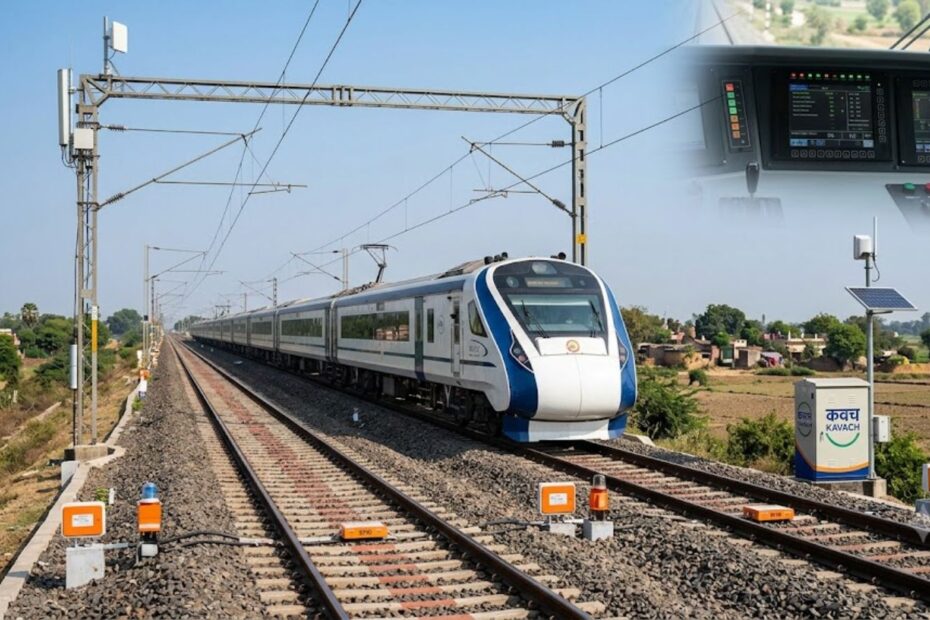
Automatic Train Protection System: The Ministry of Railways has expanded Kavach 4.0, an indigenously developed automatic train protection (ATP) system, to 2,490 route km across the Delhi-Mumbai and Delhi-Howrah rail corridors. It was adopted as National ATP system in July, 2020. Kavach automatically applies the brakes if the loco pilot fails to act, keeps trains within speed limits, and ensures safer operations even during adverse weather conditions.
Also Read | Centre plans standard design for bullet train network across 7 new corridors
In a written statement in Rajya Sabha on Friday, Railway Minister Ashwini Vaishnaw said that the first field trials of Kavach on the passenger trains were started in February 2016.
“Based on the experience gained and Independent Safety Assessment of the system by Independent Safety Assessor (ISA), three firms were approved in 2018-19, for supply of Kavach Ver 3.2.
Based on deployment of Kavach version 3.2 on 1,465 RKm on South Central Railway and experience gained, further improvements were made. Finally, Kavach specification version 4.0 was approved by RDSO on 16.07.2024,” he said.
Vaishnaw said that Kavach 4.0 includes several major upgrades, such as improved location accuracy, better signal information in large railway yards, a station-to-station interface over optical fibre cable (OFC), and direct integration with the existing Electronic Interlocking System.
“With these improvements, Kavach Ver.4.0. is planned for large scale deployment over Indian Railways,” he added.
Kavach Version 4.0 deployment on Delhi-Mumbai and Delhi-Howrah routes
Indian Railways Kavach funding
The Railways has spent Rs 3,874.9 crore on Kavach works until June 2026. For the financial year 2026-27, it has allocated Rs 2,066.24 crore for the project.
Story continues below this ad
“Kavach work is going at good pace in the entire country including Uttar Pradesh. Requisite funds are made available as per the progress of works,” the minister added. He also said work has begun to install Kavach in 7,435 locomotives and 1,200 EMU/MEMU trains.