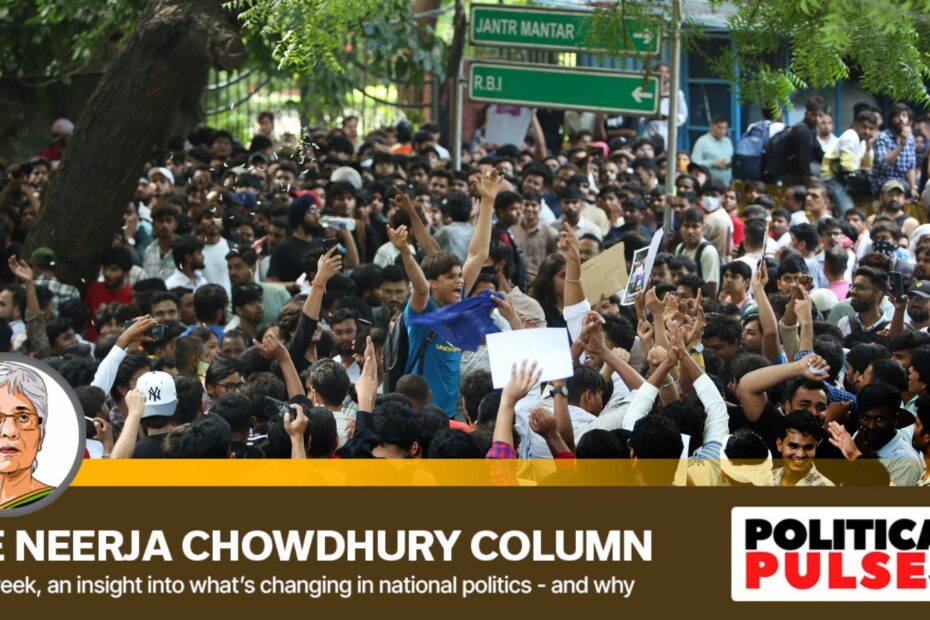
Three days after thousands of youths stormed central Delhi as they joined a march to Parliament called by the Cockroach Janta Party (CJP) demanding the resignation of Union Education Minister Dharmendra Pradhan over the NEET exam paper leak, only to face lathi-charge and tear gas shells used by the police and security personnel, their protest continues at Jantar Mantar.
Following the Delhi High Court’s order, the fasting activist, Sonam Wangchuk, has already been shifted to a private hospital in Gurgaon from the government-run Safdarjung Hospital. Rahul Gandhi along with Priyanka Gandhi Vadra and other senior Congress leaders have already been released after a brief detention on Tuesday, when they held a dharna outside Prime Minister Narendra Modi’s residence on Lok Kalyan Marg, as was Samajwadi Party chief Akhilesh Yadav who also joined their sit-in.
Advertisement
In his first remarks on the raging row on Tuesday, PM Modi, while addressing a meeting of the MPs of the BJP-led NDA, asserted that strong action was taken against those involved in the “grave offence” of paper leaks so that no one could play with the future of the youths. The government has also made a placatory gesture and reached out to the CJP leaders and Wangchuk – a move that could have been made several days ago. Why it did not do so, is a question on everyone’s lips.
The Jantar Mantar protest has underscored the extent to which a faulty examination and education system is exercising the minds of the young in India today. It has now become increasingly clear that political parties would ignore the youth sentiments at their own peril. This also showed that even though the Modi government is within striking distance of mustering a two-thirds majority in Parliament, it must be prepared to face street protests in a young, diverse and aspirational country.
The CJP protests seem to be different from other protests in the past. Firstly, these protests are not centred on the concerns of any one section of society, like what was seen in recent years – be it the year-long agitation of farmers (from Punjab, Haryana and west UP) against the now-repealed central farm laws, or the anti-CAA-NRC dharnas involving essentially the Muslim community.
Advertisement
The CJP, which was launched by Abhijeet Dipke as a satirical, youth collective in response to the Chief Justice of India (CJI) Surya Kant’s courtroom use of the word “cockroach”, is different from other movements in post-Independent India. Whether it was the JP movement in 1973-74 for “total revolution”, or the Assam movement in the early 1980s against illegal immigrants from Bangladesh, or the Anna Hazare movement in 2011 for the Lokpal and public accountability – they had a clear leadership that helmed a popular struggle and, in each case, led to the formation of a political party which eventually came to power. The CJP is an online phenomenon in this social media age, trying now to become an offline outfit, which may be a formidable task.
Also Read | Chaos, frustration among commuters as 16 key Metro stations around Jantar Mantar shut
The recent CJP protests have touched not just those appearing for the NEET or JEE-IIT exams, who would number only a few thousands. The Jantar Mantar stir represented the voice of many more – of all those who feel left out of the system.
An enquiry will reveal more about the lathi-charge against the protesting students during their march to Parliament, and the stone-throwing incidents. But the use of batons and tear gas against the protesting youngsters has taken their cause – and alleged police brutality against them – into every middle class home, with many parents asking,”What if my daughter had been there?”
Wangchuk factor
There were two turning points in the CJP’s current month-long agitation at Jantar Mantar. Wangchuk’s bid to join it on June 28, and go on an indefinite hunger strike, gave the movement a gravitas. Till then Dipke’s attempts to gain traction on the ground received a tepid response in different cities, considering that 22 million people had become the CJP’s online followers within a week after its launch.
To begin with, Wangchuk’s fast did not draw huge crowds. It was only after plainclothes policemen whisked away the fasting leader behind white sheets to Safdarjung Hospital on July 18 (21st day of his fast) that the protest venue began to see an upsurge, with thousands of youths thronging there, to participate in the July 20 march.
The importance of Wangchuk lay not just in his effort to inject a new energy into a stagnant political situation, opting for hunger strike at a time when brute power, not moral force, gets a response. But it struck a chord with the youths when he was forcibly removed from the site.
The educationist-environmentalist from Ladakh showed that the peripheries of India could speak to the heart of India – which is as it should be in a democracy. He sat on a fast in the national capital, and inflicted discomfort on himself instead of abusing his opponents – and demanded an overhaul of the country’s education system, giving voice to the concerns of millions of youths.
Government play, Congress push
The government may have tried to shift the headlines from the CJP protest and the police lathi-charge by allowing the Congress leaders’ dharna outside the high-security PM’s residence, an unusual decision. It may have succeeded for now.
While individual Congress leaders like Pawan Khera finally went to Jantar Mantar to express their solidarity with the protesters, Rahul did not visit them. Rahul himself has been leading a youth outreach programme, called “Chhatron ki goonj”. Perhaps the government may not want the CJP to run away with youth support.
In the long run, however, it is the Congress as the main Opposition force, which is likely to gain if discontent against the ruling dispensation grows. Much will, of course, depend on the damage control the government is able to undertake. The government is now reaching out to the protesters, but the key question is: will that be enough, or will its resolution require sustained dialogues with the CJP, Wangchuk, mainstream parties, and experts over the long-pending reforms in our education system?
Another question remains as to why the government did not connect with the protesters in time. Sending an emissary to Jantar Mantar to engage with Wangchuk and Dipke earlier might have defused the situation.
There is a view in the government that a “strong” government should not act under “pressure”, or it would get pushed around. Many cite what happened during the previous Congress-led UPA regime to make the point– the resignation of the then Maharashtra chief minister Ashok Chavan had a domino effect with the resignations of half a dozen other senior functionaries, at the state and central levels, following in its wake, with the Opposition having tasted blood.
A government must have the ability, if required, to be tough to rule a large country. But should a government, which is expected to be responsive, hold out when the country’s youths are signalling that they are “hurting” and that a solution must be found by addressing their concerns? After all, there may just be a fine line between toughness and arrogance in the final analysis.
(Neerja Chowdhury, Contributing Editor, The Indian Express, has covered the last 11 Lok Sabha elections. She is the author of ‘How Prime Ministers Decide’.)