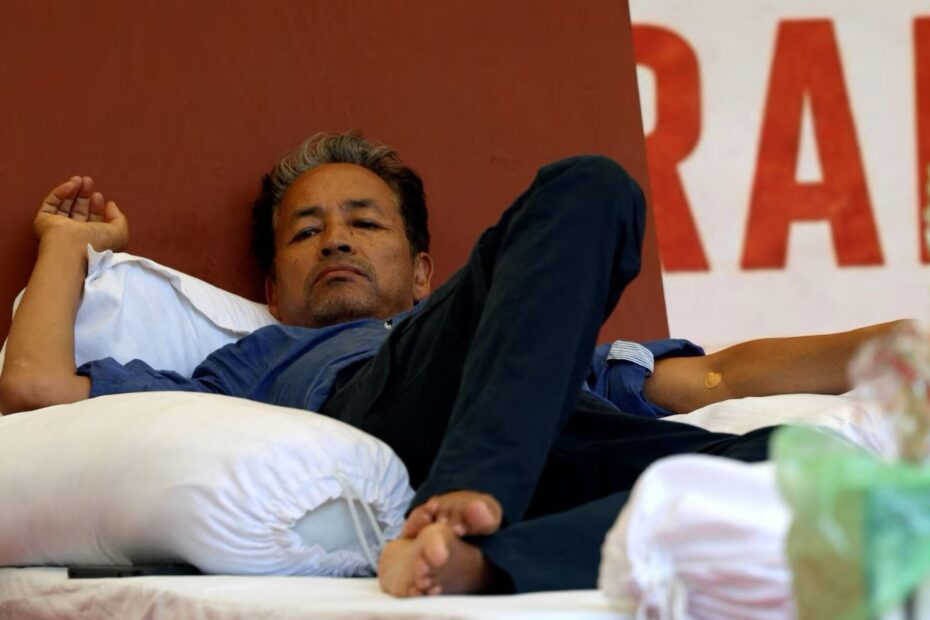
Activist Sonam Wangchuk’s fast demanding the resignation of Union Education Minister Dharmendra Pradhan over the NEET exam leak began without fanfare on June 28, but in about two weeks it began to gain traction on social media.
The thin to moderate crowds at Jantar Mantar began swelling just after he was removed from the site and shifted to the Safdarjung hospital on July 18. By July 20, when the protesters were to march to Parliament, there was a mammoth crowd – estimated to be at least 50,000 – and clashes between the police and protesters. Since then, large crowds have persisted at Jantar Mantar round-the-clock, even though Wangchuk is now in Medanta Hospital.
Advertisement
Few had anticipated that this movement would grow so soon, but it followed an unmistakable pattern that has been unique to Indian politics for over a century now – people’s sudden interest in hitting the streets on a political demand is preceded by what they see as an act of “sacrifice” by someone they don’t identify as a quintessential politician but rather as an austere, renunciatory person.
Read | Sonam Wangchuk opens a window as Centre steps up efforts to resolve crisis
The template for this was first set about 100 years ago by Mahatma Gandhi, who acquired an image of a saint. His case, though, was unique, as his mass reach endured for decades, and across three mass movements for freedom and also campaigns for other causes. He fit perfectly in an old Indian trope, the fakir or sadhu whose power comes from renunciation and sacrifice.
But the Gandhian template – or markers that make people see someone as a Gandhian, whether the person can be strictly called that or not – has endured for a century, with those reminding people of him repeatedly drawing large crowds and goodwill – and sometimes also changing the course of the polity.
Advertisement
The template has some broad characteristics: only someone not a career politician in the sense of having held office fits into it, especially when seen as a “renouncer”; or someone who lives close to nature; uses non-violent methods of civil disobedience, and shuns an aspirational career trajectory.
Also Read | ‘Don’t waste our time’: CJI Surya Kant tells lawyer raising Delhi NEET protests
Wangchuk, who insists that he should not be compared to Gandhi and be just seen as a citizen who does not ignore his responsibilities, is already being fit into the template by many who are swayed by him online. His fast in the national capital has gone viral as a marker of his “austerity” and “commitment”. Add to it his work in environmental conservation, innovation and education – plus people’s long association of Aamir Khan’s character in the film “Three Idiots” with him, though Khan recently denied it. It remains to be seen whether this image gets further strengthened or fizzles out soon.
Also Read | How the Jantar Mantar protests are different from past Modi-era agitations
However, there are precedents that people’s love for hitherto distant figures they suddenly regard as austere, committed and morally powerful has led to popular movements, which have at times even changed the course of the polity.
Anna Hazare
If the Congress faced its first national setback after the JP movement of 1974, the fasts of Anna Hazare for a strong anti-corruption ombudsman in Delhi were the first jolt for the then ruling party from 2011 onwards. Three years later, after some more jolts, the Congress fell to its lowest tally of 44 in the Lok Sabha and the BJP under Narendra Modi stormed to power.
Before Hazare came to Delhi for his first fast at Jantar Mantar in Delhi in 2011, he was virtually an unknown activist. But TV coverage made him a national figure instantly. A villager with a background in the army, a bachelor who had undertaken agitations against the government in Maharashtra, an opponent of alcohol: these worked instantly, with people in the national capital suddenly “discovering” a saintly man, a Gandhian, in Hazare.
His second fast at Ramlila Maidan months later, which lasted for 12 days, attracted even larger crowds. The Congress-led UPA government came under pressure as common people were swayed by the spartan hunger striker.
Also Read | In CJP protest, a reckoning with politics for the apolitical Indian
The Lokpal that Hazare had fasted for soon disappeared from the news. What remained was the debacle of the Congress in Delhi and the rise of the Aam Aadmi Party (AAP), whose leader Arvind Kejriwal was Hazare’s protege. In 2014, the Congress lost power at the Centre and never gained it again, something for which Hazare is also seen as a key trigger.
Jayaprakash Narayan
A freedom fighter who escaped from jail by scaling a wall and carried on the Quit India Movement underground, Jayaprakash Narayan or JP acquired a feisty image as a young man. He was a leader of the Congress Socialist Party (CSP) formed in 1934 with the aim of giving the Congress a left turn from within.
After Independence, he quit the Congress along with others in CSP, and became part of the Socialist Party. He also turned down Nehru’s offer of a Cabinet position in 1952.
In 1954, JP quit active politics altogether, associating himself with the Sarvodaya Movement and turning to Gandhian constructive work. He had by now acquired the image of someone with no desire for power. His return in 1974 to helm the students’ movement against the Congress government in Bihar – something which soon transformed into a movement against the Indira Gandhi government at the Centre – made it a powerful one. He asked students to abjure violence and prepare for Satyagraha, addressing well-attended rallies. He came across nationally as a man free from the trappings of power; a renouncer committed to a better country rather than someone with an ambition to hold high office.
The success of the JP movement along with the Allahabad High Court’s order declaring Indira’s election null and void, something that was only partially stayed by the Supreme Court, made her impose the Emergency in 1975.
JP was sent to jail alongside almost the entire Opposition’s key faces. Once the Emergency was over in 1977 and elections were announced, the Janata Party, formed with JP’s blessings after dissolving major Opposition parties, ousted the Congress from power.
Potti Sriramulu
Potti Sriramulu, who had stayed with Mahatma at Sabarmati Ashram, is credited with the creation of Andhra Pradesh, though this happened after he had died fasting for carving out the state from the Madras Presidency.
He had joined the Ashram after resigning from his job in the Railways in 1931, deciding to join the freedom struggle. He went to jail multiple times, and also fasted for the empowerment of Dalits.
He went on a fast unto death for Andhra Pradesh on October 19, 1952, trying to achieve through hunger strike a demand that had been dear to Telugu speakers for long. This immediately caught the attention of the people. On December 12 that year, Nehru wrote to Madras chief minister C Rajagopalachari that it was time to accept the Andhra demand to cool frayed tempers, but Sriramulu died on December 15. This led to widespread violence, even as Nehru announced the formation of Andhra Pradesh just two days after his death.