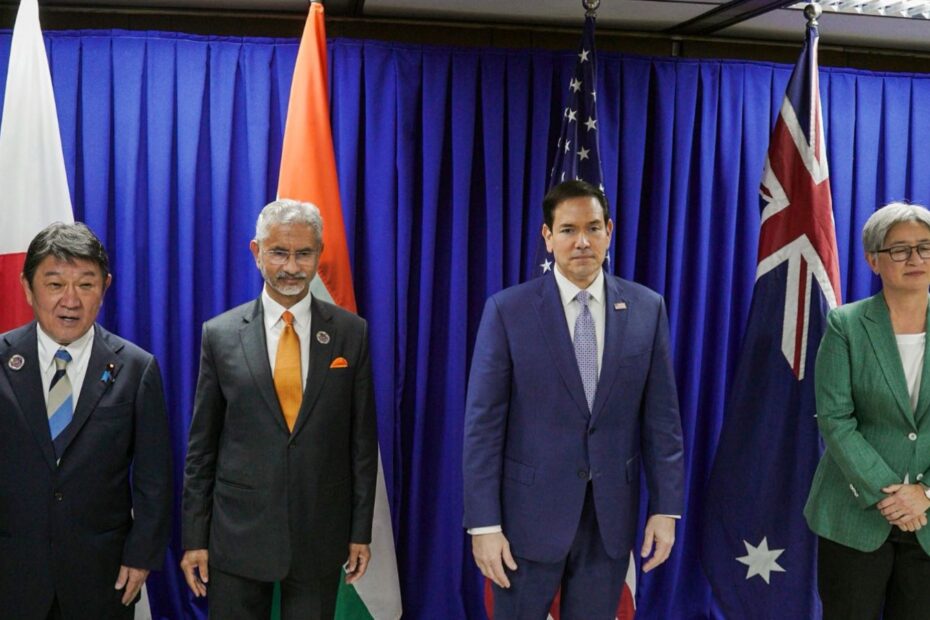
External Affairs Minister S Jaishankar with Australian Foreign Minister Penny Wong, US Secretary of State Marco Rubio and Japan Foreign Minister Toshimitsu Motegi during the Quad Foreign Ministers Meeting, in Manila on Wednesday. (Photo: X/@DrSJaishankar)
With an eye on China’s assertive behaviour in the region, the foreign ministers of India, the United States, Australia, and Japan met in the Philippines on Wednesday, pledging to work together to keep the Indo‑Pacific region stable while stressing support for the Association of Southeast Asian Nations (ASEAN).
The Quad (Quadrilateral Security Dialogue) foreign ministers’ meeting in Manila was attended by External Affairs Minister S Jaishankar, US Secretary of State Marco Rubio, Australian Foreign Minister Penny Wong, and Japanese Foreign Minister Toshimitsu Motegi.
After the meeting, Jaishankar posted on X, “Glad to participate in the Quad Foreign Ministers Meeting in Manila. Reviewed the Indo-Pacific landscape and discussed recent developments. Followed up on the outcomes of the recent New Delhi meeting. Committed to a free and open Indo-Pacific with a recognition of ASEAN centrality.”
Rubio said that the US, India, Australia, and Japan share a vision of a free and open Indo-Pacific “grounded in the rule of law, sovereignty, and territorial integrity”. “The Quad remains a priority, and we will meet again later this year,” he added.
Also Read | Energy to rare earth, Fiji port to sea patrols: Quad moves to blunt China rise in Indo-Pacific
Rubio’s statement comes at a time when the Donald Trump administration’s commitment to the Quad is being watched closely by the other partners and stakeholders in the region, including Beijing.
With US-China engagement on one side and volatility in New Delhi-Washington ties on the other, there appears to be uncertainty over the Quad leaders’ summit in Delhi this year. Rubio’s visit in May, followed by the Manila meeting, is aimed at assuaging concerns on the Quad’s viability.
“Was pleased to reconvene the Quad at the @ASEAN Foreign Ministers Meeting to emphasize our message: strong cooperation is vital to supporting ASEAN’s own priority and centrality in the region,” Rubio said.
Story continues below this ad
India’s deepening engagement with ASEAN: Centre
In its joint statement, the Quad foreign ministers reaffirmed their commitment to a free and open Indo‑Pacific and expressed strong support for ASEAN’s “unity and centrality”. “We are deeply invested in the region’s success and in cooperating with ASEAN and its member states,” it added.
The statement said the ministers discussed regional challenges and opportunities and agreed to support the implementation of the ASEAN Outlook on the Indo‑Pacific—a diplomatic framework that emphasises ASEAN’s central role in shaping cooperation across the region—by focusing on shared priorities such as maritime and transnational security, economic prosperity and security, emerging technologies, and humanitarian assistance and emergency response. “We are united in our conviction that peace and stability in the Indo-Pacific maritime domain underpin the security and prosperity of the region,” it added.
Also Read | Quad launches new maritime, critical mineral initiatives at Delhi Summit
Jaishankar is visiting Manila for the foreign minister-level meetings under the ASEAN framework, including the ASEAN-India, East Asia Summit, and ASEAN Regional Forum meetings.
The Ministry of External Affairs said that the visit “underscores India’s deepening engagement with ASEAN under the Act East Policy and reaffirms our strong commitment to further strengthening the ASEAN-India Comprehensive Strategic Partnership. It is of particular significance that 2026 has been designated as the ASEAN-India Year of Maritime Cooperation”.
Story continues below this ad
In May this year, with an eye on China, the Quad foreign ministers decided to launch an Indo-Pacific Maritime Surveillance Corporation to expand maritime awareness and enhance port infrastructure in Fiji. They also agreed to start an Indo-Pacific energy security initiative aimed at regional energy resilience and to advance cooperation under the Quad Critical Minerals Initiative to strengthen supply chains for critical minerals.