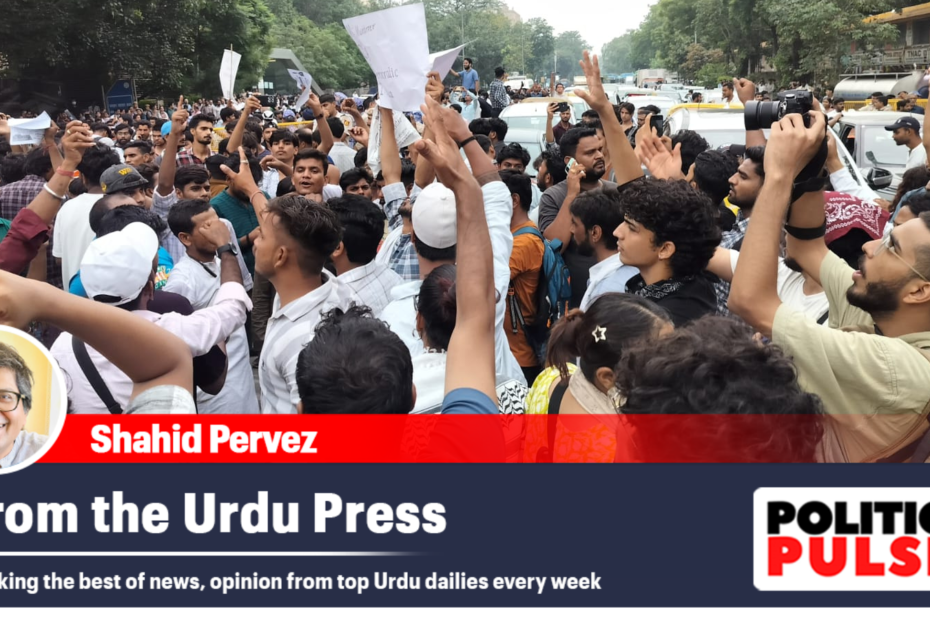
As the Monsoon Session of Parliament got underway Monday, there were stormy scenes within and outside its complex. The Cockroach Janta Party (CJP)’s weeks-long sit-in at Jantar Mantar, headlined by activist Sonam Wangchuk’s fast, spiralled dramatically as thousands of protesting youths stormed the heart of the national capital for their demands, running into police lathi-charge and tear gas shelling. The Urdu dailies kept their eye on this big story, which is likely to have a bearing on the proceedings of both the Houses, and possibly national politics, in the coming days.
Highlighting the march to Parliament by tens of thousands of students and youths under the aegis of the CJP that saw widespread clashes between the protesters and police across central Delhi, the Hyderabad-based Siasat, in its July 21 editorial, points out that the ruling dispensation failed to gauge the magnitude and depth of this agitation. “The students and youths sent out a clear message that they have the agency to struggle for their rights and concerns, and would not shy away from taking to streets,” it says. “The pro-establishment media might have turned a blind eye to the youths’ stir for weeks, but Monday’s march turned out to be an unprecedented development in both its scale and intensity despite the hurdles put up by the authorities, pushing the government to the back foot.”
Advertisement
This was evident as barely a few hours into the march – which came after three weeks of a peaceful sit-in held by the CJP activists to demand reforms in the examination system and the resignation of Education Minister Dharmendra Pradhan over the NEET paper leak – the government invited the CJP for talks, notes the daily. Union Minister J P Nadda met the CJP leaders who conveyed their demands. “While it has to be seen how the Narendra Modi government responds to these demands, the shift in the government’s
stance signals that it is now forced to acknowledge the CJP’s existence and reckon with the burning issue, which could mark the protesters’ first success,” the edit says.
The daily underlines that the government should now display sagacity and understanding in considering the demands of the protesters. “This is incumbent on the government to address the concerns of the restive youths. It must undertake reforms in the education sector and restore confidence among students. The youths also must ensure that their protests remain non-violent and within the boundaries of law,” it adds.
INQUILAB
Advertisement
Flagging the police crackdown on young and mostly peaceful protesters during their march to Parliament, the New Delhi edition of Inquilab, in its July 21 editorial, says that the country’s youths are grappling with multiple challenges, ranging from a broken education system to the deepening unemployment crisis. “They are forced to hit the streets to hold protests and observe fasts for the sake of their future,” it says. “While Sonam Wangchuk and Abhijit Dipke have led the movement in Delhi, their demands have also got traction in other parts of the country, which indicates that the issue at stake is not limited to just one tainted exam or the failure of any one institution, but a deeper, systemic crisis.”
The daily states that the demands of the youth protesters — accountability for exam leaks, resignation of Education Minister Pradhan, and clean and transparent exams and recruitment processes — could not be dismissed as “unlawful or unconstitutional”. “They are actually a legitimate expression of our fundamental democratic rights. It is unfortunate that the authorities used brutal force, lathi-charge and tear gas shells to suppress the youths’ protest, injuring scores of them. It is the government’s duty to listen to the voices of the citizens and redress their grievances rather than branding them as miscreants or disruptors,” it says.
The protests are a pointer to disquiet and anxieties among our youths, notes the editorial. “The shrinking of job opportunities, the growing disparities, and the irregularities in exams and recruitments have caused deep despair and unease in large sections of youths. If they feel that their concerns are not being heard or that its expression meets a violent crackdown, it should be a
worry for the government,” the edit says, adding that simmering youth discontent, if ignored, may have ramifications on the social, political and economic fronts. “It is imperative that the government adopts a prudent and judicious route, have a meaningful, result-oriented dialogue with the young protesters and restore their confidence. Only such an approach would be a guarantee for the country’s real development.”
Referring to the Supreme Court’s observation that deletion from the electoral rolls following the Election Commission (EC)’s Special Intensive Revision (SIR) would not result in loss of citizenship, Siasat, in its July 19 leader, writes that the apex court’s clarification has provided relief to crores of people in the country. The top court has made it clear that the EC is not the final authority to determine citizenship, which actually falls within the remit of the central government under the law, the editorial says. “There have been widespread concerns among a large section of people that they may lose citizenship if their names are not included in the voter lists for any reason. Various quarters have also expressed apprehensions that the SIR is in effect a changed version of the NRC (National Register of Citizens) proposal.”
The daily notes that the SC pointed out that it had already made this clear in its judgment upholding the Bihar SIR that removal of names from electoral rolls do not result in loss of citizenship. “The apex court’s clarification is especially welcome because tens of millions of people across the country have been excluded from the voter lists,” it says, adding that there are large sections of people whose names have been struck off from the voter lists in several states including Bihar, Uttar Pradesh and West Bengal. “There might be some undocumented immigrants in the country, but the point remains that an overwhelming number of our people whose names have been excluded from voter lists are citizens – even if they may not have all the required papers or documents,” the edit states.
The top court made the clarification while hearing a petition, which sought its intervention to streamline the functioning of the tribunals set up in Bengal to hear appeals against exclusions of voters. The plea flagged that deleted voters have also been deprived by the state government of some key welfare schemes.
The edit underlines that lakhs of appeals have been pending before these tribunals which have been able to clear only thousands of them. The disposal of these cases by the tribunals would give relief to the aggrieved people, it says. The Centre should also take measures to settle the citizenship issue concerning the deleted voters and clear the decks for restoration of their names in the electoral rolls, it adds.