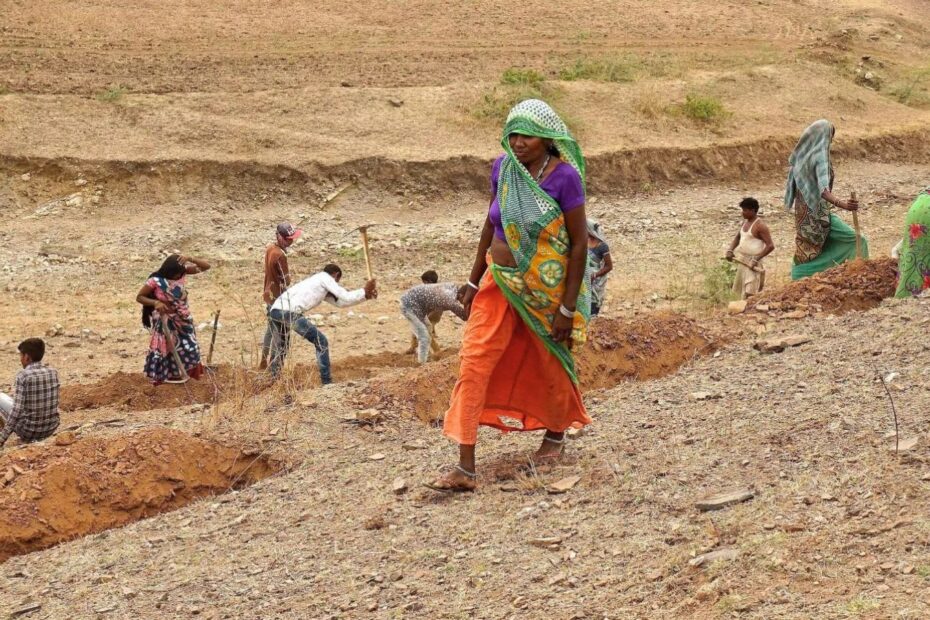
The Centre Tuesday notified wage rates for unskilled manual workers under the Viksit Bharat-Guarantee for Rozgar and Ajeevika Mission (Gramin) (VB-G RAM G) Act, 2025, which comes into effect today, replacing the two-decade-old Mahatma Gandhi National Rural Employment Guarantee Act (MGNREGA), 2005.
Daily wages have been fixed between Rs 300 and Rs 409 across states, with a special rate of Rs 450 in certain gram panchayats in Sikkim, as per a notification issued by the Union Ministry of Rural Development late Tuesday night.
Northern and northeastern states such as Arunachal Pradesh, Nagaland, Himachal Pradesh, Uttar Pradesh, Uttarakhand, Bihar, Jharkhand, Assam, Tripura, Sikkim and West Bengal have seen wage hikes of over 15%. Haryana, which has the highest wage rate of Rs 409, stands out with the lowest hike of just 2.25%.
Also Read | Punjab debt crisis to 2027 polls: Why AAP govt does a U-turn over G RAM G scheme
Southern states like Karnataka, Tamil Nadu, Andhra Pradesh and Telangana saw a hike of 3% or below.
The new wage rates
The wage rate has been fixed at Rs 300 for 21 states: Gujarat, Manipur, Mizoram, Rajasthan, Odisha, Jammu and Kashmir, Ladakh, Meghalaya, Chhattisgarh, Madhya Pradesh, West Bengal, Sikkim, Assam, Tripura, Bihar, Jharkhand, Uttar Pradesh, Uttarakhand, Himachal Pradesh (non-scheduled areas), Arunachal Pradesh, Nagaland.
The wage rates for the other states have been fixed as follows: Rs 308 for Telangana, Rs 312 for Andhra Pradesh, Rs 317 for Maharashtra, Rs 340 for Dadra and Nagar Haveli and Daman and Diu, Rs 345 for Tamil Nadu, Rs 347 for Puducherry, Rs 348 each for Andaman and Nicobar (Andaman District) and Lakshadweep, Rs 360 for Punjab, Rs 367 for Andaman and Nicobar (Nicobar District), Rs 375 for Himachal Pradesh (scheduled areas), Rs 382 for Karnataka, Rs 401 for Kerala, and Rs 406 for Goa.
Three gram panchayats in Sikkim – Gnathang, Lachung, and Lachen – will pay a fixed wage rate of Rs 450.
Story continues below this ad
Why ‘hike’ not a hike
While the wage rates notified under the VB-G RAM G Act appear higher than the prevailing MGNREGA wages, this is because the government had not increased MGNREGA wages for 2026-27. The Centre last notified the MGNREGA wages on March 27 last year, which were applicable for the 2025-26 financial year, and continued with it during the first quarter (April-June) of the current fiscal year (2026-27).
If the Centre had increased MGNREGA wages for the current financial year, the hike in VB-G RAM G wages would have been the same.
Section 10 of the VB-G RAM G Act empowers the Centre to specify wage rates for unskilled manual work provided under the Scheme. As per the Act, the Central government can notify different wage rates for different areas. The Act also mandates that the wage rate notified under the VB G RAM G law shall not be less than the prevailing wage rate as notified under Section 6 of the Mahatma Gandhi National Rural Employment Guarantee Act, 2005.
How are the wages fixed
The VB-G RAM G Act provides for the notification of different wage rates for different areas. Although the notification issued by the Union Ministry of Rural Development does not spell out the methodology used to determine the state-wise wage rates, it is understood that the Ministry adopted the prevailing MGNREGA wage rates as the basis.
Story continues below this ad
Consequently, states such as Haryana, Goa and Kerala, which already had relatively high MGNREGA wage rates, have been assigned correspondingly higher wages under the VB-G RAM G Act, exceeding Rs 400 per day in all three states.
Also Read | States to get VB-G RAM G funds based on the Finance Commission formula
The Act further stipulates that the wage rate notified under the VB G RAM G Act cannot be lower than the prevailing wage rate notified under Section 6 of the MGNREGA, 2005. It also provides that, until the Central government notifies wage rates under the new law, the wage rates notified under the MGNREGA will continue to apply.
Why higher wage rates in Haryana
It can be traced to the methodology adopted by the Rural Development Ministry for fixing state-wise wages.
When the National Rural Employment Guarantee Act (NREGA) was enacted, it stipulated that wages could not be less than Rs 60 per day. It also provided that, until the Centre notified a wage rate for a particular area, the minimum wage for agricultural labourers fixed by the respective state governments under Section 3 of the Minimum Wages Act, 1948, would apply.
Story continues below this ad
As a result, states such as Haryana, where the statutory minimum wage for agricultural labourers was already higher than Rs 60 per day, offered higher wages under the MGNREGA.
Subsequently, when the government linked MGNREGA wage revisions to the Consumer Price Index for Agricultural Labourers (CPI-AL) and established a minimum wage floor of Rs 100 per day, these states retained their wage advantage.
Consequently, Haryana has continued to record one of the highest wage rates under the rural employment guarantee scheme.
Why low hikes for South
The lower hike in percentage terms to southern states may be because of two reasons. First, the base effect: these states already have high wage rates in absolute terms. Second, as VB-G RAM G wages have been fixed after taking into account the current MGNREGA wages and inflation, the regional variation is obvious.