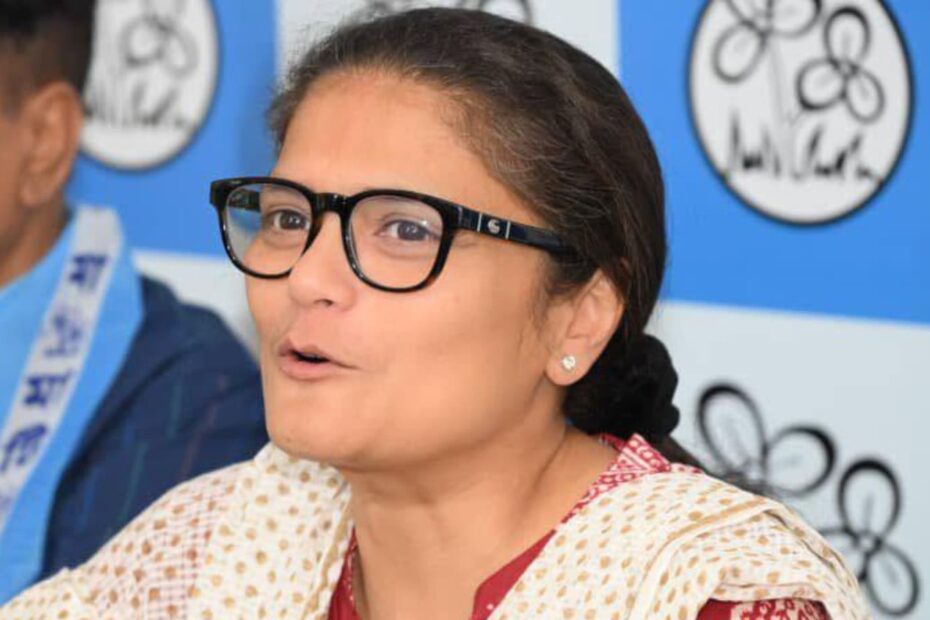
A member of one of Assam’s most prominent Congress families, from one of Rahul Gandhi’s trusted young faces in the party to leaving for the Trinamool Congress (TMC) and becoming one of its most prominent faces outside West Bengal, and now sparking speculation about an entry into the BJP: Sushmita Dev’s political career has seen some acute turns.
However, until a much talked about meeting with Assam Chief Minister Himanta Biswa Sarma on the same day that she resigned from the TMC and the Rajya Sabha, 53-year-old Dev had been a sharp critic of the BJP and a strong Opposition face.
Advertisement
After meeting Sarma against the backdrop of an unravelling TMC, Dev said her resignation from the TMC on Wednesday was “the principled thing to do”. Dev, who hails from Assam’s primarily Bengali-speaking Barak Valley, had been nominated to the Rajya Sabha by the TMC from West Bengal in October 2021.
Referring to her association with Sarma since their days as Congress leaders, Dev told reporters in Delhi, “I took advice from him (Sarma). To remain in politics, what is the best course of action? That was the discussion. What will be the decision, we will see.”
Her earlier departure from the Congress in 2021 had come as a shock to the party. She comes from one of the most prominent political families of Silchar, the centre of the Barak Valley, and from a line of Congress stalwarts.
Advertisement
Her grandfather Satindra Mohan Dev was a freedom fighter and later a minister in Assam, and her father Santosh Mohan Dev was a seven-time Congress MP, a Union minister, and one of the tallest political figures from the Barak Valley. Her mother Bithika Dev too had been a Congress MLA from Silchar.
With this background, Sushmita Dev began her political career with the Silchar Municipal Board in 2009, and quickly rose through the ranks in the party. She was elected to the Lok Sabha in 2014 and was serving as the president of the All India Mahila Congress when she decided to quit the party. She was also the party’s most prominent face in the Barak Valley.
“The possibility of her joining the BJP, which seems quite high at the moment, doesn’t practically make a big difference for the BJP because they have plenty of leaders in the Barak Valley. But from her perspective, it’s a big ideological shift given her background. Joining the TMC itself was not such a big turn in that sense, but if this happens, it will be a big somersault,” said Joydeep Biswas, who teaches at Cachar College in Silchar.
By the time she had left the Congress, the BJP had a practically unchallenged hold among the Bengali Hindu population of the Barak Valley. Though she was sent to the Rajya Sabha by the TMC soon after joining the party – as a representative from West Bengal – neither she nor the TMC found a footing in the Assam region.
“She lost her relevance in the region because the TMC is irrelevant here,” said a political observer from the Barak Valley.
Even so, she was the TMC’s most prominent face in Assam, and some would argue, its only face in Assam. She also played an active part in the party’s endeavours in Tripura, including during the 2021 civic body elections and the 2023 Assembly elections.
But in Assam itself, the TMC has barely registered a presence, except a victory by Sherman Ali Ahmed in this year’s Assembly polls from the Baghbor seat in western Assam, which can be largely attributed to his individual appeal since he joined the party just days before the election.