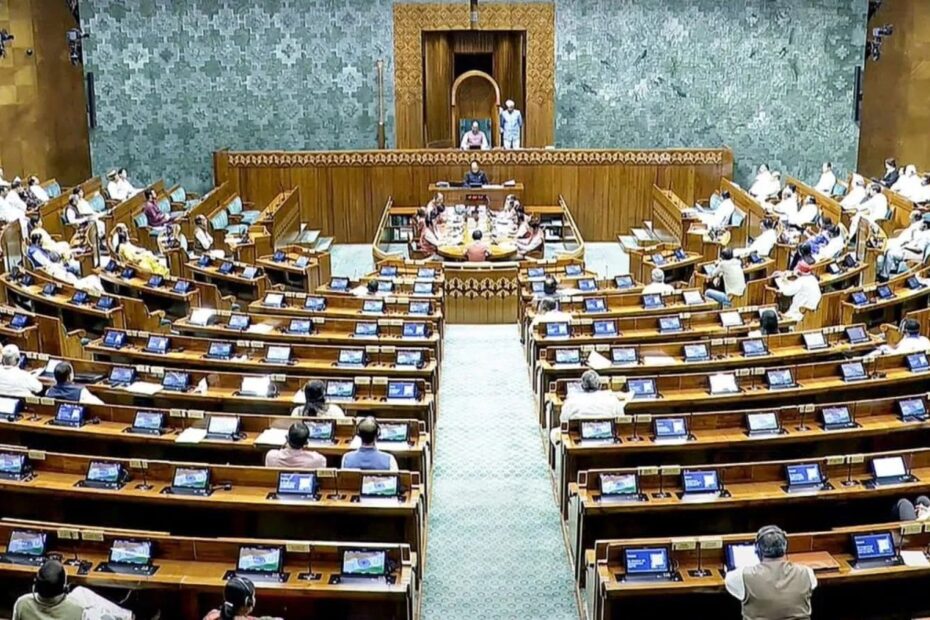
Two months after its first attempt to pass a Constitution amendment to operationalise delimitation and women’s reservation was defeated in the Lok Sabha in April, the government now plans to reintroduce it with some changes that clarify that the number of seats of all states in the Lok Sabha with an enhanced strength of 850 seats will be in proportion to their existing numbers.
According to at least two senior government functionaries, talks are ongoing with the DMK, which recently lost the Assembly elections in Tamil Nadu. With Lok Sabha MPs of Trinamool also resigning, issue-based support may be forthcoming from both the DMK and the Trinamool Congress, they said. Both had earlier rejected the Constitution amendment Bill.
Advertisement
The government plans to retain the 1971 Census in which the increased number of seats will be allocated among states while increasing the maximum strength of the Lok Sabha from 550 to 850, a senior government functionary and BJP leader told The Indian Express.
Read | Centre aims to revive delimitation Bill, push joint polls by 2029
A Delimitation Commission, to be set up following the enactment of a separate Delimitation Bill, will decide on how the new Lok Sabha and Assembly constituencies will be redrawn.
For the division of Assembly constituencies within states, the 2011 Census could be the basis, changing from the current basis of 2001 Census, one of the two functionaries said.
Advertisement
The Indian Express had reported on May 15 that the government had reached out to the DMK with proposed changes to the Bill in order to implement the delimitation before the 2029 Lok Sabha elections. DMK sources had said Tamil Nadu’s interests and federal rights should be protected, while dismissing any talks of allying with the BJP as premature.
As of now, Article 81 (3) of the Constitution says the allotment of Lok Sabha seats to states and the division of states into territorial constituencies would be as per population “at the last preceding Census”, until the figures for the first Census taken after 2026 are published.
Explained | Delimitation: At heart of row, value of a vote, fiscal imbalance
A senior government functionary argued that if the Constitution amendment is not passed, the delimitation process would get automatically triggered when the ongoing 2027 Census, which has a reference date of March 1, 2027, is completed next year. This would mean that the gap between the Northern states and Southern states in terms of population, and therefore the distribution of seats, would widen.
Opinion | After defeat of delimitation bill, South India must confront inequalities within
“This is one good reason for southern states to agree to what is being proposed,” the functionary said, referring to Union Home Minister’s earlier statement in Lok Sabha that each state’s number of Lok Sabha seats would go up by 50% when the Lok Sabha strength goes up from 543 now to 816.
But the southern states had then refused to buy Shah’s oral commitment in Lok Sabha on April 17 during the debate on the three bills — Constitution (One Hundred and Thirty-First Amendment) Bill, 2026, The Delimitation Bill, 2026, and Union Territories Laws (Amendment) Bill, 2026. “The delimitation commission will be chaired by a Supreme Court judge who will be appointed by the government… The Home Minister said that a 50% increase in seats will occur… What happens if the delimitation commission doesn’t listen to the home minister… Where will we go for justice,” DMK MP Kanimozhi Karunanidhi asked in Lok Sabha during the debate.
Delimitation and Census
A big concern around delimitation is the year of Census to be used for deciding how Lok Sabha seats will be allocated among states. The Bill is likely to clarify that seats will be proportionate to states’ population as in Census 1971.
But there is a lot at stake for southern states now, argued the senior BJP leader and government functionary. If the size of the Lok Sabha is not increased, then the southern states would see a reduction in seats, which would be more if the basis is 2027 instead of 2011. In case the Opposition does not agree, the freeze on readjustment of seats that has been there for the past 50 years would expire as soon as the 2027 Census is notified next year, automatically triggering delimitation on the basis of this Census, BJP sources said. This would mean that the Southern states would see a reduction in their seats.
As of now, the Lok Sabha seats are allotted on the basis of the 1971 Census and the Assembly constituencies on the basis of the 2001 Census.
The Constitution (One Hundred and Thirty-First Amendment) Bill, 2026 had sought to amend Article 81 (3) to define the population on the basis of which the allotment of seats would be done as “population as ascertained at such census, as Parliament may by law determine”. The Opposition had wanted an assurance on which Census would be used for the same, which the Bill had not specified.
Home Minister Amit Shah had said during the debate that “no injustice would be done to any state, particularly to the states of South India”. He had said the proportion of seats allocated to each state as of now would be maintained if the Lok Sabha’s strength was increased to 816. He said Karnataka’s seats would increase from 28 to 42, with its share of total seats going from 5.15% to 5.14%. Similarly, Tamil Nadu’s seats would go from 39 to 59, with the seat share going from 7.18% to 7.23%; Andhra Pradesh’s seats would increase from 25 to 38, with its share increasing slightly from 4.60% to 4.65%; Telangana’s seats would go from 17 to 26 and its share from 3.13% to 3.18%; and Kerala’s seats from 20 to 30 and its share from 3.68% to 3.67%, as per the data given in the Lok Sabha.
After the Bill was negatived, Parliamentary Affairs Minister Kiren Rijiju asked the Speaker not to take up the other two Bills that were moved – the Delimitation Bill, 2026 and the Union Territories Laws (Amendment) Bill, 2026 – saying that they were linked to the Constitution amendment Bill. These two Bills are yet to be withdrawn and remain pending in the Lok Sabha.
Government sources say the government has the option of bringing the same Constitution Bill to Parliament in the Monsoon Session or make some amendments, get it cleared by the Cabinet and then introduce it. Even if the Constitution amendment Bill is not passed, the delimitation Bill can be passed with a simple majority, they said.