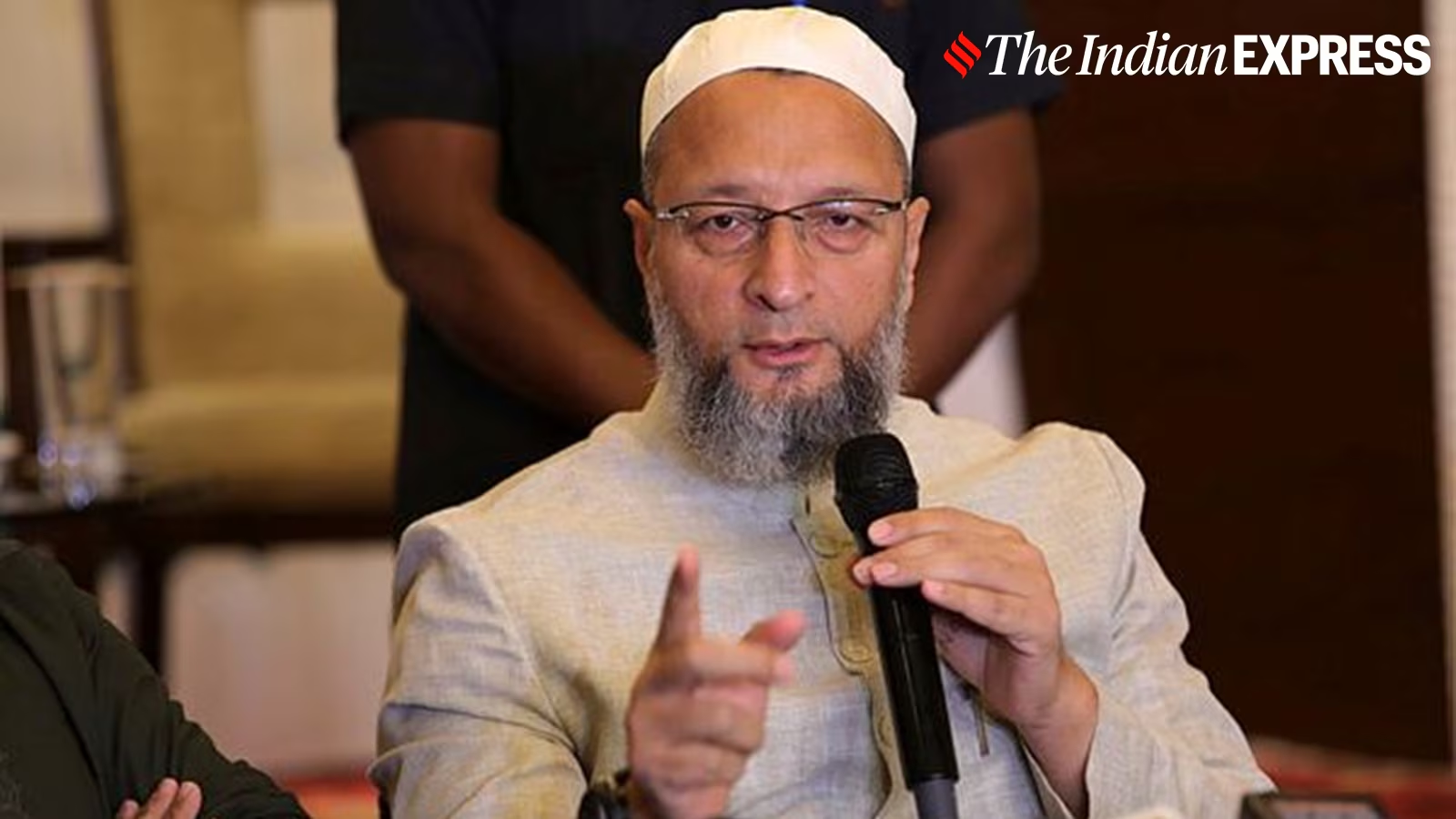
A war of words has erupted again between AIMIM chief Asaduddin Owaisi and Union Minister for Minority Affairs Kiren Rijiju over the status of Muslims as a minority community.
In response to Rijiju’s statement comparing the demographic size of Muslims with Parsis, a small minority group, Hyderabad MP Owaisi said the “minister is indulging in propaganda to deny Muslims their fundamental rights under Article 30”.
Advertisement
Their sharp exchange puts the spotlight on a larger question: Who constitutes a minority in India?
Political row
In an interview to The Indian Express last year, Rijiju had said that “minorities receive more government support” than Hindus. “The main point we have to understand is that minority communities are receiving more funds and support from the government than the majority community, the Hindus. Whatever the Hindus get, the minorities also do. But what the minorities get, the Hindus don’t,” the minister had said.
Earlier this week, addressing a conference of the State Minorities Commissions organised by the National Commission for Minorities in Delhi, Rijiju said, “… if we look at the Muslim population in India as a separate country, it could be the sixth-largest country”, while Parsis with a population of about 52,000 would constitute a town or a village. Still, both Parsis and Muslims have the status of minorities in the country, he said.
Advertisement
Flagging Rijiju’s statement, Owaisi, in an X post, posed a “simple math question” to him. Comparing the population of the Hindu community with Muslims, the AIMIM chief asked, “What is bigger? 79.8% or 14%? If Hindus are the majority community, then every non-Hindu group is a minority community.”
Joining issue with Owaisi on X, Rijiju replied: “You’re the tallest Muslim leader in India as you always speak for Muslim rights. But remember, Congress has become a Muslim League party.” This was a reference to the large number of Muslims elected on Congress ticket in the recent Assembly elections. He also said, “Every Indian is equal. Even Parsis with around 53,000 population are as safe as the Muslims. Every religion has flourished in India. Only the population of Parsis and Hindus (in percentage) have come down (in) India.”
Definition of a minority
The Constitution does not define a “minority” even when it offers fundamental protections to them. Articles 29 and 30 safeguard the protection of the interests of minorities and the right of minorities to establish and administer educational institutions of their choice, respectively.
The framers of the Constitution deliberately left it to the Executive to define who is a minority. However, the term minorities is constitutionally understood in two contexts: religious and linguistic.
Statutorily, the National Commission for Minorities Act, 1992 provides a definition: “minority” is a community notified as such by the Central government. This law empowers the government to notify “minority communities”.
Currently, six religious communities are recognised as minorities at the national level. These are Muslims, Christians, Sikhs, Buddhists, Parsis, who were notified in 2013, and the latest one, Jains, who were added in this list in 2014. This is a Central notification that entitles communities to benefits under government welfare schemes, including scholarships, Waqf protections, and various Ministry of Minority Affairs programmes.
Determining minorities
Over the years, there have been various political and legal calls for determining the status of minorities state-wise, rather than nationally.
The argument from the right is that in a state like Jammu and Kashmir, where Muslims form a majority, they should not be considered a minority at the Central level.
In the landmark ruling on minority educational institutions in TMA Pai v State of Karnataka in 2002, a Constitution Bench of the Supreme Court stated that linguistic minority status is to be determined state-wise. “Linguistic and religious minorities are covered by the expression ‘minority’ under Article 30 of the Constitution. Since the reorganisation of the State in India has been on linguistic lines, for the purpose of determining the minority, the unit will be the State and not the whole of India. Thus, religious and linguistic minorities, who have been put on par in Article 30, have to be considered State-wise,” it ruled.
SC challenge
In 2021, BJP member Ashwini Upadhyaya filed a petition in the Supreme Court, arguing that Muslims are a majority in Lakshadweep (96.20%) and Jammu & Kashmir (68.30%), and that Christians form a majority in Mizoram, Meghalaya, and Nagaland. Similarly, Sikhs form a majority in Punjab.
As per the 2011 Census, Upadhyaya’s plea argues, Hindus are a numerical minority in eight states and Union Territories: Lakshadweep (2.5%), Mizoram (2.75%), Nagaland (8.75%), Meghalaya (11.53%), Jammu & Kashmir (28.44%), Arunachal Pradesh (29%), Manipur (31.39%), and Punjab (38.40%).
The petition challenges provisions of the National Commission of Minorities Act, arguing that a nationwide determination of minority status is “arbitrary, irrational and offensive”. The matter has been pending before the apex court.