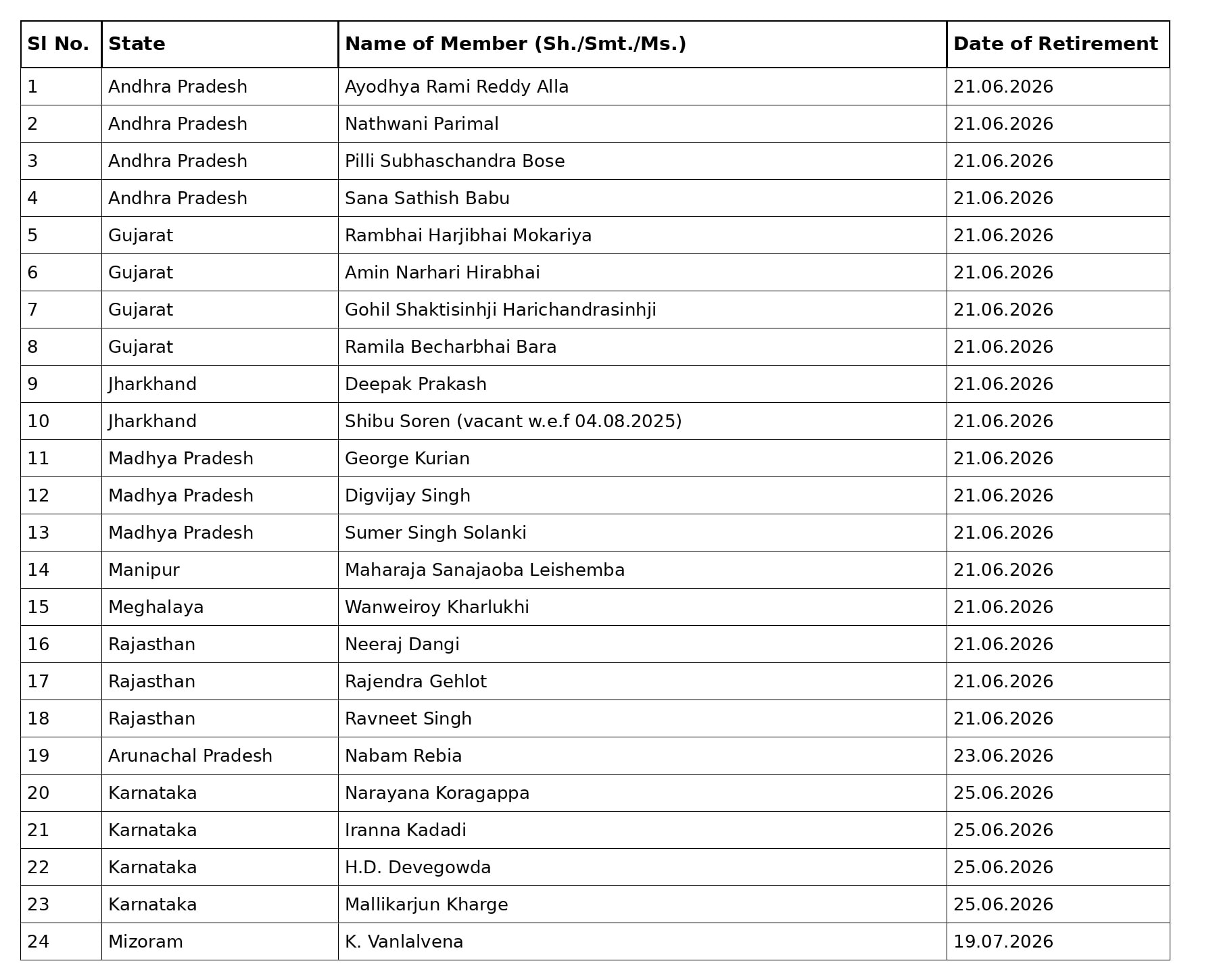
The Election Commission on Friday announced elections to 24 Rajya Sabha seats across 10 states, which fall vacant this June and July, on June 18. The counting of votes will take place the same evening.
With the BJP’s current strength at 113 and the NDA at a consolidated tally of 148 in the Rajya Sabha, the BJP-led alliance is 15 MPs short of the two-thirds majority in the 245-member House required for significant legislative business such as Constitution amendments. While the NDA is unlikely to achieve this, it will register gains of four seats in Andhra Pradesh and Gujarat taken together and possibly suffer the loss of one seat each in Karnataka and Jharkhand, given how the numbers are stacked. The NDA tally is likely to climb further but still fall short of a two-thirds majority. The government needs to have a two-thirds majority in a House to pass any Constitution amendment Bill.
Advertisement
Among the well-known MPs whose seats will fall vacant are Union Minister Ravneet Singh Bittu from Rajasthan, Congress president Mallikarjun Kharge from Karnataka, former Prime Minister and JD(S) leader H D Deve Gowda from Karnataka, former Union minister and Congress leader Digvijaya Singh from Madhya Pradesh, and former Gujarat state Congress president Shaktisinh Gohil.
Four Rajya Sabha MPs each from Andhra Pradesh and Gujarat, three each from Madhya Pradesh and Rajasthan, and one each from Manipur and Meghalaya will retire on June 21. Elections will also take place for two seats in Jharkhand, one of which falls vacant on June 21 and another, that of late JMM leader Shibu Soren, that fell vacant on August 4, 2025, with his death. One seat in Arunachal Pradesh will fall vacant on June 23, four from Karnataka will fall vacant on June 25, and one from Mizoram will be vacant on July 19.
The RS election process
Rajya Sabha MPs are elected by elected members of state legislative Assemblies through the system of proportional representation by a single, transferable vote. The term of a Rajya Sabha member is six years and one-third of the members retire every two years. This ensures continuity, as the Rajya Sabha is a permanent body that is never dissolved, unlike the Lok Sabha.
Advertisement
Also Read | Amid buzz of Union Cabinet reshuffle, BJP eyes organisation rejig, elevation of RS picks
To calculate the quota at which a candidate wins the election, the total number of MLAs voting in a state is divided by the number of seats going for elections plus 1. To the number that comes, 1 is added to calculate the quota.
However, the system followed is that of a single transferable vote. So MLAs who vote — there is an open ballot in the Rajya Sabha polls — can mark their first, second, third, etc, preferences. Every candidate getting enough first preference votes to reach the quota will be declared elected. If this does not fill all the seats, the surplus votes — votes secured above the requisite quota — of those already elected are transferred to those candidates who were the second preference candidates of the MLAs who gave the already victorious ones their first preference. If more than one victorious candidate has surplus votes, the largest surplus will be transferred first.
If even this does not fill all vacancies, the candidate with the lowest number of first preference votes is eliminated, and the second preference votes on his ballot paper are transferred to those candidates. This process goes on till all seats are filled.
Possible scenarios
Among the four seats falling vacant in Karnataka, three are with the NDA — two with the BJP alone — and one is with the Congress. However, this is set to change, as the 224-member Assembly right now has 135 Congress MLAs, 66 BJP MLAs, and NDA ally Janata Dal (Secular), or JD(S), has 16. So, the quota to win the Rajya Sabha polls here is 46. In this scenario, the Congress is sure to get two seats, up from one at present, and the NDA is sure to get one seat. The fourth seat will depend on how the MLAs cast their votes.
In Andhra Pradesh, the YSRCP of Jagan Mohan Reddy has three seats among the four falling vacant, and one is held by the ruling Telugu Desam Party (TDP). This too shall change, as the present party position in the 175-member Assembly is 135 for TDP, 21 for JanaSena Party, eight for the BJP, and 11 for the YSRCP. The quota to win is 36. In this situation, the NDA with 164 seats is sure to win all four seats.
In Gujarat, the BJP at present has three seats out of the four falling vacant and the Congress one in the 182-member House. The quota to win any of the four seats is 37. With the BJP having 156 MLAs and the Congress 17, all four seats are set to go to the BJP.
In Rajasthan, the BJP has two and the Congress one among the three seats falling vacant in the 200-seat Assembly. The quota to win a seat is 51. With the BJP having 115 seats and the Congress 69, the BJP is again expected to bag two seats and the Congress one.
In Madhya Pradesh, the BJP has two among the three seats falling vacant and the Congress 1 in the 230-seat Assembly. The quota here is thus 58, while the present strength of the BJP and the Congress is 163 and 66, respectively. The BJP thus seems set to bag two seats again, and the Congress one, unless the BJP springs a surprise by bagging all three.
In Jharkhand’s 81-member Assembly, the quota is 28, as two seats are falling vacant. As of now, the BJP and JMM share one each. Given the present strength of 56 for the INDIA bloc and 24 for the NDA, the Opposition will look to clinch both seats, while the NDA will try to bag one through strategy.
Party strategies
A party first calculates the quota required to win a seat. Then it counts its MLAs. So, if it has 100 MLAs and the quota is 41, it will tell each of its MLAs which candidate they have to vote for in such a manner that 82 MLAs make two candidates win. Its third candidate will get 18 first preference votes and is unlikely to win. But even here, parties try to ensure cross-voting, or to convince Independents or smaller parties to vote for those of their candidates who cannot win only by means of first preference votes.
They also try to prevent cross-voting by their own MLAs. For this, since 2003, there has been an open ballot system wherein all party MLAs must show their ballot papers to authorised agents of their parties. Otherwise, their vote will become invalid. This ensures that there is fear of party action by any MLA wanting to cross-vote. Independent MLAs do not show their ballot papers to anyone.