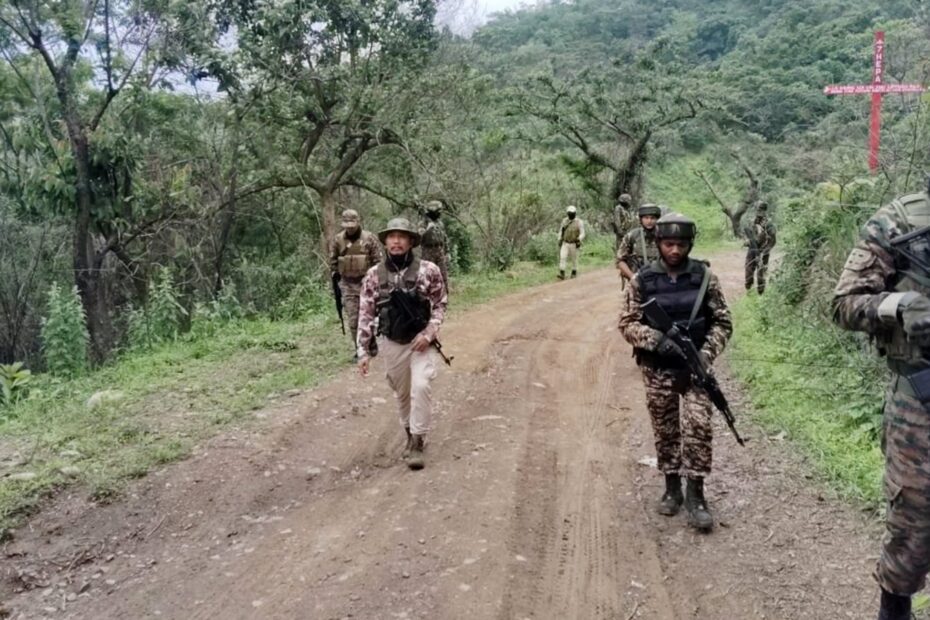
As a hostage crisis involving six missing Naga men allegedly abducted by armed Kuki groups in Manipur’s Kangpokpi district continues to unfold, security officials are trying to piece together how the state’s ongoing Meitei-Kuki conflict has now transformed into an equally dangerous Naga-Kuki confrontation – one that security agencies now believe is being driven by a complex mix of territorial ambitions, political calculations and a shifting geography of the illicit drug trade.
On May 13, after the killing of three church leaders, tensions erupted between Manipur’s Kuki and Naga communities and dozens of villagers from both sides were abducted and held captive in Kuki-Zo-majority Kangpokpi district and Naga-majority Senapati district. After a day-long stand-off, both sides released 14 individuals each. However, Naga groups in Senapati continue to hold on to 14 captives, demanding the release of six people who they claim were abducted by Kuki groups and are still missing. Kuki groups maintain they have released all hostages.
Advertisement
With security forces unable to find six Naga men nine days after they went missing, and 14 Kuki men still being held hostage, Manipur remains on edge. Highway blockades have meant hundreds of trucks are stranded, paralysing everyday life.
Officials say tensions between the two communities have existed for decades owing to the history of Naga-Kuki clashes in the 1990s. But they believe a combination of recent developments – including competition over territory, changes in smuggling routes and political ambitions – has sharply aggravated the faultlines.
From village clashes to armed mobilisation
What began as a drunken brawl in a small village in Manipur’s Ukhrul district in February has spiralled into a widening and increasingly militarised ethnic conflict between Nagas and Kukis.
Advertisement
The violence, which initially erupted in and around the mixed-population Litan-Sareikhong area of Ukhrul district on February 7, has since spread across Ukhrul, Kangpokpi and Kamjong districts up to the Indo-Myanmar border, drawing in armed militant groups, triggering abductions and ambushes, and opening up a volatile new front in Manipur’s already fractured ethnic landscape.
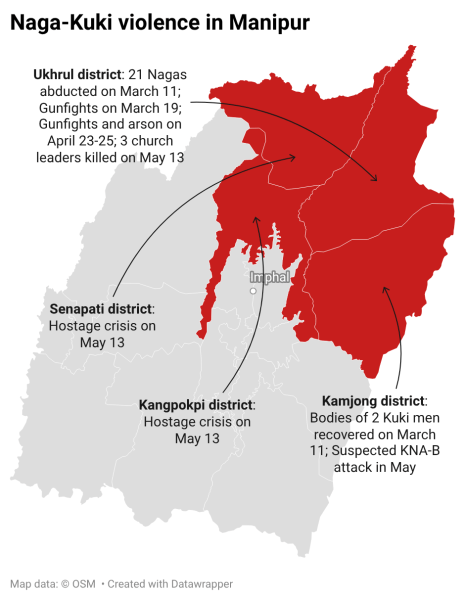
After a brief lull, the violence resurfaced in March in a more organised form. On March 11, 21 Naga passengers travelling on the Ukhrul-Imphal road were allegedly abducted near Mongkot Chepu by suspected armed Kuki volunteers. They were released the next day after negotiations involving state officials and civil society groups.
 Naga Kuki violence in Manipur
On the same day, bodies of two Kuki men, suspected to have been kidnapped by Naga volunteers, were recovered in a forest in Kamjong district. The incident marked a sharp escalation from sporadic village clashes to coercive armed mobilisation.
Barely a week later, on March 19, fresh gunfights broke out near Sirarakhong, Sinakeithei and Mongkot Chepu villages in Ukhrul district. Police sources said suspected Kuki militants armed with heavy weapons attempted to enter Sirarakhong, a Tangkhul Naga-dominated village, triggering armed resistance by local volunteers.
By late April, the conflict had intensified further and spread geographically. Between April 23 and 25, major gun battles and arson attacks were reported in Mullam, Shongphel and Sinakeithei areas of Ukhrul district. Multiple people were killed and several houses burnt in what became the most serious flare-up since February.
Tangkhul Naga civil society groups and local police accused suspected Kuki militants of carrying out pre-dawn attacks on Tangkhul Naga villages. Kuki organisations, meanwhile, accused Naga insurgent groups of targeting Kuki settlements, with each side blaming the other for initiating attacks.
Myanmar border becomes new flashpoint
The conflict took an even more worrying turn in early May when armed assailants attacked Tangkhul Naga villages close to the Indo-Myanmar border in Kamjong district, including Namlee, Choro and Wanglee. Several villagers were injured and houses vandalised and set ablaze. The Kuki National Army-Burma (KNA-B), a banned faction of the Kuki National Army operating out of Myanmar, was suspected to have been behind the attack.
The attacks stood out for two reasons. First, they marked a shift of the violence eastwards towards the Myanmar border after initially remaining concentrated around western Ukhrul and adjoining Kangpokpi. Second, they appeared to bring Myanmar-based militant formations directly into the conflict.
Officials believe the KNA-B may have acted in coordination with Kuki militant organisations operating in Manipur under ceasefire arrangements with the government.
“They do not have a strong local presence in Kamjong. So, there is suspicion that cross-border cadres may have been used for operations in the area. The conflict suddenly shifted to the Indo-Myanmar border, which is why investigators are also examining the role of illicit trade networks,” a Manipur police officer said.
The battle for drug trade
According to security establishment sources, the shifting geography of drug smuggling routes is emerging as a major factor behind the new faultlines.
Officials said until recently, the Moreh border town in Tengnoupal district functioned as the principal transit point for trafficking of narcotics and other illicit goods into Manipur. However, the ethnic violence since 2023 has left Moreh largely under Kuki control.
“Kuki groups effectively control the Moreh side, but their access to Imphal – where the financial networks and handlers sit – has become difficult because of the conflict. This has disrupted the old chain,” a security establishment officer said.
According to officials, trafficking networks have increasingly begun using routes through Kamjong district as an alternative corridor. But unlike Moreh, Kamjong is dominated by Tangkhul Nagas, raising fears among Kuki militant groups that the trade – and the revenues flowing from it – may gradually shift under Naga influence.
“This has created friction between armed groups on both sides,” the officer said.
The fear of a ‘Kuki corridor’
Alongside the competition over smuggling routes, security agencies also believe the violence is being shaped by competing territorial anxieties.
Kuki groups increasingly argue that the February violence in Litan was used as a pretext to push Kukis out of mixed-population areas in Ukhrul district. Naga groups, meanwhile, suspect Kukis are attempting to establish a continuous Kuki-dominated corridor stretching across parts of Ukhrul and Kangpokpi districts.
Security officials point to repeated attacks around Sinakeithei – one of the few major Naga villages situated amid a chain of Kuki-dominated settlements – as central to these fears.
“Naga groups believe there is an attempt to drive them out of strategically located villages and create a Kuki corridor linking settlements across the region – from Litan to Saikul (in Kangpokpi). That is why retaliatory attacks by the NSCN (IM) have intensified,” said a security establishment officer, referring to the National Socialist Council of Nagalim (Isak-Muivah), a separatist faction.
Politics of separate administration
The violence has also begun intersecting with the larger political demand for separate administrative arrangements in Manipur.
Following the recent clashes, the Kuki-Zo Council renewed its demand for separate administration for Kukis, Nagas and Meiteis in a memorandum addressed to Prime Minister Narendra Modi.
“The continuing conflict in Manipur has deeply fractured relations among the Meitei, Naga, and Kuki-Zo communities,” the memorandum stated, adding that “a lasting and peaceful solution” lay in separate administrative arrangements for the three communities.
Security officials say prolonged instability often strengthens such political demands by hardening ethnic boundaries and reducing the possibility of coexistence.
The conflict has meanwhile acquired an increasingly dangerous pattern of retaliatory attacks and targeted ambushes.
Politicking from the Valley?
Security agencies are also examining whether repeated flare-ups are being timed to coincide with key political developments involving the new Chief Minister, Y Khemchand Singh.
Officials pointed out that the initial Litan violence erupted just three days before Singh’s proposed outreach visit to Jiribam to meet people displaced by earlier ethnic violence. Another major attack in Bishnupur district, where two Meitei children died in a rocket attack, took place shortly before Singh’s scheduled visit to the Naga-dominated Senapati district. The killing of the three church leaders in Kangpokpi on May 13, meanwhile, occurred as Singh was preparing for his first visit to Kuki-dominated Churachandpur after taking office.
“Every time the Chief Minister attempts a politically significant outreach, there appears to be a major incident. There are political actors in Imphal who would like the CM to fail. Already there are indications of the influence of these actors in some past incidents,” a Union Home Ministry official said.
A self-sustaining conflict
For security agencies, the concern now is that what began as a localised clash in Ukhrul has evolved into a far more fragmented and multi-layered conflict – involving rival ethnic assertions, militant groups operating across the Myanmar border, political instability and competing control over strategic routes and territory.
With retaliatory violence spreading across districts and armed groups increasingly active along the Indo-Myanmar frontier, officials fear the conflict may become self-sustaining unless a political and security intervention is mounted quickly.