
Set up on March 20 in the run-up to the West Bengal elections, 12 of the 19 Supreme Court-ordered Appellate Tribunals disposed of 6,581 appeals out of 24.98 lakh filed — 0.26% — against decisions of Judicial Officers during the Special Intensive Revision (SIR) of electoral rolls, The Indian Express has learnt.
Till May 14, the 12 tribunals, covering 17 of the state’s 23 districts, accepted 4,043 appeals and rejected 1,267, according to official data accessed by The Indian Express. These appeals include both those filed by citizens whose names were deleted from the rolls and those filed by the Election Commission against inclusions ordered by the judicial officers.
Advertisement
While the data does not mention the status of the remaining 1,271 appeals, EC sources in Kolkata and Delhi have said that some of the appeals were filed by those who had been included in the rolls through supplementary lists published before the polls, which meant their appeals did not require action.
Also Read | 65 on Bengal poll duty among SIR exclusions, Supreme Court says approach tribunals
Of the total disposals, 27%, or 1,777, were from Kolkata North and Kolkata South districts, handled by the tribunal of retired Calcutta High Court Chief Justice T S Sivagnanam, who resigned on May 7, and later cited personal reasons. A total of 51,234 appeals remain pending in the two districts.
The two districts with the highest number of appeals and deletions, Murshidabad and Malda, had just over 100 disposals each as of May 14. Murshidabad, with 6,29,392 appeals, had 112 disposed; Malda, with 5,26,215 appeals, had 185. Across the 12 tribunals, 98 appellants appeared in online mode and 21 in offline mode.
Advertisement
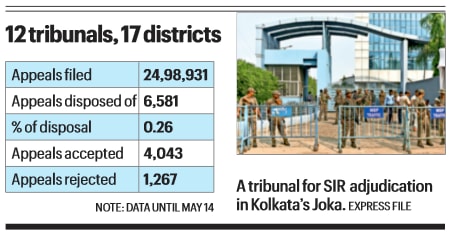 Nearly 25 lakh appeals filed
EC sources say total disposals now stand at around 10,000. The commission is yet to make public the total number of appeals filed and disposed. During a hearing on April 13, the Supreme Court had noted that 34 lakh appeals had been filed against exclusions and inclusions in the West Bengal electoral rolls.
Also Read | Bengal SIR: TMC won 13 of 20 seats with highest voter deletions
On February 20, the Supreme Court had taken the unprecedented step of ordering judicial officers to decide on the eligibility of electors in West Bengal, after noting the trust deficit between the Election Commission of India and the then-Trinamool Congress government.
Acting on the court’s orders, the Calcutta High Court recommended around 700 judicial officers for the task. These officers decided on the eligibility of 60.06 lakh electors flagged by the EC’s algorithm for “logical discrepancies” in identity documents submitted during the SIR. Just weeks before the Assembly elections on April 23 and 29, they deleted 27.16 lakh names from the rolls.
Also Read | Calcutta High Court denies bail to West Bengal poll candidate who ‘attacked’ judges during SIR drive
On March 10, the Supreme Court ordered an appellate mechanism for those aggrieved by the decisions of the judicial officers. On the recommendation of Calcutta High Court Chief Justice Sujoy Paul, the Election Commission notified 19 appellate tribunals, all comprising retired High Court judges, on March 20.
Even as elections neared, the tribunals were slow to start. After the court ordered that all those cleared by the tribunals up to 48 hours before polling be added to the rolls, 1,607 names were restored, leaving the remaining 27.16 lakh deleted electors unable to vote in the Assembly polls.
The EC had on June 24 last year decided to conduct the SIR of electoral rolls, breaking from two decades of practice in which rolls were summarily revised annually and ahead of polls. The intensive revision involves preparing rolls afresh. The EC’s SIR order and the process adopted, including the unprecedented document-based verification of existing electors, has been challenged in the Supreme Court.