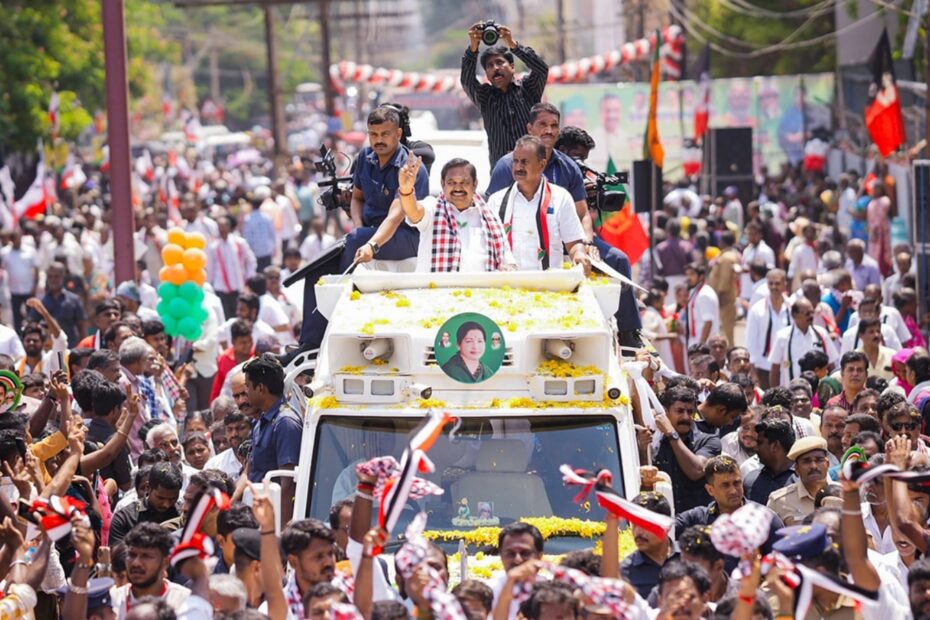
AIADMK general secretary and former chief minister Edappadi K Palaniswami, popularly known as EPS, who steered the Dravidian major through its most turbulent phase after J Jayalalithaa’s demise, is now projecting himself as a leader who could bring change to Tamil Nadu and cohesion to his party. EPS, 71, is spearheading the Opposition AIADMK-led NDA in the April 23 state Assembly polls.
In the course of an interview with The Indian Express, EPS argues that this election will be determined by issues like law and order, unemployment and public resentment with the incumbent M K Stalin-led DMK which, he says, has run “a government of announcements without outcomes”.
Advertisement
After travelling through nearly 200 of the state’s 234 constituencies, EPS says he has seen a “growing appetite for change” and a “renewed public belief” that the AIADMK, under a leadership that preserved its unity post-Jayalalithaa years, can return as a “stable alternative”.
“There is a clear and unmistakable trend for change,” he says. “The discontent is visible, vocal, and deeply felt.”
He makes familiar but sharp allegations against the DMK government — that promises have outrun delivery, insecurity has deepened, unemployment has risen and that the government, despite its claims about welfare and efficiency, appears “distant from people’s distress”. “Farmers speak of procurement delays, women worry about safety, and youth have recurring anxiety about jobs,” he says.
Advertisement
There are glimpses, too, of an astute politician beneath these talking points. When asked about a lingering memory from his recent canvassing, he says: “There was an elderly woman who held my hand and asked, ‘When are you coming back?’ It was not a political question, it came from a place of trust and expectation.”
He then goes on to underline that “listening is the foundation of effective leadership”. “If I am able to stand for hours and address people on the campaign trail, it is because I have spent years listening to farmers, workers, women, and youth. Their experiences shape my understanding and guide my decisions.”
EPS’s central plank against the DMK is public safety. “The DMK government’s most serious failure has been the breakdown of law and order,” he says. He says people across Tamil Nadu feel “insecure” in a way they did not earlier, attributing it to rise in violent crimes, atrocities against women, and drug menace. “Drug abuse is no longer confined to isolated pockets – it is spreading across districts and is directly spurring criminal activities,” he says, pledging to take decisive action to make the state “drug-free” if voted to power.
Governance cannot be reduced to just a publicity exercise, the AIADMK chief says, adding that it has to produce measurable outcomes. “Many schemes are announced with fanfare but do not translate into visible gains on the ground.”
Besides law and order and unemployment, the need for an “efficient and transparent government” are the “three defining issues” of this election, he says. When asked about his message to youth, he says they should realise that their vote is not just a right but also a responsibility that will shape the state’s future. “You must look beyond slogans and evaluate performance, intent, and credibility of the candidates and political parties,” he says. He cites 7.5% special reservation for government school students in professional courses introduced during his tenure, saying it benefited more than 40,000 students. His pitch is clear: The AIADMK wants young voters to believe that it has not only flagged their aspirations but has also taken legislative initiatives for it.
NDA alliance
Palaniswami’s justification of his alliance is less defensive than it might once have been. “AIADMK has the strength and organisational depth to fight alone,” he says, but argues that an alliance in a democracy serves a larger purpose. He frames the NDA coalition in pragmatic terms: the BJP ruling the Centre under Narendra Modi offering “decisiveness”, and the AIADMK offering a “proven record of delivery” in the state. His emphasis is not on ideological chemistry so much as on stability.
He draws a comparison with the DMK dispensation. “The difference is fundamental,” he says, adding that governance under Stalin has turned into
a “family-centred exercise”. He highlights Udhayanidhi Stalin’s elevation as the Deputy CM, prominence of Kanimozhi, and influence of Sabareesan, Stalin’s son-in-law. In contrast, he claims the AIADMK, shaped by the legacies of M G Ramachandran and Jayalalithaa, remains a party where any worker can rise, and which “sees governance as service rather than inheritance”.
On Tamil film superstar-turned-politician Vijay’s plunge into the polls, EPS’s reply is measured rather than dismissive. “Any new entrant into politics must ultimately be judged by electoral performance,” he says. “Public meetings and crowds can create visibility, but elections are about converting that into votes.” He invokes Sivaji Ganesan to underline the distinction between celebrity and electoral success, and says it is too early to draw any conclusion about the Vijay-led TVK in its poll debut.
EPS’s arc
Palaniswami, who hails from Edapadi in Salem district in the Kongu belt, belongs to an agrarian family, who built his career steadily through the AIADMK ranks. A multiple term-legislator from Edapadi, he has been known earlier as a loyalist of both Jayalalithaa and her close aide Sasikala, his political instincts forged less by theory than by obedience, organisational work and survival.
While his critics call him volatile and high-handed, another section in political circles call him a leader of few words and a “capable administrator”. Now, he prefers another formulation as his marker: listening to people, accessibility and simplicity. Asked what has remained unchanged from his days as a first-time MLA, he says: “I remain the same person I have always been. I believe in simple, direct engagement – meeting people without barriers, treating everyone with respect, and staying grounded.”
With less than a week left for voting, EPS does not think of taking any breaks from his intense campaigning. He says being among the people in districts infuses him with energy. Earlier, he says, he occasionally enjoyed watching cricket, especially when Chennai Super Kings were playing well in the IPL.