
For many Mexican Americans and Californians of a certain age and political stripe, Cesar Chavez had long since secured his standing as a kind of secular saint.
He had all the markers for beatitude: helping form a union to represent poor and mistreated farm workers; insisting on non-violence, even in the face of anti-union thuggery; fasting for weeks on end to bring attention to mostly forgotten field hands.
But reporters who spent time probing more deeply into Chavez’s United Farm Workers of America also came to understand that the union’s co-founder was abundantly flawed and frequently not held to account by his allies, a recipe that could lead to trouble.
The depths and depravity of those flaws only came into full view this week, with the New York Times’s publication of an expose, which revealed that the iconic human rights champion had been accused of sexually assaulting two under-aged girls in the 1970s as well as fellow farmworker leader Dolores Huerta in the 1960s.
The persuasive evidence of Chavez’s wrongdoing landed as both a shock and as sadly in keeping with what has been revealed in recent years about how powerful men abused their positions of authority to assault and rape women and girls. That knowledge comes atop earlier warning signals: Chavez became increasingly paranoid and autocratic, particularly in his later years with the union. (He died in 1993 at age 66.) He purged many of the UFW’s most persuasive and popular organizers, after deeming they insufficiently willing to bend to his directives. Chavez even employed teachings from Synanon, the substance-abuse recovery organization that devolved into an abusive cult.
Days before his legacy took its biggest hit, the UFW’s legion of followers on the political left began exchanging messages about the rumored New York Times investigation. On Wednesday, a few activists who I talked to already whipsawed through the stages of grief — with very little denial, given the evidence, but heaping portions of anger and depression.
“I left high school to go work for the union,” one told me. “This is terrible, just terrible.”
Many of the disenchanted sounded like they might have been channeling Esmeralda Lopez. She is one of the women who told the New York Times about her ordeal. She described how, as a 19-year-old, a 61-year-old Cesar Chavez tried to persuade her to have sex with him. She found herself alone with the union leader in a camper attached to a pickup truck and said she rebuffed his overture. Ten months later, she said she lost her job at a union health clinic.
“It makes you rethink in history all those heroes,” Lopez said. “The movement — that’s the hero.”

Adela Leon yells her support for farm worker’s rights at a rally supporting farm workers held in front of the Federal Court House in Fresno on Wednesday.
(Tomas Ovalle/For The Times)
The “movement” meant the cause of getting better pay and working conditions for not just farm hands, but all working people. “La causa” produced scores of leaders who would go on to prominence in California unions, nonprofits and politics.
What I recall from reporting about the UFW back in the 1990s is how members spoke about Chavez with reverence. And how some close to him bristled when asked questions about his authoritarian streak and his departure from organizing, distractions that left the union’s power flagging.
They made it clear that the UFW’s co-founder was not to be questioned, even after his death, even as membership declined from its high about 80,000 in the 1970s. Those declines have been fairly steady since then, with a 2023 news story putting the union ranks at just 5,500. At that time, the union had about two dozen contracts with agricultural growers, a huge decline from about 150 in its heyday.
For the time being, the work of reinvigorating the union takes a backseat to new calls to divulge once unspeakable secrets. The UFW offered mental health counseling. The Cesar Chavez Foundation told other possible victims to come forward. The union also included a message — that may struggle to get traction in the midst of this crisis.
“The United Farm Workers is fighting to protect immigrant communities from the wage cuts, violence and attacks farm workers face today,” the message reads. “The work to support the farm workers who feed our nation is more important than ever, and this work will continue.”
Here’s more on the Cesar Chavez allegations:
‘We’re in shock’: Farmworkers grapple with Cesar Chavez sex abuse allegations
As she and Cesar Chavez made history, Dolores Huerta carried a horrifying secret
Cesar Chavez’s name is on buildings, parks, roads and calendars. Some are demanding change
And just like that, the Cesar Chavez myth is punctured. What’s next?
‘My silence ends here’: The heartbreaking burden of Dolores Huerta

Entire blocks of homes in Altadena were destroyed by the Eaton fire, shown Jan. 19, 2025. At least 19 people died in the blaze.
(Brian van der Brug/Los Angeles Times)
- Edison’s chief executive received a $16.6-million pay package — a 20% rise — despite the company’s suspected role in the deadly Eaton fire that killed 19 people.
- Edison ties most executive compensation not to safety but to its financial performance. Last year, its profit soared 200% to $4.5 billion.
- New polling shows just 52% of California voters support a one-time 5% tax on billionaires to fund healthcare, leaving proponents in a precarious position.
- The measure divides sharply along party lines: 72% of Democrats support it while 72% of Republicans oppose it.
- Judges in one of the nation’s largest court systems have started using an artificial intelligence tool that can help them summarize motions and draft rulings in civil court.
- The announcement has drawn concern from some members of the county’s legal community who fear the technology could create errors and erode public trust in the legal system.

A ‘Welcome to California’ sign is seen at Prisk Native Plant Garden in Long Beach.
(Dania Maxwell/Los Angeles Times)
Email us at essentialcalifornia@latimes.com, and your response might appear in the newsletter this week.
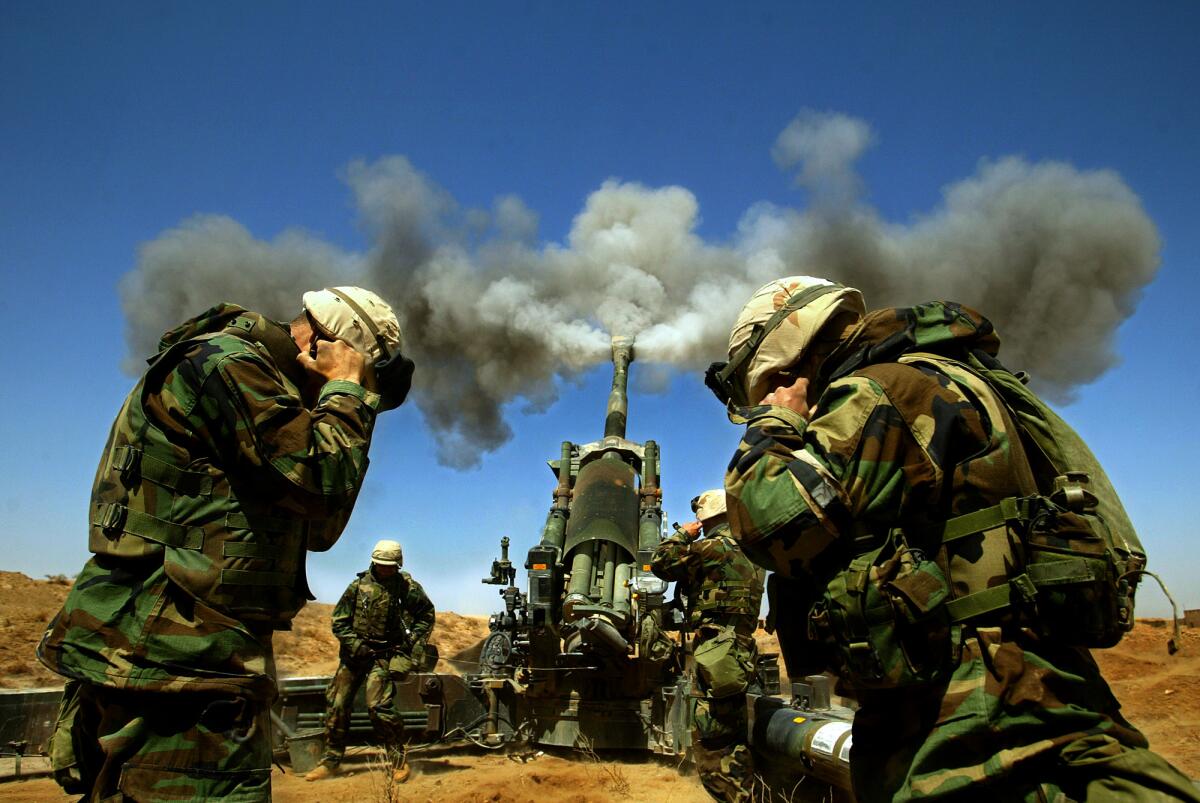
Members of the 1st battalion, 11th Marines hold their ears upon the release of an artillery round from a 155mm Howitzer headed toward a destination in southern Iraq.
(Rick Loomis/Los Angeles Times)
On March 19, 2003, President George W. Bush ordered the invasion of Iraq, to oust Saddam Hussein who was believed to be manufacturing weapons of mass destruction.
Times columnist Robin Abcarian wrote in March 2023 about the 20th anniversary of the Iraq war, which also marked a colossal failure of the mainstream media.
Jim Rainey, staff reporter
Hugo Martín, assistant editor, fast break desk
Kevinisha Walker, multiplatform editor
Andrew Campa, weekend writer
Karim Doumar, head of newsletters
How can we make this newsletter more useful? Send comments to essentialcalifornia@latimes.com. Check our top stories, topics and the latest articles on latimes.com.