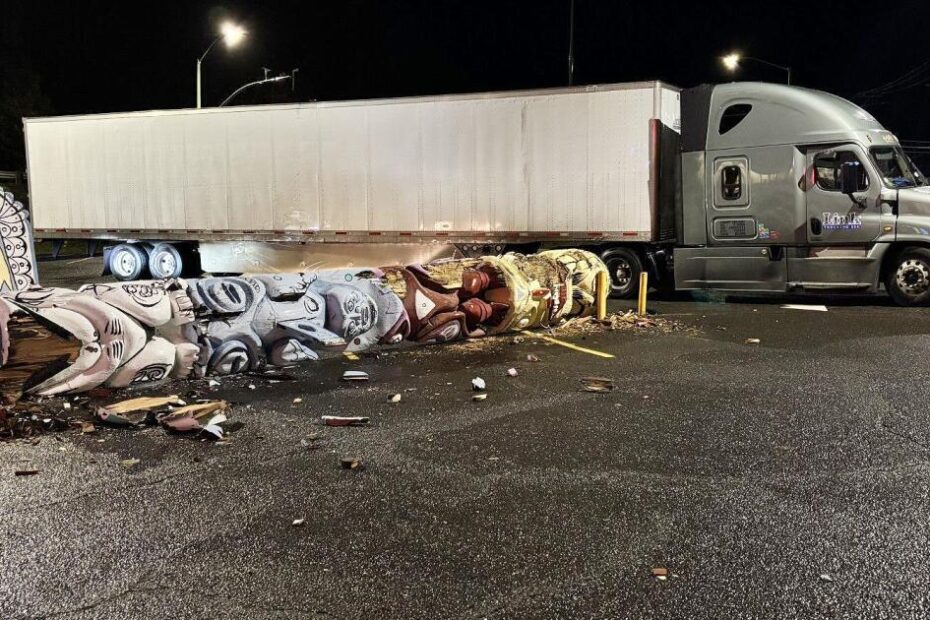
WEED, Calif. — Its big-toothed smile is busted. Its left side is shattered. Its ornate bird wing has been ripped off.
The redwood totem pole of Weed — a 32-foot roadside oddity that stood for 64 years — now lies flat in the parking lot of the Ray’s Food Place grocery store.
While on a reporting trip to Northern California a few days ago, I stopped for coffee in Weed, a historic logging town of 2,700 people about an hour south of the Oregon border. I pulled into Ray’s to check my map, and there, to my surprise, was the totem, half smiling in the rain, out by the dumpsters.
It was, according to the Weed Police Department, felled the night of Feb. 10 by a semi truck driver who knocked it over while trying to make a turn — an apparent accident.
As in so many rural places, including the Oklahoma farm towns where I grew up, the people of Weed take immense pride in their town’s history and are fiercely defensive of their home, even when the future looks uncertain and outsiders dismiss the place as dead or dying.
The totem pole was the kind of quirky thing locals brag about. Seeing it fallen, a stark symbol of the town’s recent struggles, broke my heart.
With its worn and chipped paint and its exposure to the elements, the totem pole has been slowly rotting from the inside. For decades, it was a landmark in Siskiyou County, standing tall at the intersection of Highways 99 and 97, with an epic vista of snowy Mt. Shasta behind it.
The totem pole was installed in the summer of 1962 to celebrate the opening of what was then a gleaming new Safeway store.
Weed, officially incorporated as a city just one year prior, was thriving. Amid the post-World War II housing boom, timber was king, and the town hit its peak of more than 3,200 people in the early 1960s.

The totem pole stood as a landmark in Weed since it was erected in 1962. Now, it lies flat in the parking lot of a grocery store.
(Hailey Branson-Potts / Los Angeles Times)
The totem pole was hand-carved by the Marin County artist Barney West, whose enormous redwood sculptures included another 50-foot totem pole outside a Safeway in Tahoe City and numerous giant tikis outside Polynesian-themed Trader Vic’s restaurants.
In 1969, United Press International dubbed him “the world’s most ambitious whittler.”
“Michaelangelo had his granite blocks, and I’ve got my redwood trees,” West told the wire service. “We both, if you’ll pardon the expression, let the chips fall where they may.”
West told reporters that he was aboard two U.S. Merchant Marine boats during World War II that were torpedoed and sunk in the South Pacific. He survived and on the nearby islands, he learned to carve. In his later years, he wore a seaman’s cap while he whittled and mused to a Santa Cruz Sentinel journalist in 1960 that he should put “a totem pole at every supermarket across the country.”
It was an optimistic time in rural Northern California. Then, in the 1990s, the timber industry cratered. Sawmills shuttered. Towns shrank.
The loss of the beloved totem pole outside the Weed supermarket comes amid a tough stretch for Weed, which is still recovering from a deadly 2022 fire that destroyed scores of homes.
In September, the 1917 building that once housed the historic Black Butte Saloon in downtown Weed was destroyed in a fire. City officials said they suspect it was arson.
Then in December, one of the town’s largest employers, Roseburg Forest Products, shut down its veneer mill, putting 140 employees out of work. The plant stood on the site where town founder Abner Weed, who bought the property in 1897, built his first timber mill.
In mid-January, Mount Shasta Brewing, a 23-year-old craft brewery, closed. The brewery’s chief executive told the Redding Record Searchlight that tourist traffic had dipped and that the business was looking for a new location — not necessarily in Weed.
I talked to Weed City Manager Dustin Stambaugh in December, just after the veneer plant closure was announced. He told me the town was grappling with how to care for so many suddenly jobless residents.
While the losses of recent months had been devastating, he said, city leaders “want to acknowledge that behind every situation, there is hope.”
“We’re not ignoring the pain,” he said. “You have those human moments of grief. … We’re not ignoring those feelings, but at the same time, it’s, ‘What can we salvage? How can we adapt?’”
As for the totem pole? Dan Gustafson, the director of advertising for C&K Market, which owns Ray’s Food Place, told me by email: “We are still assessing whether the Totem Pole can be repaired; if it can, we will get it back up.”
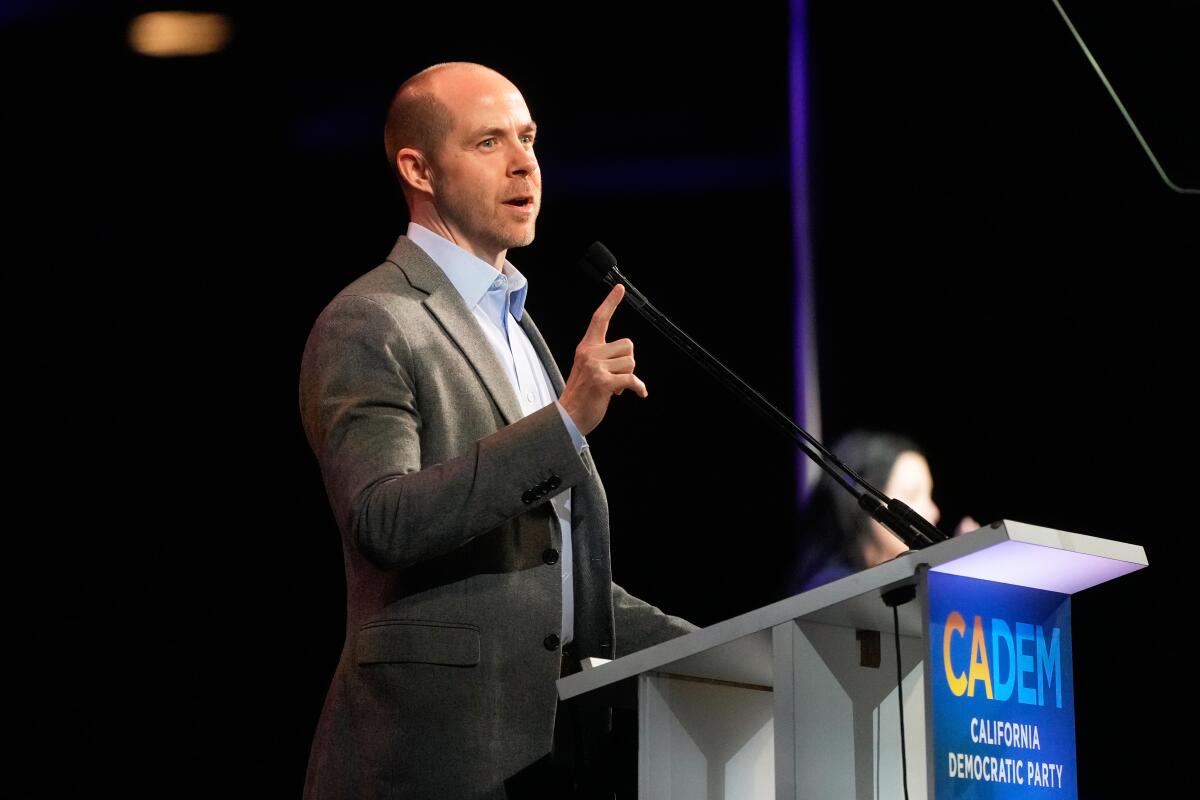
Rusty Hicks, chair of the California Democratic Party, sent a letter to Democratic candidates for governor that urged those whose campaigns are languishing to drop out of the race.
(Jeff Chiu / Associated Press)
- California Democratic Party Chair Rusty Hicks urged struggling gubernatorial candidates to withdraw before Friday’s filing deadline to prevent vote-splitting in the June primary.
- Under California’s top-two primary system, the two candidates with the most votes advance to November regardless of party, risking an all-Republican general election despite Democrats outnumbering Republicans statewide.
- L.A. County banned sales of kratom products over concern about potential overdoses.
- Some say officials are not considering how the decision will affect the health of those who use it to alleviate pain and avoid opioids.
- Residents who relied on kratom for chronic pain and opioid withdrawal now struggle to access the substance, turning to online orders and black markets.
- The Supreme Court’s ruling Monday affirmed the constitutional right of parents to know about their child’s gender identity issues at school.
- California schools now face legal pressure to disclose student gender information to parents, even when students fear negative family reactions.
- News analysis: Toppling Iraq’s Saddam Hussein unleashed chaos. Here’s why the Iran war poses similar risks.
- Trump Media racks up huge losses and meager revenue while reporting investments in crypto and nuclear fusion — but columnist Michael Hiltzik asks, what kind of company is it, really?
- Ticketmaster and Live Nation could be divorcing. What to know about the ongoing antitrust trial.
- How a mural of Altadena became a symbol of resilience for one small store, through fire and flood.

Greenery alongside the North Kenilworth Stairs in Los Angeles.
(Kayla Bartkowski / Los Angeles Times)
- Staircase walks: Here are 10 L.A. staircase walks with stunning views of iconic Wright, Neutra and Schindler homes.
- Dating show: L.A. Affairs Live will bring The Times’ dating column to a Hollywood stage. Here’s how to get tickets.

A snowwoman, spotted near the Charlton Flats Picnic Area in the Angeles National Forest.
(Chuck Posner)
Email us at essentialcalifornia@latimes.com, and your response might appear in the newsletter this week.

Dr. Bill Releford owns Bloom Ranch, a 250-acre farm on the edge of L.A. County.
(Jason Armond / Los Angeles Times)
Today’s great photo is from Times photographer Jason Armond. Pictured is Dr. Bill Releford, owner of L.A. County’s largest Black-owned farm, where healing grows from the ground up.
Jim Rainey, staff reporter
Hugo Martín, assistant editor
Kevinisha Walker, multiplatform editor
Andrew Campa, weekend reporter
Karim Doumar, head of newsletters
How can we make this newsletter more useful? Send comments to essentialcalifornia@latimes.com.