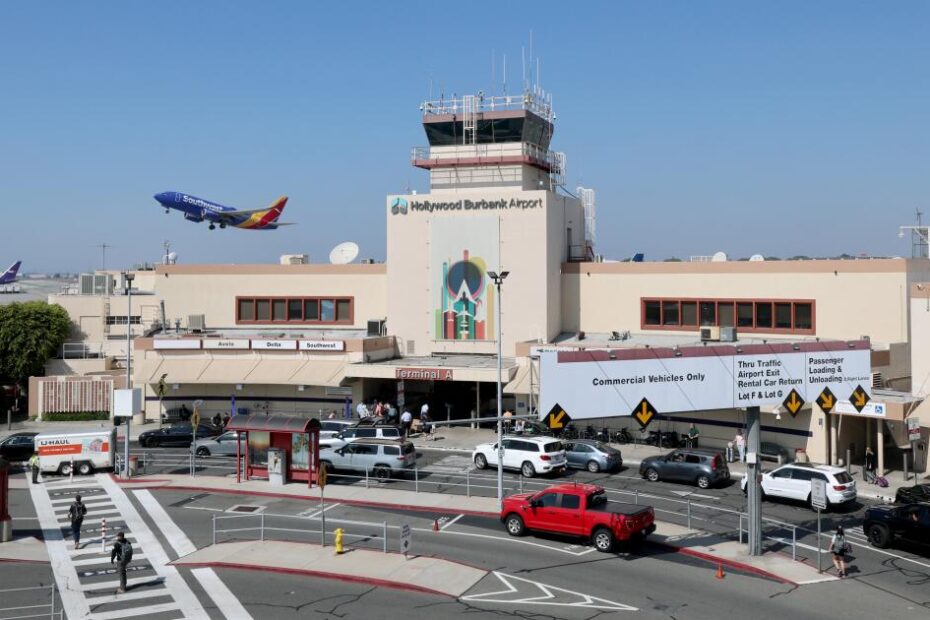
Those bumpy and rough landings and takeoffs out of Hollywood Burbank Airport are the chatter of legendary social media rants.
They’ve left passengers with an “unnerving feeling” or feeling like “stones skipping on water” throughout the course of rough landings.
If only the short runways and bumpy landings were the biggest concern at the airport.
Unfortunately, there is now a serious national discussion about the safety of flying into and out of the Burbank airport that my colleague Grace Toohey and I have investigated in the last two weeks.
The controversy started when Jennifer Homendy, National Transportation Safety Board chair, said last month that “commercial airlines have called me to say the next midair [collision] is going to be at Burbank and nobody is paying attention to us.”
Let’s jump into what she said and why she said it.
Homendy made the comments at a meeting marking the first anniversary of the midair collision between a jetliner and military helicopter that killed 67 people in Washington, D.C.
The agency revealed key findings into the crash of an American Airlines regional jet and an Army Black Hawk helicopter.
As Homendy laid out what she called a series of institutional failures by the Federal Aviation Administration before the January 2025 crash, she pointed to concerns about the mixing of commercial airplane and helicopter traffic, noting that there are extensive data pointing to the danger of such a mix.
The airspace over Los Angeles is among the most congested in the world, but the Hollywood Burbank Airport is uniquely situated in the base of a valley surrounded by mountains on all sides, creating extremely tight parameters around the midsize airport.
Burbank’s main runway is particularly short, and there is significant, nearby air traffic generated by the busy Van Nuys Airport — a general aviation airport just six miles away — leaving little room for error as pilots prepare to land at Burbank, according to a review of safety records and interviews with local and national aviators.
The location of the two airports puts their planes in the same airspace, with overlapping flight patterns as they land and take off, though they are supposed to fly at different altitudes.
Adding to the challenge, the FAA itself has pointed out, is the fact that Van Nuys — home to several flying schools — has a “wide variation of pilot experience, and aircraft capability.”
Since 2018, there have been at least 12 near-collisions reported at Burbank, according to a Times review of reports in the Aviation Safety Reporting Database, which the website says “captures confidential reports, analyzes the resulting aviation safety data, and disseminates vital information to the aviation community.”
The Times reviewed instances in which those safety reports mentioned an aircraft’s Traffic Alert and Collision Avoidance System (TCAS) or a report of a near midair collision (NMAC).
The agency pointed to a recent change that lowered the altitude for Van Nuys aircraft, increasing clearance between descending Burbank flights and the smaller planes at Van Nuys.
“Based [on] our safety analysis, the FAA lowered the Van Nuys traffic pattern by 200 feet during an evaluation in 2025 to see if that would reduce conflicts with aircraft landing at Burbank,” the statement read. “Preliminary data indicated the change resulted in a reduction of Traffic Collision Avoidance System (TCAS) alerts for Burbank arrivals and we permanently lowered the Van Nuys traffic pattern effective Jan. 5.”
Trent Sanders, who has flown privately for decades from Whiteman Airport in Pacoima, another noncommercial airport about six miles from Burbank and Van Nuys, said he’s very aware of the heightened risk between Burbank and Van Nuys.
Sanders said he worries the change of 200 feet isn’t drastic enough to foster significant safety improvements.
“That’s not much at all,” Sanders said. “You can drift, you’re looking out the window, you’re looking at your instruments, … [and] you drift down a little or drift up.”
For more on the concern at Burbank Airport, check out the full article here.

(Maja Hitij / Getty Images)

(Micah Fluellen / Los Angeles Times; Getty Images)
A selection of the very best reads from The Times’ 143-year archive.
Jim Rainey, staff reporter
Hugo Martín, assistant editor, fast break desk
Kevinisha Walker, multiplatform editor
Andrew J. Campa, weekend writer
Karim Doumar, head of newsletters
How can we make this newsletter more useful? Send comments to essentialcalifornia@latimes.com. Check our top stories, topics and the latest articles on latimes.com.